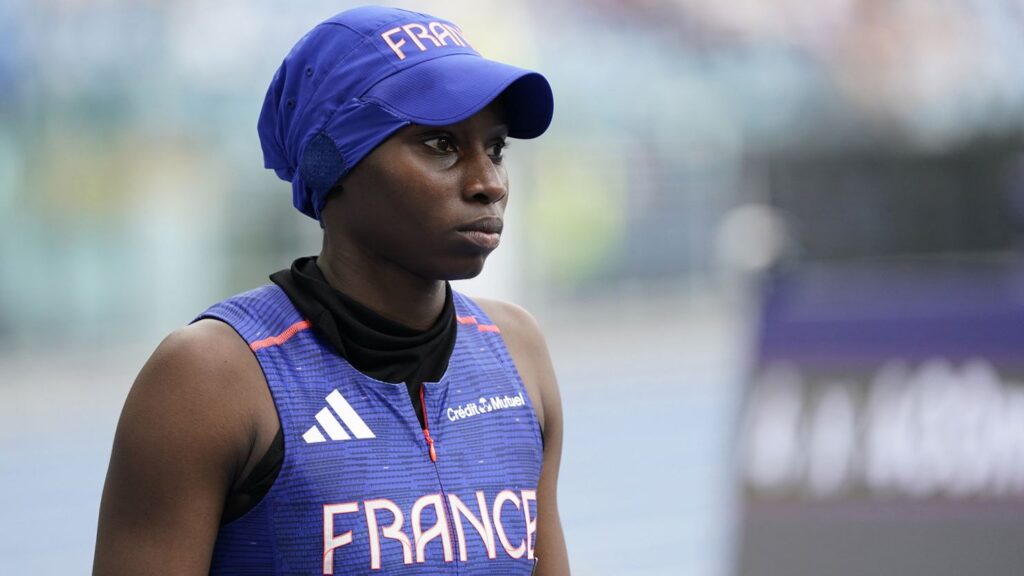












French sprinter Sounkamba Sylla will now be taking part in the Opening Ceremony at this year’s Olympics, France’s sports minister told CNN, after the runner previously said she would not be allowed to because she wears a headscarf.
“You are selected for the Olympic Games, organized in your country, but you can’t take part in the opening ceremony because you wear a scarf on your head,” Sylla posted on her private Instagram account Sunday, per Reuters.
But in an interview with CNN’s Christiane Amanpour, French sports minister Amélie Oudéa-Castéra said a solution has been found to allow Sylla to take part in Friday’s ceremony.
“The issue is solved,” Oudéa-Castéra told Amanpour.
Oudéa-Castéra outlined that it had been explained to Sylla that the rule exists based on the French constitution and that she would not be allowed to wear religious or political signs.
“That’s the law and we need to obey by the law, and she understands perfectly that when you’re an athlete representing your country, you need to be exemplary,” the French sports minister explained.
“So what we discussed with her is the fact that she can wear something, but not something that can be assimilated to a religious symbol.”
France has pursued a series of controversial bans and restrictions on items of customarily Islamic dress in recent years.
Last year, the United Nations’ human rights office criticized the French government for banning French athletes from wearing the hijab at the Paris Olympics.
At the time, Oudéa-Castéra argued in favor of “a strict regime of secularism, applied rigorously in the field of sport.”
On Thursday, Oudéa-Castéra said that Sylla and LVMH, who are designing France’s Opening Ceremony outfits, have now found a solution where the sprinter can cover her hair.
“That’s a win-win and we are happy. I always say when you’re benevolent, when you’re constructive, when you’re pragmatic, you can have a solid respect of your rules but while finding the right, you know, avenues, to find solutions,” Oudéa-Castéra added.
The Opening Ceremony takes place on Friday and will be held along the River Seine, marking the first time that the ceremony has not taken place inside a stadium.
The post French sprinter to take part in Opening Ceremony despite not being allowed to wear a headscarf appeared first on Egypt Independent.