












Reading in English | Read in العربية (Arabic)
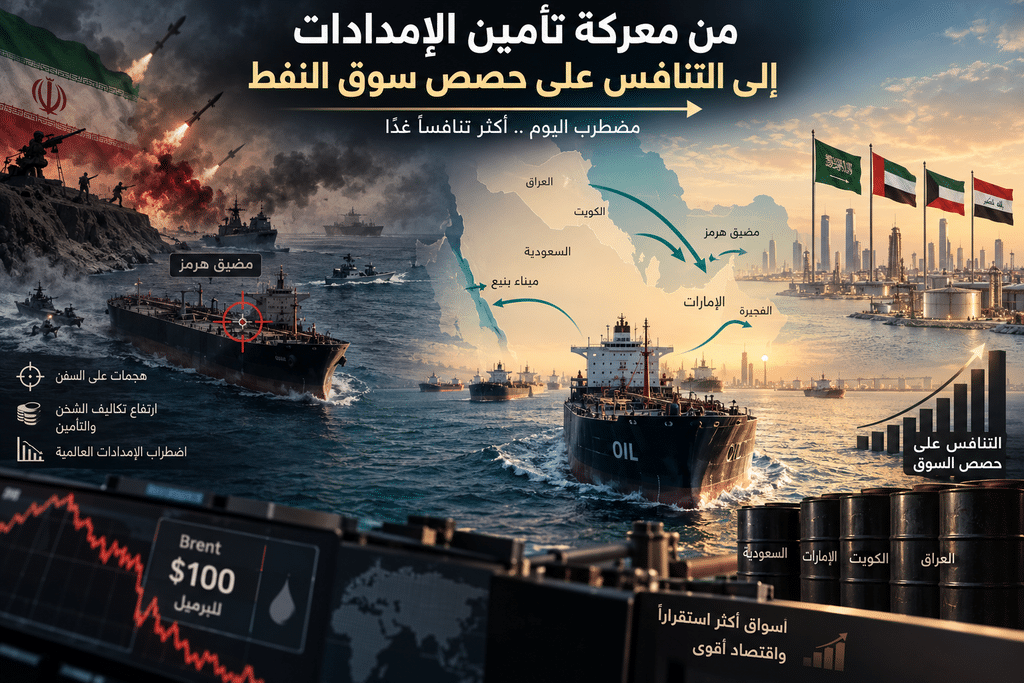
The war with Iran, now entering its eighth month, has become one of the biggest shocks to the global oil market in decades. As the conflict’s repercussions mounted and Iran sought retaliation, a de facto blockade of the Strait of Hormuz was imposed — the passage through which roughly one-fifth of the world’s oil supplies used to transit — depriving Gulf producers, notably Saudi Arabia, the United Arab Emirates, Kuwait and Iraq, of one of their main export routes.
Although some producers turned to alternative routes to bypass the strait, Gulf oil exports remained far below pre-war levels for several months. Still, average crude shipments through the Strait of Hormuz have risen since late September and early October to about 12 million barrels per day, roughly 80% of pre-war levels, according to Kpler, the vessel-tracking and commodities-data analytics firm.
When shipments passing through Hormuz are combined with exports using alternative routes — including Saudi Arabia’s Red Sea port of Yanbu, which ships roughly 4.5 million barrels per day, and the UAE’s Fujairah export hub, which handles about 1.5 million barrels per day — Gulf crude exports exceeded the pre-war average of 18 million barrels per day on most days during the week ending October 3, Kpler estimates.
On that basis, consultancy Energy Aspects expects the global crude supply deficit to shrink to about 250,000 barrels per day in October, down from roughly 4 million barrels per day in May.
But the uptick in supplies does not mean navigation through the Strait of Hormuz has returned to its previous level of safety. The Islamic Revolutionary Guard Corps continues to target vessels transiting the vital waterway. Over the past two weeks, roughly one tanker per day has come under attack, with Tehran citing transits conducted without coordination with Iranian authorities or use of unapproved routes.
Gulf producers, meanwhile, appear more willing to endure those risks — and the higher shipping and insurance costs — in an effort to boost exports and win back customers who turned to alternative suppliers during the disruptions. Charter rates for very large crude carriers (VLCCs) on the route from the Gulf to East Asia have climbed to about $1.4 million per day, nearly six times pre-war levels, in addition to extra costs associated with shuttle transport operations.
Paradoxically, Brent crude has remained above $100 per barrel — some 40% higher than pre-war levels — despite the rise in per-barrel transport costs to an estimated $15–$20 and the escalation of hostilities that spread effects from the Strait of Hormuz to the Bab al-Mandeb and the Red Sea. Against this backdrop, the oil market is gradually shifting from a battle to secure supplies toward a new phase of competition over regaining market share.
In earlier episodes, competition for global oil market share intensified with the emergence of new supplies — for example, offshore exploration expansion in the 1980s and the shale-oil revolution in the 2010s. Today, Gulf producers, led by Saudi Arabia, the UAE, Kuwait and Iraq, face a different challenge: reclaiming markets and shares lost during the war, at the same time that navigation through the Strait of Hormuz is only slowly recovering after months of disruption and constraints.
This shift comes after the market was heading toward a supply surplus in 2026, amid rising global inventories and expectations of lower prices, a scenario that threatened fiercer competition among producers. Withdrawals from stocks to cover the supply shortfall have reshaped that equation: reliance on available barrels increased, and restoring Gulf exports to previous levels has become closely tied to producers’ ability to win back customers and markets.
Although battles over market share typically push crude prices sharply lower — especially when producers boost output to defend positions — record-high transport, tanker-charter and insurance costs are keeping prices elevated and make it unlikely that consumers will see a meaningful drop in pump prices in the near term.
The current competition does more than unsettle market balance; it also presents a fresh test of the cohesion of the Organization of the Petroleum Exporting Countries (OPEC). The group, long riven by disagreements over production levels and market shares, suffered another blow in May 2026 when the United Arab Emirates withdrew, a move tied to Abu Dhabi’s plans to expand production capacity and increase its export potential.
That development raises the prospect of escalating rivalry among current and former members at a time when coordination is increasingly necessary to avoid volatile price swings. It also prompts fundamental questions about OPEC’s ability — a body founded more than six decades ago and led by Saudi Arabia in market management — to bridge internal divisions and retain influence.
OPEC’s effectiveness depends not only on members’ reserves and production capacity but also on their ability to coordinate production policies and shape the global supply–demand balance. If competition over share turns into a race to raise output, the organization’s ability to manage prices could weaken, even if its members remain dominant players in the global energy market.
In sum, competition among producers to defend or regain market share could have a positive side if it increases supply and eases price pressures. The more important issue, however, is whether that improvement passes through to refined-product markets and helps curb the inflationary impact of higher fuel costs on transport, insurance and the prices of goods and services. Restoring supplies does not necessarily mean price stability unless shipping and insurance costs — and the underlying geopolitical risks weighing on the global oil market — also decline.