












Reading in English | Read in العربية (Arabic)
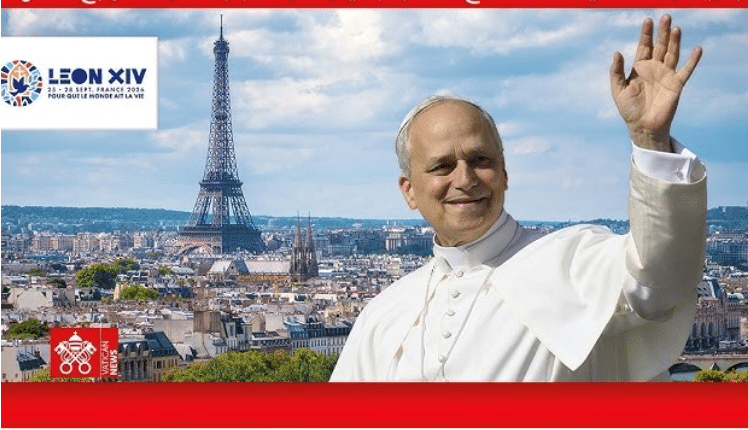
A papal welcome shook the heart of France and entered the history books in a solemn scene: a sea of faithful gathered, their yearning rising in an unexpected moment of devotion, as if the French were rediscovering their thirst for their Christian roots. This historic crowd that greeted Pope Leo XIV in Paris was the largest of its kind during a papal visit in modern French history. The striking spectacle brought Christian faith back into public conversation and raised deep questions about the state of Christianity in secular France and the future of its role in French society. It was an exceptional event that left its mark on France’s religious and historical landscape.
What does it mean for the Vatican’s pope to return to France, the “fille aînée de l’Église” — the eldest daughter of the Church — after France became a secular state and as the world stands on the threshold of a new era driven by machines and artificial intelligence? That is the broader significance of his visit to France.
From the Notre-Dame de Paris cathedral, where His Holiness reclaimed an enduring symbol among France’s deepest Christian emblems, to UNESCO where he spoke about the future of humanity and artificial intelligence, the visit felt like a bridge between a profound Christian religious past and a rapidly transforming technological future.
Although France’s political system has become secular, this has not erased the Christian roots of the French people. Christianity remains an integral part of their history, memory, and culture, visible in cathedrals and religious landmarks that tell deep chapters of France’s past.
Looking back at France’s historical memory since King Clovis embraced Christianity in the late fifth century, the history of France has been intertwined with the Church, earning it the title “eldest daughter of the Church.” French kings historically bore the title “King of Christianity” because of their protection of the Papacy and Rome’s interests. Over centuries, France became a center of theological thought, architecture, and Catholic missions in Europe, leaving a deep imprint on culture, education, the arts, and public life. Seventeen popes have sat on the Holy See from France. The country has also produced many Catholic saints famous across Christendom, including Saint Thérèse of Lisieux, Joan of Arc, Bernadette Soubirous, Saint Vincent de Paul, and Saint Catherine Labouré.
In the eighteenth century, the Enlightenment emerged as an intellectual and philosophical movement that celebrated human reason, relied on experience and science, fought ignorance and blind tradition, and rejected the intellectual and political tutelage once imposed by the Church and religious institutions in the Middle Ages. Leading French philosophers such as Voltaire, Jean-Jacques Rousseau, and Montesquieu drove this movement. The Enlightenment was the key intellectual and philosophical fuel for the French Revolution (1789–1799), which opened a new chapter in France’s history.
Then, in 1905, the law separating church and state established the secular face of the Republic and redefined the relationship between Church and state, transforming the Church’s role from political authority to a spiritual and cultural presence. Still, political changes could not erase Christianity from France. It remained present in the national consciousness and culture, with Catholic roots deeply embedded in French heritage. Notre-Dame, the Shrine of Our Lady of Lourdes, cathedrals, crosses, and bells remain living testaments to those rooted Christian traditions, continuing to shape France’s history and identity. The passionate and remarkable reception given to the pope is perhaps the strongest proof of that enduring presence.
During his visit, His Holiness Pope Leo XIV was officially received at the Élysée Palace and met President Emmanuel Macron. He also visited Notre-Dame, UNESCO, Lourdes, and Metz, and met with young people. The pope opened his address at the Élysée by praising France’s cultural and spiritual heritage and its historic role in shaping human rights, urging the nation to continue as a builder of peace in Europe and the world. He warned against “excluding religion from the public sphere,” stressing the importance of protecting human dignity and the right to life as the foundation of all other rights. He criticized practices such as euthanasia — which France officially approved on August 19, 2026 — abortion, and the buying and selling of human organs, calling them “deviations,” and he denounced genetic manipulation and surrogacy. He also admonished world leaders for the dangers of armament and the tendency to treat the suffering of war as inevitable, warning against the spread of nuclear weapons and reaffirming his commitment to conflict resolution and the establishment of peace.
In a speech at UNESCO’s headquarters in Paris, Pope Leo XIV warned that organizations, foremost among them the United Nations, risk turning from platforms for dialogue and peacebuilding into a “farce” losing their ability to serve the common good. He highlighted the importance of protecting human dignity and promoting peace and dialogue, criticizing world leaders who fail to respect the rule of law and treat justice as if it were a commodity to be bought and sold. He further cautioned humanity against sliding toward a future dominated by a “paradise of machines” at the expense of human beings, emphasizing the need for ethical safeguards to prevent science and technology from becoming profit-driven tools that violate human dignity and the right to life.
At the evening prayer with youth, Pope Leo XIV urged young people to bear witness to Christ through love and dialogue, to face anxiety with hope, and to discover their vocation through prayer and service. He affirmed that true freedom springs from a living relationship with Jesus. Speaking about artificial intelligence, he cautioned the youth to use its tools with moderation and discipline to avoid losing their humanity amid machines permeating their daily lives, imposing conditions on them, and luring them into a virtual world where deceptive appearances replace real human values.
The pope’s four-day visit to France, from September 25 to 28, 2026, culminated in a grand Mass in the heart of Paris. Vatican estimates put participation at around 800,000 people, their crowds stretching along the Champs-Élysées to Place de la Concorde — a striking devotional scene reflecting the continuing Catholic presence in France. In the heart of a secular republic, the head of the Catholic Church stood with the French, restoring their deep Christian roots in a meeting where history felt vividly present.
This enormous gathering to see the Pope of Rome is the clearest sign that faith in France has not died, contrary to some public statistics. Rather, it is undergoing a “renewal or awakening” and marks a significant spiritual shift and a living testimony. Most notable is the growing phenomenon of adult baptism among the French (aged 18 and older): since 2023 their numbers have risen sharply, exceeding 13,000 in 2026 after being about 4,000 a decade earlier. Behind the figures and statistics beats a soul searching for God and hearts choosing Christ with awareness and faith.
This historic scene reveals that the “eldest daughter of the Church,” despite successive regimes, shifting intellectual currents, and the dominance of secularization, is returning to the embrace of her Father, Christ.
Vive la France, Vive la Christianité, Vive la fille aînée de l’Église.