











Reading in English | Read in العربية (Arabic)
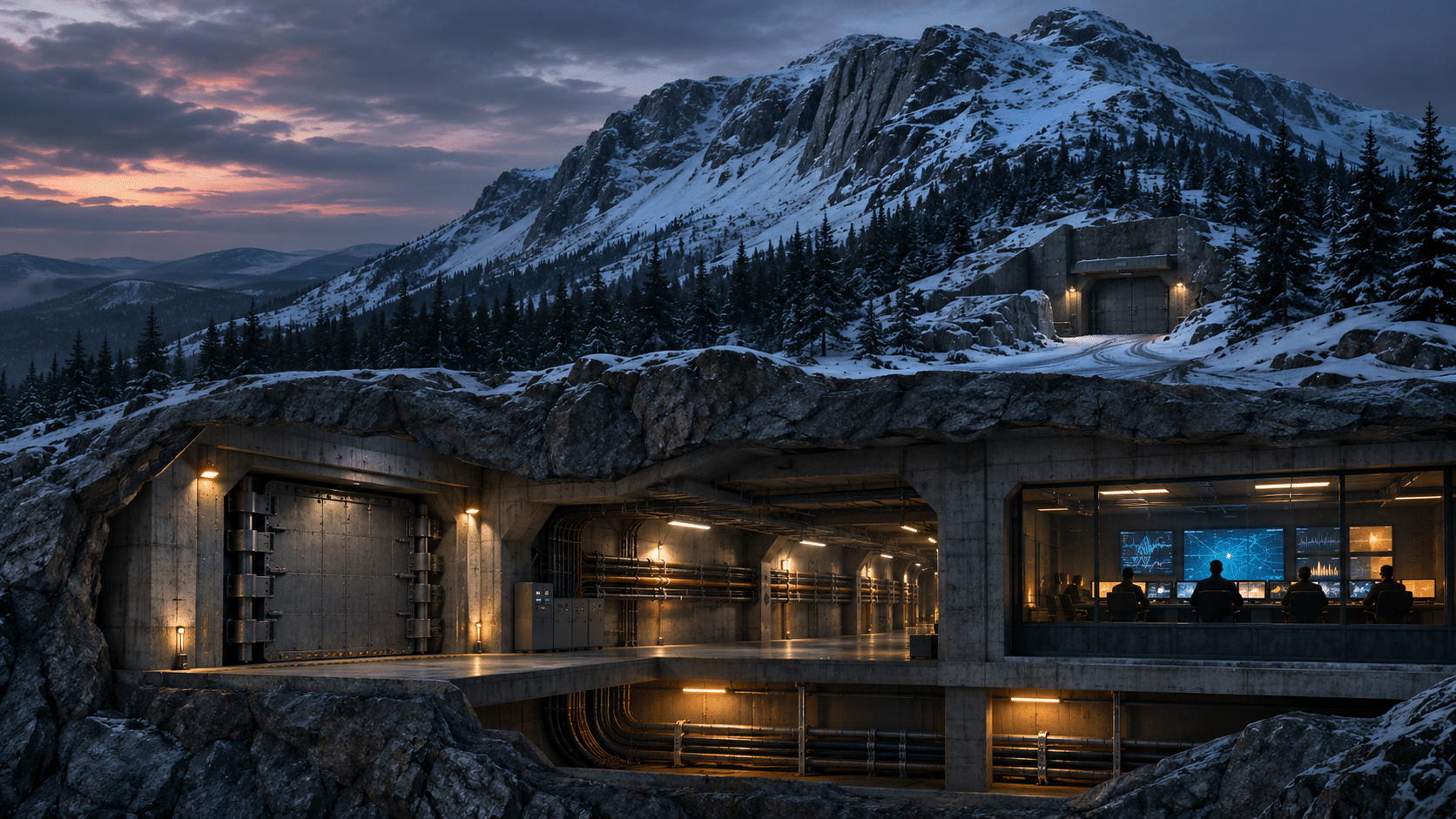
In this politically turbulent world, military facilities have become a constant — their only change coming at the “zero” moment. Some installations are built to protect weapons; others are built to protect the state from the moment those weapons might be all that remains of it. Deep in the Russian Urals, Kosvinsky Kamen stands like a closed page from the Cold War. Yet procurement records and recent investigative reporting suggest the page has not entirely shut. Beneath the mountain sits a highly secret facility numbered “1335,” linked to a hardened command-and-communications center codenamed “Grot.” Since 2018, documents reveal extensive work — steel, concrete, cables, drilling equipment, and power, ventilation, and protection systems — pointing to a major upgrade of the underground infrastructure.
The figures look more like a code than a construction bill: tens of thousands of tons of materials, hundreds of kilometers of cable, and systems designed to operate in environments that could be contaminated by radiation, chemical, or biological agents. That raises the deeper question: what needs all this fortification?
The answer takes us to the heart of Russian nuclear doctrine itself: command and control.
In a nuclear war the fear is not only that missiles will destroy, but that the chain that keeps their use under leadership control will be severed. That fear led, during the Cold War, to backup systems designed to preserve communications and the ability to issue orders even in the most catastrophic scenarios. From that context comes the name “Perimeter,” known in the West as the “Dead Hand.” Even so, that label should be treated with caution: the familiar image of a doomsday machine that automatically launches rockets after the Russian leadership dies is far simpler than what is known about the system. Expert Pavel Podvig argues that “restarting” the system is not the most accurate description; available indicators more clearly point to upgrading existing facilities and systems. That shifts the question to: why now?
Why is Moscow reinforcing a Cold War–era facility at a time when nuclear war, which for decades seemed like a historical specter, has returned to international security discourse? No published document says Russia is preparing to launch a nuclear war, but the records say something else just as important: Russia is investing to ensure its nuclear command system can function in the worst conditions. That is a crucial difference. Nuclear deterrence does not need a missile launch to work; sometimes it is enough for an adversary to know that destroying a command center will not necessarily eliminate the ability to retaliate.
The mountain is part of the message. Above ground, governments, alliances, and maps change; beneath them remains a system designed for a very different scenario — one in which the state endures even after it loses its visible centers. That is the terrifying paradox of Kosvinsky Kamen. As the world increasingly talks about satellites, artificial intelligence, and hypersonic weapons, part of the most sensitive deterrent apparatus returns to a primitive-looking setting: a mountain, rock, tunnels, steel doors, and wires waiting for the order. It is not so much a return to the past as a reminder that the past has never entirely gone away.
For that reason, the true story is not what is inside the mountain but the question the mountain refuses to answer: if Moscow is investing so heavily to preserve nuclear decision-making after catastrophe, what scenario is it preparing for? The answer may not be outright war, and there may be no “final day” at all. But in the world of nuclear deterrence, messages are measured not only by what happens but by what states prepare to prevent. At Kosvinsky Kamen, Russia appears to be building not just a fortress against bombs but a fortress against silence — the silence of communications, of command, and of the moment someone might conclude the state has lost the ability to respond. Under the mountain, Russia seems to be hiding not a single weapon but a possibility: that decision-making will remain alive even when everything around it has died.