











Reading in English | Read in العربية (Arabic)
The Hashemite Kingdom of Jordan, led by His Majesty King Abdullah II and his government, presented an exemplary model of citizenship and humanity that became evident immediately after the cowardly terrorist attack on worshippers at Saint George the Rûm Orthodox Church in the village of Humoud in Karak governorate, southern Jordan. The attack, directed at mourners during the funeral prayer for a member of the church, was carried out by three gunmen using firearms including an automatic rifle, leaving nine dead and dozens wounded.
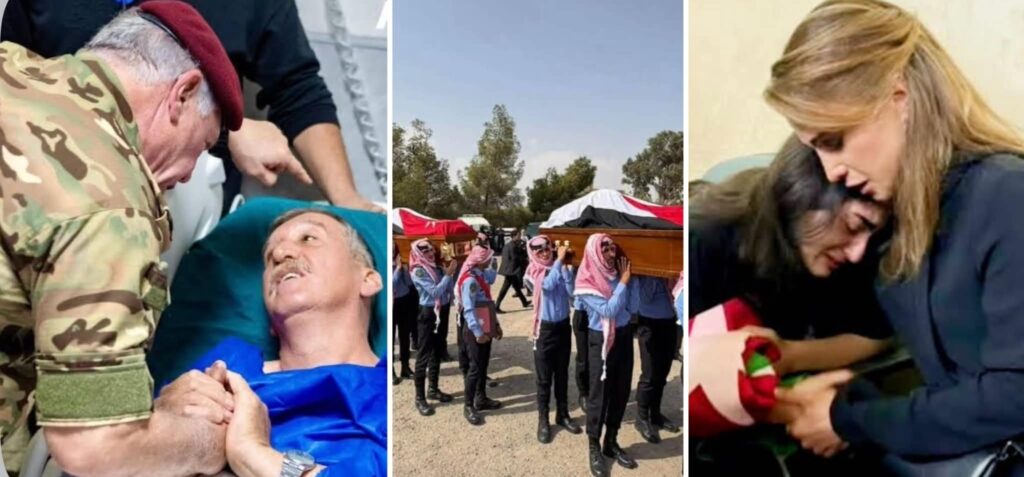
The King’s response was swift and forceful. In contrast to some neighboring leaders’ reactions to even worse attacks on churches elsewhere, His Majesty visited the wounded in hospital wearing military uniform and accompanied by senior military commanders, declared war on terrorism, and vowed to pursue the perpetrators. His message to the nation and the world was clear: an attack on the church is an attack on the Kingdom, its sovereignty and its people. As he said, “Those who imagined that treacherous bullets would divide Jordanians have been disappointed by our firmness and unity. Jordanians from the north to the south are partners in the land and in stance, and treachery will not diminish their unity.” Queen Rania also visited the families of the martyrs in tears, offering consolation and exemplifying the highest standards of humanity.
The Jordanian government immediately implemented the royal directives: three days of national mourning were declared across the country, and flags over ministries, official buildings, institutions and public authorities were lowered during the mourning period. Government ministries responded in ways that reflected civic solidarity. The Interior Minister stated that the incident was a terrorist operation carried out by a group of extremists—not the act of “mentally ill” individuals—and security forces succeeded in identifying and arresting the perpetrators. Authorities also addressed offensive social media posts that violated the privacy and dignity of the martyrs and the wounded, threatened social peace, or sought to incite sectarian tensions, in order to preserve national unity. The Ministry of Local Administration instructed municipal committees to name a street in every municipality after one of the church’s martyrs as a mark of honor and solidarity with their families.
The world witnessed the attack and the widespread anger and grief of the Jordanian people, shared by political and religious leaders of all denominations. Tears of pain united citizens, and blood donations from fellow countrymen mixed with the blood of the church’s wounded in hospitals. Local and international human rights and charitable organizations issued individual and collective condemnations and offered support and condolences to the families of the martyrs, at the church and in their homes. The official and public funeral was solemn and imposing: Jordanian security personnel carried the coffins, and a 21-gun salute was fired in honor of the martyrs.