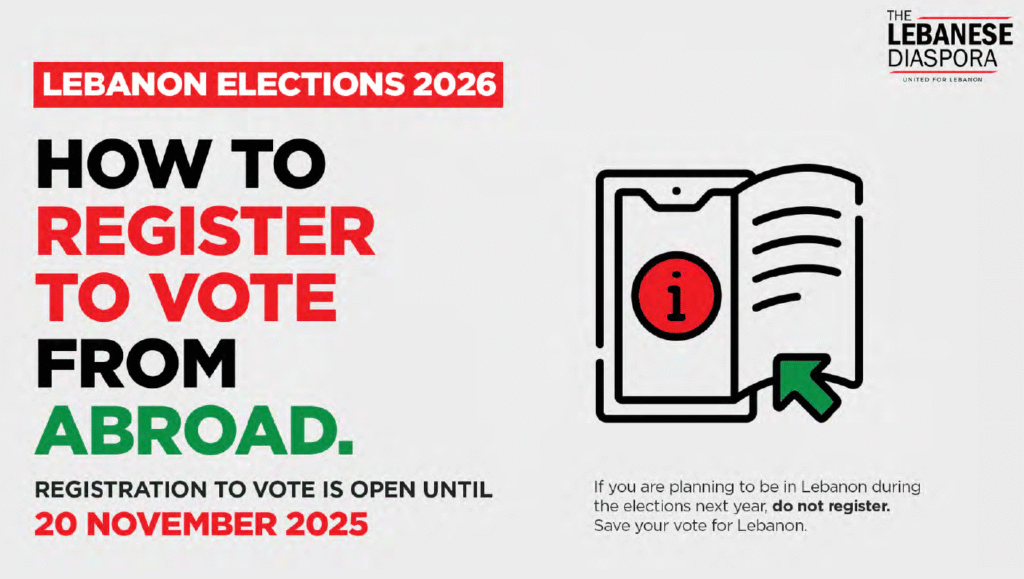













The upcoming Lebanese parliamentary elections, scheduled for May 2026, will determine all 128 seats in Lebanon’s Parliament under the country’s proportional representation system. As preparations intensify, Lebanese citizens living abroad are being urged to register early to secure their right to vote from their country of residence.
According to Lebanon’s Ministry of Foreign Affairs and Emigrants, expatriates can register online through the official diaspora voting platform at diasporavote.mfa.gov.lb. The registration process closes on 20 November 2025.
To complete registration, applicants must provide two types of documentation. First, proof of Lebanese citizenship—this can be a Lebanese passport, Lebanese national ID, or an Ikhraj Kayd (civil status extract). Second, proof of residence abroad—this may include a foreign passport or ID, foreign driver’s licence, or other proof of residency.
Lebanese authorities have clarified that individuals planning to be physically present in Lebanon during May 2026 should not register online, as doing so would restrict them to overseas voting and prevent participation in domestic polling stations.
National Bloc has also provided a helpline, +961 79 354 383, for those who require assistance or have questions about the registration process.
As of mid-November 2025, more than 51,000 Lebanese expatriates had already registered, according to L’Orient-Le Jour, signalling strong interest from the diaspora in shaping Lebanon’s political future. However, the overseas vote remains a point of contention among political factions.
Under the current electoral law, Lebanese expatriates are allocated six reserved parliamentary seats. Several political blocs have proposed expanding this right to allow the diaspora to vote for all 128 members of Parliament, arguing that it would ensure full equality of citizenship. Opponents of this change, however, caution that such reforms could shift the domestic political balance and complicate the legislative framework.
The debate has contributed to ongoing parliamentary disputes, with analysts warning that any further delays in resolving the issue could impact election logistics and timelines. Nonetheless, both the government and electoral authorities have reaffirmed their commitment to holding the elections as scheduled in May 2026.
Lebanese citizens abroad are encouraged to register as early as possible, verify their documentation, and retain confirmation of their submission. For many in the diaspora, this election represents not just a civic duty but an opportunity to contribute to Lebanon’s political renewal and reform from afar.
For official information or to register, visit https://diasporavote.mfa.gov.lb/.