











Reading in English | Read in العربية (Arabic)
Shifts in Turkish-Libyan Relations, Power Struggles within the Haftar Camp, and the Future of Strategic Balances
Strategic Research Paper
Introduction
The changes underway in Libya can no longer be fully explained by the traditional east–west divide, nor by the alliances formed during years of conflict. Libya’s scene has entered a more complex phase in which competition for power overlaps with a reordering of external relations, and where military leadership calculations intersect with economic and maritime interests — all while the state remains unable to unify its institutions or formulate a stable national policy.
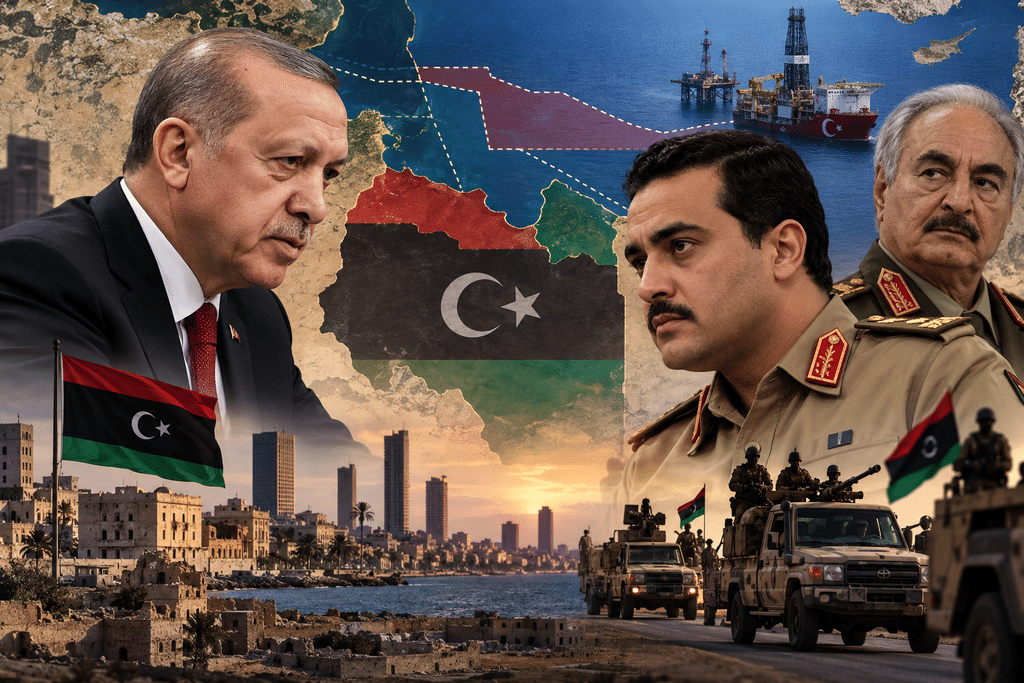
One important indicator of this phase is the shift in Turkey’s relations with certain centers of influence in eastern Libya. Ankara — whose military and political presence during the confrontation years was linked to the authorities in the west — is expanding channels of contact with eastern actors that once viewed Turkey as part of the opposing camp. This change does not appear to be a fleeting diplomatic opening; rather, it reflects a wider reassessment of how Turkey manages its interests in a country that occupies a strategic position in the eastern Mediterranean and North Africa.
These developments gain additional significance against the backdrop of the rising political and military profile of Saddam Haftar and growing questions about the future leadership within the system led by his father, Khalifa Haftar. A rapprochement with Turkey could offer Saddam new foreign-policy options, but it could also affect internal balances within his camp, especially given the multiple centers of military, political, and economic influence within the family.
At the same time, the House of Representatives’ approval on 20 October 2026 of the 2019 maritime agreement between Libya and Turkey — and the repeal of earlier decisions rejecting understandings with Ankara — has brought this file back to the top of regional agendas. That decision is not just about bilateral ties; it concerns maritime boundary delimitation, energy interests, influence in the eastern Mediterranean, and potential repercussions for relations among Libyan actors and their external partners.
Still, connecting all these developments should not lead to hasty conclusions. A rapprochement with Turkey does not necessarily signal that eastern Libya is shifting into a new regional axis, nor does potential competition within the Haftar family prove an imminent direct confrontation among its members. Likewise, one cannot assume the existence of a unified international plan targeting Saddam Haftar or seeking to weaken him solely because his external ties are changing.
The significance of the present moment lies in the growing interweaving of local and regional interests: shifts in Libya’s relationship with Turkey are likely to affect the internal distribution of influence as much as they are shaped by it. Understanding this phase therefore requires treating these issues as parts of a single strategic equation linked to the future of power in the east, Turkey’s role in Libya, the stances of regional powers, and the Libyan state’s capacity to protect its interests amid ongoing division.
1. Turkey’s Shift: From a Narrow Alliance to Expanding Circles of Influence
During the years of conflict, Turkey’s presence in Libya was closely associated with support for western authorities and with the political and military understandings Ankara concluded with Tripoli. Turkish intervention altered the balance of forces in military confrontations, and the 2019 maritime agreement provided a strategic framework for bilateral relations that extended beyond immediate political cooperation to encompass maritime boundaries, energy issues, and influence in the eastern Mediterranean.
By contrast, actors in eastern Libya took opposed stances toward Turkish involvement and the maritime agreement, aligning their foreign relations with a different set of regional and international partners. For a long time, the picture suggested that relations with Turkey were one of the main fault lines between Libya’s camps.
That equation, however, has begun to lose explanatory power. Prolonged division, stalled political settlement efforts, and changing priorities among some regional actors have pushed Libyan parties to revisit their calculations. The shift from broad military confrontation to competition over institutions, resources, and the shape of future authority has made external relationships a more important tool in strengthening negotiating positions.
For Turkey, limiting its ties to a single Libyan faction carries strategic risks. Changes in the balance of power or a faltering political process could leave its interests exposed. Building channels of communication with eastern centers of influence increases Ankara’s ability to shape any future settlement and allows it to engage with actors who wield real influence over military, security, and economic files.
This approach does not mean Ankara is abandoning its interests in western Libya or replacing former allies with new ones. States rarely run their foreign relations according to exclusive alignment; they often diversify partnerships to reduce dependence on any one partner. Opening to the east may be intended to secure existing interests, broaden cooperation opportunities, and avoid being excluded from future political arrangements.
Seen this way, Turkey’s outreach to some eastern figures can be understood as a move toward a more flexible policy that engages different centers of power rather than relying solely on wartime alliances. Yet the success of such a policy depends on Ankara’s ability to build stable understandings and to avoid turning new relationships into sources of tension with former partners or with regional powers watching its influence expand.
These developments also indicate a broader change in Libyan politics. Alliances are no longer as fixed as during earlier confrontations; economic and security interests and positions within institutions increasingly shape relations. This does not mean old disputes have vanished, but it does mean parties may be more willing to reorder their positions when calculations of gains and losses shift.
2. Saddam Haftar and the Reordering of Power in Eastern Libya
Saddam Haftar’s rise deserves particular attention in reading Libya’s evolving scene. His growing presence within the military establishment and his expanding political and foreign contacts have pushed his role beyond a conventional military post and into deliberations about the future leadership in the east and the arrangements that might precede any political settlement.
This rise cannot be detached from the nature of the eastern political-military system, where military leadership intersects with networks of economic interests, political representation, and external relations. A person’s position in this system is determined not only by formal posts but also by their ability to build loyalties, engage regional actors, and influence decisions on resources and institutions.
From that perspective, a rapprochement with Turkey could give Saddam more room to maneuver and strengthen his standing in future arrangements. Opening channels with Ankara could offer him additional options for security, military, and economic cooperation and allow him to appear as an actor capable of engaging with parties that previously had strained relations with his camp.
But the effects of this outreach extend beyond foreign relations. As the network around a rising figure broadens, the chance that this will affect the distribution of power within their system increases. Some actors may see such ties as opportunities to strengthen the entire camp, while others may fear they will become the basis for an independent power center with greater bargaining leverage.
This sensitivity is heightened by questions about succession. Shifts in influence inside military and political structures do not always follow clear formal sequences; they are shaped by balances of loyalty, resources, and the ability to manage external relations. Saddam’s ascent therefore raises questions that go beyond his person to the kind of system that will govern the distribution of power in eastern Libya going forward.
Could his prominent position become the nucleus for consolidating decision-making around a new leadership? Or might his expanding role open the door to greater competition over prerogatives, resources, and external ties? These questions cannot be answered decisively now, but leadership has clearly become a central factor in understanding developments in the east.
Saddam’s future trajectory depends on his ability to balance political and military ambitions with the interests of other centers of power. If he can broaden external ties without provoking internal fears or severing relations with traditional partners, Turkish outreach could become an added source of strength. If, however, that openness is associated with attempts to monopolize foreign channels or to unilaterally redistribute influence, it could intensify competition within the system.
3. Rivalry within the Haftar Family and the Succession Dilemma
Analyzing the future of leadership in eastern Libya requires examining role distribution within the Haftar family. Saddam’s rise is matched by Khalid Haftar’s important position within the military establishment and Belqasim Haftar’s prominent role in reconstruction and investment affairs. This division reflects multiple channels through which influence can be exercised in the eastern system.
The existence of these varied roles does not prove that a direct conflict among the brothers is underway or inevitable. Yet it poses a structural question about how to manage power when the instruments of authority are distributed across multiple centers that share a family environment but operate in different spheres and maintain divergent networks and interests.
This multi-centered distribution can be a formula for complementarity if a central leadership can maintain equilibrium among the parties — allowing each figure to manage a distinct domain without threatening the system’s cohesion. But that balance becomes fragile when succession issues arise, interests change, or one party gains new resources that increase its influence over decision-making.
Competition need not manifest as armed conflict to be consequential. It can begin as disputes over the allocation of powers, the management of resources, representation in external relations, or the appointment of personnel to sensitive political and military positions. Over time, such disputes can evolve into struggles to build loyalties and expand influence within institutions.
External relations take on extra importance in this context, because they can afford certain figures opportunities not available to others. Meetings with foreign officials, security understandings, and economic ties can be leveraged to strengthen one’s internal standing. But not every new external tie is intended to bypass family members; it might form part of role distribution or a broader strategy to bolster the eastern camp.
The problem is that systems based on personal understandings may appear cohesive under a strong central leadership, but they face severe tests when the balance of power shifts or the leadership transition approaches. Independent institutions can regulate transfers of authority according to clear rules; systems grounded in personal loyalties may struggle to manage competition when ambitions collide.
Thus, the future of relations among Saddam, Khalid, and Belqasim should not be read as a predetermined family feud but as a reflection of the challenges that accompany any transfer of influence in eastern Libya. The family may preserve its balances through new understandings, or disagreements may surface if calculations diverge or resource and power distributions change.
More broadly, this raises a political question: will authority in the east continue to be managed through family arrangements and networks of influence, or will the coming phase push toward building more independent institutions capable of arbitrating disputes? The answer will shape the region’s stability and the prospects for unifying Libyan institutions at the national level.
4. The Maritime Agreement and the Reshaping of Eastern Mediterranean Calculations
The 2019 maritime agreement between Libya and Turkey is one of the most prominent files where Libyan interests intersect with regional competition. It is not only about defining maritime jurisdiction; it also concerns the future of energy exploration, resource transit routes, maritime infrastructure projects, and balance of influence among states bordering the eastern Mediterranean.
The House of Representatives’ approval of the agreement in October 2026 reopened debate about its political and strategic implications. Endorsing the pact and overturning earlier decisions that rejected understandings with Ankara marks a shift in the stance of an institution that previously took a different position. That shift raises questions about the motives behind the review, its connection to changes in Libya’s internal power balances, and whether it reflects attempts to reorder external relations.
It is important not to reduce the decision to the calculations of Saddam Haftar alone. The change may reflect a broader reassessment among eastern Libyan actors of the benefits of ties with Turkey, an adaptation to new regional developments, or a desire to widen Libya’s options in economic and energy matters. These motives may intertwine without a single explanation fully accounting for the decision.
For Ankara, the agreement retains significant strategic value because it ties into its vision for its role in the eastern Mediterranean and its efforts to cement maritime and economic interests. For Libya, the pact presents an opportunity to reorganize relations with Turkey around maritime interests and economic cooperation, but it also brings national responsibilities to assess rights, obligations, and long-term legal and economic consequences.
Political approval of the agreement does not guarantee automatic economic gains, nor does it resolve legal disputes with other states. Practical outcomes will depend on technical, legal, and diplomatic pathways and on Libyan institutions’ capacity to manage the file coherently.
Here the distinction between attitude toward Turkey and evaluation of the agreement itself becomes important. Relations with Ankara alone should not be a reason to accept any arrangement without national review, nor should a political dispute with Turkey automatically lead to abandoning potential Libyan interests. The key criterion must be how compatible the agreement is with Libyan rights and interests and whether it can provide a sustainable basis for maritime and economic cooperation.
Treating the agreement as a sovereign issue requires institutions capable of evaluating it, overseeing its implementation, and negotiating its implications. If the file becomes part of local competition, it risks being used as leverage for political gain or for building external alliances rather than serving a coherent national strategy.
5. Regional and International Objections and Risks of Escalation
The maritime agreement cannot be separated from the positions of Greece, Egypt, and Cyprus, or from European concerns about energy arrangements and maritime security in the eastern Mediterranean. These actors view the agreement through the lens of their maritime claims, economic interests, and regional balance considerations.
Greece opposes the Turkish-Libyan maritime understanding as an infringement on its maritime claims. Egypt’s reservations are linked to broader calculations regarding its regional standing and balances in the eastern Mediterranean and North Africa. Cyprus is concerned because maritime disputes and energy projects make any change to existing arrangements consequential. European interests overlap with concerns about energy security, navigation, and relations with Turkey.
Objections to the agreement do not necessarily mean that all these actors are pursuing a unified strategy to confront Turkey, nor do they prove the existence of a coordinated plan targeting Saddam Haftar or seeking to reduce his influence in the east. Divergent interests can produce differing stances; disagreement alone is insufficient evidence of secret coordination about Libya’s leadership.
Nonetheless, the regional environment could exert pressure on Libyan parties if some states perceive that shifts toward Turkey alter the balance of influence or threaten their interests. Such pressure might take the form of diplomatic moves, reassessments of partnerships, bolstered ties with alternative figures and institutions, or attempts to influence political settlement arrangements.
Pressure will vary by interest. States focused on maritime borders may prioritize legal and diplomatic routes, while others may concern themselves with the future of military cooperation or positions of influence within Libyan institutions. There is no guarantee that these priorities will align or that they will produce a common stance toward any Libyan actor.
The United States and European countries enter this equation with a broader set of interests that include Libya’s stability, Mediterranean security, migration, energy, countering armed groups, and the future of Russian presence in the country. Their positions may shift with on-the-ground and political developments and may align with Turkey on some issues while diverging on others.
Therefore, any Libyan leadership seeking to broaden external relations must manage a delicate balance among partners. Drawing closer to one state does not require severing ties with others, but converting such a rapprochement into an exclusive alignment could raise the cost of action and place Libyan actors under competing pressures.
Libya’s ability to handle these pressures depends on a unified foreign policy. A state with clear national priorities can diversify partnerships without becoming a battleground for regional disputes. A divided state, by contrast, may be forced to make inconsistent concessions to external actors to secure ongoing political, economic, or security support.
6. Could the Rapprochement with Turkey Become a Source of Tension within the Haftar Camp?
One important hypothesis is that closer ties with Turkey could affect the balance of influence within the eastern system, particularly if they strengthen Saddam Haftar relative to other centers of power. External relations are not limited to diplomacy; they can become political resources that give their beneficiaries added leverage over internal decision-making.
If Saddam can use ties with Ankara to expand his military and political influence, some actors around him may view this as a shift in the balance of power. But this does not necessarily presage a direct confrontation; parties could instead seek a redistribution of roles or reach understandings that preserve common interests.
If Turkish rapprochement coincides with existing disputes over leadership, resources, or political representation, it could deepen competition. In that case, Turkey would not necessarily be the cause of fragmentation; the underlying issue would be how external ties are used to enhance local actors’ positions.
It is useful to distinguish three analytical levels. The first is the declared shift in Turkish-Libyan relations, observable through meetings, agreements, and official positions. The second is the impact of that shift on the distribution of influence within eastern Libya, which requires tracking appointments, political and military moves, and economic actions. The third concerns the possibility of external arrangements aimed at specific figures or at changing leadership in the east — a claim that cannot be established without independent evidence.
Confusing these levels can lead to interpreting every political move as part of a secret confrontation and turn analysis from a study of interests and facts into untestable conjecture. A realistic strategic reading lays out possible scenarios while remaining open to revision as new information emerges.
The rapprochement with Turkey could evolve into a stable cooperative relationship if both sides find their interests aligned and if the relationship is not used to exclude other centers of influence. It could face pressures if Ankara’s priorities clash with those of Saddam’s traditional partners, or if the relationship becomes a catalyst for internal disagreement. But these possibilities do not mean confrontation is imminent; they illustrate that the rapprochement will be tested by competing interests and outcomes.
7. Possibilities of Pressure and the Redistribution of Influence
Current developments raise the question of Saddam Haftar’s capacity to maintain a balance between his internal ambitions and his external engagements. As an individual’s influence grows within a political-military system based on multiple balances, the need to manage relations with other centers of power carefully increases. Building internal understandings may be more important than external backing, because international support alone does not guarantee sustained local loyalties or control over institutions.
If internal actors perceive Saddam’s expanding role as threatening their interests, they may resort to political and institutional measures to curb his influence or to renegotiate the allocation of authorities. Competition could manifest in disputes over positions, resource management, representation in negotiations, or the nature of relations with regional powers.
However, moving from the possibility of competition to concrete actions — such as forced exclusion, house arrest, or cutting off funding channels — requires evidence and should not be assumed. Those are high-impact scenarios and should not be presented as certain merely because interests diverge.
External pressures, if they occur, will not necessarily be uniform. One state may view rapprochement with Turkey as harmful to its interests, while another may see engagement with Saddam as an opportunity to bolster stability or open new cooperation channels. Positions will evolve according to developments in the maritime agreement, the political settlement process, and Turkey’s relations with other regional actors.
A realistic prediction is that competition over Saddam’s position will increase as his external ties widen and his role in shaping future power arrangements grows. This could lead to renegotiation of role distribution within the eastern system, efforts by some to prevent any single figure from monopolizing external channels, or internal settlements that preserve a balance of interests.
In all cases, Saddam’s room to maneuver will depend on his ability to avoid turning new external ties into a cause of rupture with former partners and on his capacity to demonstrate that opening to Turkey is not intended to exclude others. Diversifying relationships can enhance influence if managed prudently; it can become a burden if it triggers simultaneous disputes at home and abroad.
8. Libya in the Calculations of Regional and International Powers
These shifts do not only reflect changes in Turkey’s relations with some Libyan actors; they also underline Libya’s continuing strategic importance in the calculations of regional and international powers. Libya’s location makes it a point of contact between North Africa, the Sahel, the Sahara, and the Mediterranean. Its energy resources, coastlines, and ports give it economic and security significance beyond its borders.
Turkey aims to protect its maritime, economic, and security interests, while Egypt views Libyan developments through the prism of national security and western neighborhood balances. The UAE pursues political, economic, and security interests in the region; European countries focus on Mediterranean security, energy, and migration; and Russia approaches Libya as part of broader engagements across Africa and the Mediterranean.
These powers do not operate with a single shared vision, nor do their interests align across all issues. They may converge on supporting stability or countering certain security threats, but they diverge on questions of influence, maritime boundaries, and governance arrangements. Thus, invoking a single international axis managing Libya’s developments does not adequately capture the complexity of regional relations.
More realistically, Libya has become a stage where multiple powers compete, each with its priorities, tools, and local networks. These actors may exploit Libya’s division to expand influence, especially when national institutions cannot articulate a unified stance. Yet this does not mean external forces alone determine Libya’s fate; local actors retain agency to maneuver, negotiate, and reshape alliances.
That agency diminishes when institutions become extensions of power centers and when foreign relations serve to bolster specific figures rather than the state. A local actor may gain short-term advantage through foreign backing, but accumulating fragmented gains does not necessarily build national stability. The result could be multiple centers of decision-making, conflicting obligations, and difficulty in making unified sovereign choices.
Therefore, the strategic challenge is not to block Libya’s cooperation with Turkey, Egypt, the UAE, European states, or others, but to ensure these relationships are embedded in a clear national policy. Diverse partnerships can give the state greater room to maneuver; multiple loyalties, by contrast, can make it more vulnerable to external pressure.
9. Potential Strategic Scenarios
Three main trajectories can be imagined for Libya’s near-term evolution. These scenarios are not deterministic forecasts but possibilities that depend on the interaction of internal and regional factors.
Scenario 1: Expanding Relations without a Break
In this trajectory, Turkey succeeds in broadening its ties with eastern Libya while preserving partnerships in the west. Saddam Haftar leverages this opening without turning it into a confrontation with other centers of power in his camp.
Libyan actors continue to engage external powers based on interest calculations, and the maritime agreement becomes part of a wider dialogue about economic and security cooperation. This path requires pragmatism, de-escalation, and the creation of channels that manage regional concerns and reduce tensions.
If Turkish outreach helps lower political barriers between east and west, this scenario could support expanded cooperation. Yet its results will be limited unless accompanied by institutional understandings that prevent foreign relations from being used to deepen domestic divisions.
Scenario 2: Intensified Competition within the East
Here, Saddam’s increasing political and military role fuels greater competition over the allocation of influence within the eastern system, especially if differing visions emerge on external relations or leadership succession.
Competition may take the form of disputes over powers, positions, resources, and political representation without necessarily escalating to open military confrontation. This scenario becomes more likely if external ties are instrumentalized as competitive tools inside the system or if a party feels its position eroding because another’s influence has grown.
Centers of power might seek to resecure their places through political, military, or economic institutions, complicating decision-making and weakening the eastern camp’s ability to negotiate with other Libyan actors.
Scenario 3: Rising Regional Pressure and Hardened Alignments
In this path, disputes over the maritime agreement or Turkey’s role prompt heightened political and diplomatic pressure on Libyan parties to revisit their relations. Regional powers may strengthen ties with alternative figures and institutions, raising the cost of maneuvering for actors like Saddam and making it harder to pursue diverse partnerships.
This scenario does not require a coordinated international plot against Saddam or the Haftar family; it can emerge from conflicting interests, cumulative tensions, and shifts in various actors’ calculations.
Escalation may compel external powers themselves to seek new understandings if prolonged tensions threaten their economic or security interests. Thus, the direction of this scenario will depend on the extent to which parties can separate maritime disputes from broader political rivalry.
Key indicators to monitor across these scenarios include the nature of official meetings between Ankara and Libyan leaders, developments related to the maritime agreement, distribution of military and political posts in the east, relations among Haftar family members, and regional states’ responses to any new political arrangements.
10. Implications of the Shifts for Libya’s Statehood
These developments matter beyond the interests of Turkey, Saddam Haftar, or regional players because they raise fundamental questions about the kind of state that may emerge in Libya after years of division.
If power remains dispersed among military, political, and economic centers with diverse external ties, any shift in alliances could reproduce internal conflicts. If regional openings are harnessed to build unified institutions, multiple external relationships might expand Libya’s economic and political options.
Having ties with Turkey does not conflict inherently with relations with Egypt, Europe, or the United States. Cooperation with different partners is not problematic as long as it is guided by a clear national policy and overseen by state institutions. Problems arise when foreign ties substitute for domestic legitimacy or when political and military leaders derive their primary strength from external backing instead of national institutions.
This dilemma is particularly evident in strategic files such as maritime borders, energy, and military cooperation. These areas require technical, legal expertise and institutional continuity; they cannot be managed stably if positions shift with changing power balances or if decisions hinge on the interests of particular figures.
Moreover, any political settlement that fails to address how powers, resources, oversight, and accountability are distributed will be vulnerable to recurring conflict. Elite agreements may ease tensions temporarily but will not secure stability unless accompanied by clear rules that define the relationship between military and civilian institutions, ensure unified fiscal and security decision-making, and prevent the monopolization of authority or resources.
The ongoing shifts create an opportunity to rethink the question of statehood in pragmatic terms. The goal is not merely to agree on names or distribute posts but to build a system capable of managing competition without recourse to force and of conducting foreign relations without turning them into instruments of internal conflict.
General Assessment
The shifts in Turkish-Libyan relations, the maritime agreement’s approval, and developments within the Haftar camp indicate that Libya has entered a new phase of influence reallocation. Past alignments may not hold as regional interests change and as some local power centers seek to broaden their political, military, and economic options.
Turkey’s engagement with figures from eastern Libya reflects a change in Ankara’s tools more than an abandonment of ties in the west. Turkey aims to protect its eastern Mediterranean interests and to increase its influence over any future settlement, while some Libyan actors view engagement with Ankara as a way to remake external relations and strengthen their internal positions. This trajectory is likely to continue as long as Ankara deems its interests served by engaging various Libyan centers.
Saddam Haftar’s rise tests the eastern leadership system’s capacity to manage a transfer of influence and role distribution. Potential rivalry within the Haftar family should not be seen as a foregone conflict, but it is a significant factor in assessing the future of military institutions and decision-making centers in the east. Its ramifications will depend on whether involved parties can manage divergent interests without turning them into destabilizing disputes.
The maritime agreement may grant Ankara additional political support within Libya, but it does not resolve maritime disputes nor guarantee economic gains for the Libyan state by itself. Regional objections could increase the cost of managing the file, especially if maritime disputes intersect with broader energy and influence competition in the eastern Mediterranean. The agreement should therefore be handled as a sovereign issue requiring legal, technical, and institutional assessment rather than as a tool for local political rivalry.
Available evidence does not support asserting the existence of a unified international plan to weaken Saddam Haftar or provoke a family confrontation. Yet it is realistic to expect that expanding his external ties will change some partners’ and competitors’ calculations and increase pressure on Libyan actors when their interests clash with those of regional powers. Competition among interests does not require secret coordination to produce political or diplomatic pressures that shape local choices.
The more consequential prospect is not a simple shift of Libya from one regional axis to another, but the persistence of multiple centers of influence, each seeking to broaden its maneuvering space. This environment could open the door to new understandings if actors recognize that cooperation serves their interests; alternatively, it could deepen division if external relations are used to entrench personal power or exclude rivals.
The real test for Libya’s leaders is not how many external alliances they can form but their ability to convert these alliances into sustainable national benefits. Relations with Turkey can be opportunities for maritime, economic, and security cooperation, or they can become sources of tension if they feed into broader axis-based conflicts. Competition within the Haftar camp might lead to a peaceful redistribution of roles, or it could further weaken cohesion if clear rules for managing authority are absent.
Ultimately, Libya does not need to replace one foreign alignment with another nor to add more agreements to a chain of understandings that have failed to end division. What is required is a change in how interests and authority are managed: building institutions capable of making sovereign decisions, monitoring their implementation, and holding officials accountable. State strength is measured not only by the number of external partnerships but by the ability to manage those partnerships from an independent position and to turn geographic advantages, natural resources, and international relations into drivers of stability and development.
Only then can Turkish and regional shifts become instruments that serve Libya’s stability and restore the state’s capacity to determine its own future.