










Arabic version: لوزنيتسا ينتقد خفض تمويل الاتحاد الأوروبي لبينالي البندقية
According to The Guardian, Ukrainian film-maker Sergei Loznitsa has criticised the European Commission’s decision to terminate a €2m (£1.7m) multiyear grant to the Venice Biennale Foundation after Russia was allowed to use its pavilion for the first time since 2022. He compared the withdrawal of funding to “a punishment in kindergarten”.
The Russian pavilion’s exhibition, The Tree is Rooted in the Sky, was accessible only during pre-opening vernissage dates and has been closed to the public since 9 May. Loznitsa said he would “never ever” visit the pavilion, but argued that the dispute diverted attention from European imports of Russian gas. The EU’s Agency for the Cooperation of Energy Regulators said imports of Russian liquified fossil gas rose 17% from the same period in 2025, before an EU-wide ban from 2027.
The funding cut is expected to affect the Venice film festival despite its institutional independence from the Biennale. Biennale management said the grant had co-financed cinema department activities connected to Biennale College and the Venice Production Bridge, which it said had no connection to Russia’s participation in the art exhibition. Biennale president Pietrangelo Buttafuoco accused the commission of “abandoning our journey”.
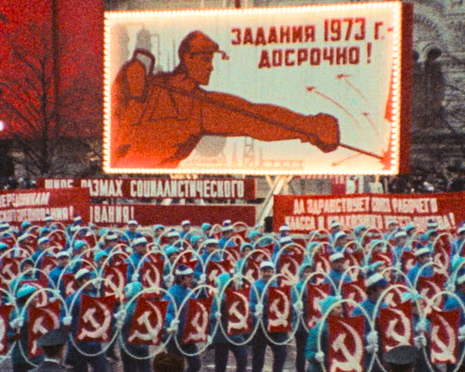
Loznitsa is presenting Imperium out of competition at the Venice film festival. The three-hour documentary uses archival material filmed by Italian crews during officially sanctioned Soviet Union expeditions between 1970 and 1973. Loznitsa said he wanted to show that the Soviet Union collapsed not only for economic reasons but because it was impossible to keep so many different cultures together.
The festival programme also includes films addressing Russia and countries within its sphere of influence, including Alexandre Smia’s Jupiter, Andrei Kutsila’s Letters from the Silenced Country and Julia Loktev’s My Undesirable Friends: Part II – Exile. Ukrainian authorities also raised concern over Ilya Khrzhanovsky’s Dau, while artistic director Alberto Barbera said it was not a Russian film or pro-Putin propaganda.