











Arabic version: صور ماكس دوبان للشاطئ والحرب وسيدني
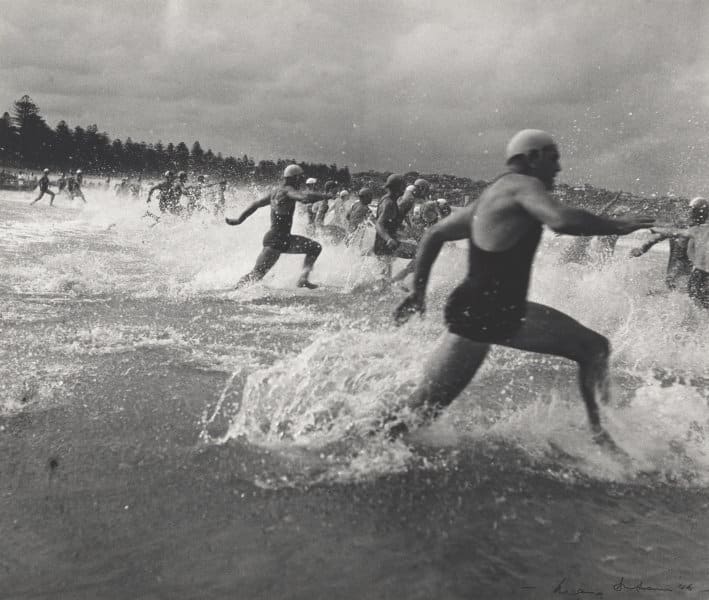
According to The Guardian, a selection of photographs by Max Dupain traces subjects including Sydney life, beach culture, wartime work and the construction of the Sydney Opera House. Dupain’s favourite among the hundreds of thousands of photographs he took was Meat Queue, a 1946 image capturing life in Sydney in the 1940s.
Several images reflect his close association with the beach. Discus thrower, Cronulla Beach, made around 1937, was among photographs taken after Dupain bought a bright yellow soft-top Chevrolet Roadster in 1936, allowing him to travel beyond the city centre for shoots. In Forms at Bondi from 1939, a couple faces the sea in a low-angle Rolleiflex photograph. His interest in physical culture was encouraged by his father, who owned a gymnasium.
Sunbaker, made around 1938, depicts Dupain’s friend Harold “Hal” Salvage after he came out of the surf during a camping trip to Culburra beach near Nowra. Dupain preferred the version showing Salvage’s right-hand fingers wrapped over his left hand. Prints from another negative, in which the hand is relaxed, became his best-known photograph; that negative is lost, and the exhibition includes the only known print of the preferred version.
Dupain also documented wartime and civic subjects. Although a pacifist, he joined the Sydney Camouflage Group and became an accredited camouflage officer with the RAAF in 1941. He made personal photographs while undertaking war work, including images around Alice Springs and on the route to Darwin, where he arrived in 1943, a year after the city was bombed. He began photographing the Sydney Opera House’s early construction in 1958 and continued until its completion in the early 1970s. One of his last self-portraits, taken in Vanuatu in 1988, shows him with a Hasselblad camera.