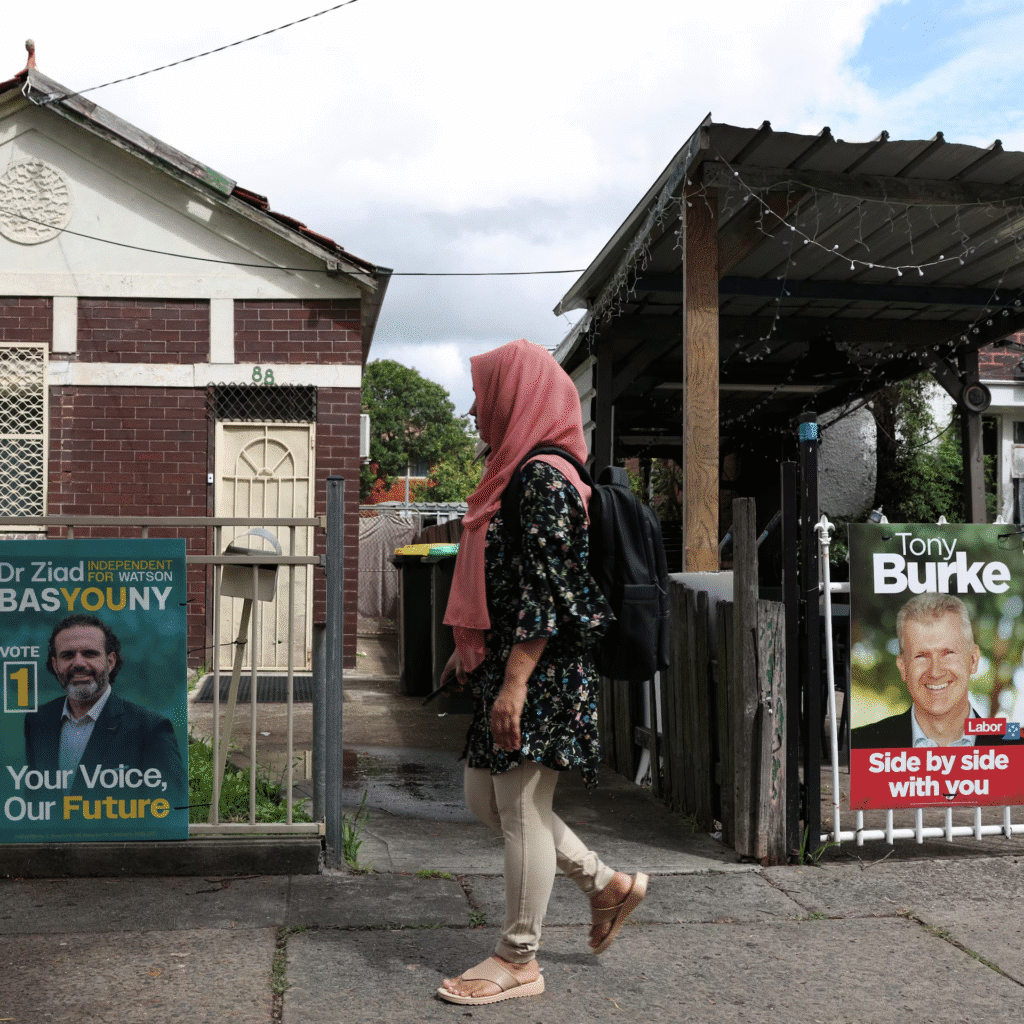













Labor has retained a firm grip on key marginal seats in Sydney’s West and South-West, but early results and shifting community sentiment suggest an increasing preference for minority parties, such as the Australian Greens, and independent candidates. These changes are becoming apparent in electorates like Barton, covering parts of Bayside, Canterbury-Bankstown, and Georges River Councils, and Blaxland, which spans diverse communities across Canterbury-Bankstown, Cumberland, Fairfield, and Strathfield Councils.
Early results indicate a different story unfolding in pockets of these regions. In Blaxland, despite Labor’s stronghold and the expected win by incumbent Jason Clare, the Federal Education Minister, the seat saw a shift in voter sentiment toward independent candidate Ahmed Ouf, who was endorsed by the Muslim Votes Matter online community. Ouf edged out the Liberal Party’s Courtney Nguyen, signalling a potential shift in voter allegiance.
The online community Muslim Votes Matter garnered attention in late 2024 and early 2025, claiming to be the only group in Australia advocating for the rights of Muslim voters. However, the online community faced criticism from other Muslim voters and the broader public over these claims, with some questioning the faith-based nature of their agenda and ties to the sacked Bankstown nurses.
Similarly, in Watson, independent candidate Dr Ziad Basyouny, also endorsed by Muslim Votes Matter, secured over 10,000 votes, surpassing Liberal candidate Zakir Alam and posing a challenge to Labor’s Tony Burke. This result could be an early indicator of shifting voter preferences that may impact future elections.
The Gaza Australian Program (GAP) issued a statement congratulating Labor MP Tony Burke on his re-election, commending his longstanding support for the Australian Arab community and his advocacy for justice in Palestine.
“The Gaza Australian Program extends its heartfelt congratulations to the Honourable Mr Tony Burke. The Australian Arab community has always seen you as a sincere ally and an unwavering advocate for justice, particularly regarding Palestine,” the organisation said in a publicly shared message.
Dr Jamal Rifi, a community leader in the Canterbury-Bankstown region and a vocal advocate for Labor MPs Tony Burke and Jason Clare, recently delivered a message on behalf of the Gaza Australia Program.
Rifi’s outspoken support for Labor in Sydney’s west, particularly in highlighting the party’s efforts to support Gaza, has sparked criticism from some community members. Among them are supporters of the Muslim Votes Matter campaign, who have been working to shift traditionally safe Labor votes toward candidates they believe better represent their stance on Gaza and broader international issues.
Dr Rifi, a medical professional and international aid advocate often referred to as “the heart of Punchbowl,” appeared alongside Jason Clare, Member for Blaxland, at a pre-election campaign fundraiser in western Sydney. The event drew public backlash, with many calling for both Rifi and Clare to be “held accountable for the [government’s] complicity” in Israel’s ongoing attacks on Gaza.
The humanitarian crisis in Gaza remains a deeply felt issue in Sydney’s western and southwestern suburbs, where voters—both Arab and non-Arab—feel emotionally connected to the rising death toll and continued conflict overseas.
Kenny Sabir, Greens Party campaigner for the electorate of Watson, one of the key seats that drew attention earlier this year due to divisions within Muslim communities, voiced his disappointment over what he sees as the government’s lack of meaningful response to Gaza.
“It’s interesting because [Watson] isn’t usually an area where the Greens focus much effort. It’s typically very conservative,” Sabir explained. “But we got a response because of Palestine. Mehreen Faruqi has been especially vocal about what’s happening there. It’s an issue close to people’s hearts. When you compare Gaza to countries like Ukraine, it’s clear no one is doing enough.”
“It doesn’t matter if I’m Arab or not,” he added. “By not supporting action for Gaza, we’re highlighting hypocrisy.”
Labor’s Zhi Soon has claimed victory in the seat of Banks, unseating Liberal Party incumbent David Coleman. Soon, who was contesting the seat for the second time, focused his campaign on improving access to healthcare and education for local communities.
He attributed his win to voters’ strong concerns about healthcare and the rising cost of living — issues he pledged to continue prioritising in the next chapter of his political journey.
“Consistently throughout the campaign, people raised the cost of living and healthcare as their main issues,” Soon said. “So, when we spoke with them about the new, fully bulk-billed urgent care clinics and initiatives to make PBS medications cheaper, they were really pleased.”
In other pockets of Sydney’s South-West, minor party candidates have also made notable strides. In Banks, Greens candidate Natalie Hanna received more than 10,000 votes – the highest ever for a female candidate in the seat.
“I’m really proud of what the team [Greens] has achieved,” Hanna said. “I feel exhilarated. It feels like my efforts are being rewarded. You feel like a lone voice at times, especially on issues like Palestine and mental health. It’s good to see wider support for these issues in Banks.”
Hanna’s candidacy received support from Muslim Votes Matter, which has advocated for candidates pushing progressive agendas.
Other Greens candidates also made strong showings, with Manal Bahsa securing more than 13,000 votes in the two-party-preferred count in Barton, and Liz Tilly receiving over 9,000 votes in Parramatta.
In another significant result, Andrew Charlton retained Parramatta, edging out the Liberal Party’s Katie Mullens and marking substantial gains since the 2022 election, reflecting growing community support.
Dai Le, still fighting to retain her seat against Labor’s Tu Le, is part of the broader trend of voters shifting toward independent candidates and minority parties like the Australian Greens, signalling a potential shift in political preferences.
While many are still awaiting the outcomes of the Senate elections, community leader Dr Mehreen Faruqi remains a leading contender. She praised the recent efforts of the Greens in securing voter support, challenging the dominance of major party strongholds.
“This has been the Greens’ biggest campaign ever in NSW,” said Faruqi. “Despite attacks from the far-right, we’ve held our ground, stuck to our values, and refused to back down, whether it’s justice for Palestine, putting dental care into Medicare, fighting for renters and first home buyers, or ending new coal and gas projects.”
Conroy Blood, Greens Party councillor in Canterbury-Bankstown, shared his perspective on the growing shift toward minority parties in the region.
“What’s driving the shift is a failure by the Albanese Government to take real action in support of Palestine and Labor’s lack of solutions to the real cost of living crisis. People in Western Sydney feel like they’re being taken advantage of, because some of them are in a ‘safe seat,’” said Blood. “Labor’s primary vote was growing significantly, while seats here saw small increases or declines, with smaller parties like the Greens and independents seeing growth.”
Regardless of the election results, seats in Sydney’s West and South-West continue to see a high number of informal votes, surpassing the state average of 5%. Informal votes occur when a ballot paper is not fully completed, is filled out incorrectly, or when the voter’s identity can be determined, rendering the vote invalid and not counted toward the election result.
Despite increased efforts from the Australian Electoral Commission (AEC) to address this issue, early results in seats like Watson, Fowler, and Blaxland show an above-average rate of informal votes compared to the national average. While some attribute this to gaps in voter education, others suggest a growing disinterest among voters.