












Pacific leaders are showing their resolve to keep their region nuclear-free, raising concerns at the Pacific Islands Forum over AUKUS and Japan’s release of Fukushima power plant wastewater into the ocean.
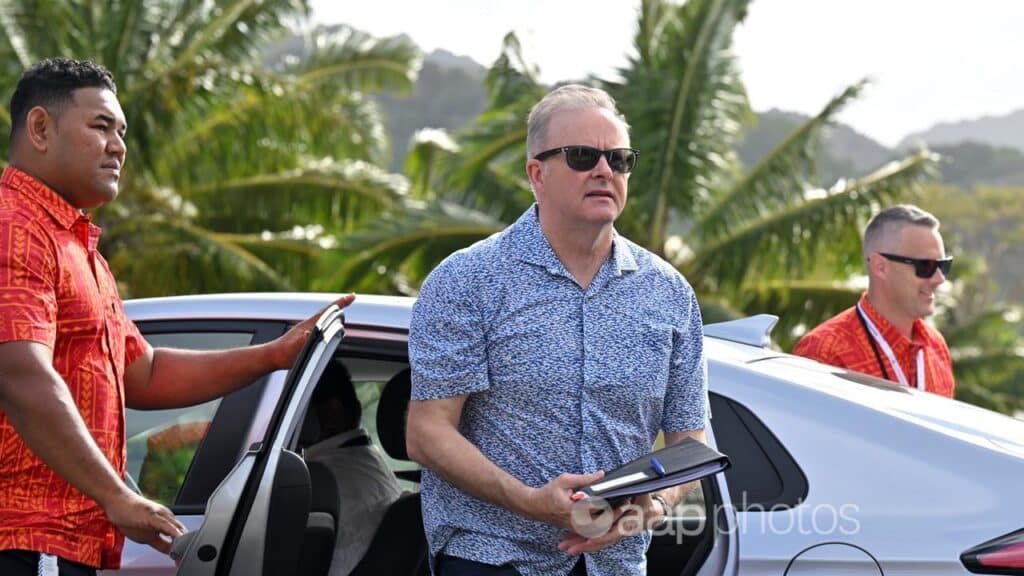
Anthony Albanese has joined Pacific leaders in the Cook Islands this week for the annual meeting of regional powerbrokers.
On Thursday, he will board a flight to the idyllic island of Aitutaki, sailing around the picturesque turquoise lagoon as the group thrashes out the region’s top issues.
Top of the list is climate change, which is intensifying cyclones in the region and threatens to raise sea levels and threaten Pacific settlements.
Beyond the existential challenge, nuclear issues are bubbling away as major points of friction among members.
Much of the Pacific is stridently nuclear-free, a legacy of the region’s painful history with testing of nuclear weapons by the United State, United Kingdom and France.
In 1985, the vast majority of Pacific Islands Forum (PIF) members signed the Treaty of Rarotonga, which forbids the use or possession of nuclear weapons within the South Pacific.
The Pacific is our home and our relationships with our neighbours matter to Australia.
This afternoon I met with Prime Minister Natano of Tuvalu, President Maamau of Kiribati, and Prime Minister Brown of Cook Islands, the host of this year’s Pacific Islands Forum. pic.twitter.com/G4AvSlMzh4
— Anthony Albanese (@AlboMP) November 8, 2023
Australia’s AUKUS deal – a tripartite arrangement with the US and UK to obtain nuclear-powered submarines does not break that treaty, but it has grown concerns among some signatories that it could erode the nuclear-free Pacific they so cherish.
Leaders in Kiribati, Tuvalu, Solomon Islands and Fiji have previously expressed reservations on different fronts, including the extravagant cost, which exceeds the entire annual GDP of PIF members excepting Australia and New Zealand.
PIF Chair and Cook Islands Prime Minister Mark Brown has suggested the time could have come to “reinvigorate” the treaty, which was signed during the Cold War, as leaders gather again where it was first agreed.
“Tensions have again escalated,” he told TVNZ, going on to indirectly reference AUKUS.
“Tensions between the US, China and now the conflict occurring in the Ukraine, the conflict in Israel and Gaza, (and) the increase in military positioning of countries like the US, Australia and the UK.”
The legacy of another nuclear incident – the 2011 Fukushima power plant disaster – also hangs over the Pacific.
Japan is releasing treated wastewater from the power plant, insisting it is safe to do so, with an International Atomic Energy Agency report as proof.
Australia and New Zealand accept those guarantees, but a growing number of Pacific nations hold concerns.
On Wednesday, the Cook Islands News reported eight countries in the Polynesian bloc – Niue, Cook Islands, Samoa, Tonga, French Polynesia, American Samoa, Wallis and Futuna and Tuvalu – want a “pause in the discharge of treated radioactive water”.
Melanesia appear to back those calls, as Fiji Prime Minister Sitiveni Rabuka apologised to his Melanesian colleagues for earlier support of the wastewater release.
“My intent was never to oppose the collective views of MSG nations. Let’s foster unity and understanding,” he posted on social media.
At the PIF Summit, Mr Rabuka is championing another initiative: declaring the Pacific an “ocean of peace”.
That could feed into Mr Brown’s proposed reinvigoration of the Treaty of Rarotonga, which he told journalists could be wider in scope.
“Pacific leaders and Pacific nations have concerns around these specific issues, which is why we feel it’s appropriate that we should rediscover and revisit our Rarotonga Treaty to ensure that it reflects the concerns of Pacific countries today,” he said.