












Arabic version: الروبوتات والتصنيع المسبق يستهدفان خفض كلفة الطاقة الشمسية الأسترالية
According to ABC News, Australia’s rooftop solar uptake and household battery installations have made it a domestic energy trendsetter, but the country is not building enough utility-scale solar to power industry. The Australian Renewable Energy Agency says construction and labour costs remain major obstacles to deploying solar cheaply at the scale needed to reshape the economy.
ARENA has set an aspirational 30-30-30 target: solar panels with 30 per cent efficiency, installed at 30 cents per watt, by 2030. ARENA chief executive Darren Miller said panels now represent a relatively small share of solar-farm costs, with heavy civil works, concrete, piling, steel, cables and manual labour making up much of the expense.
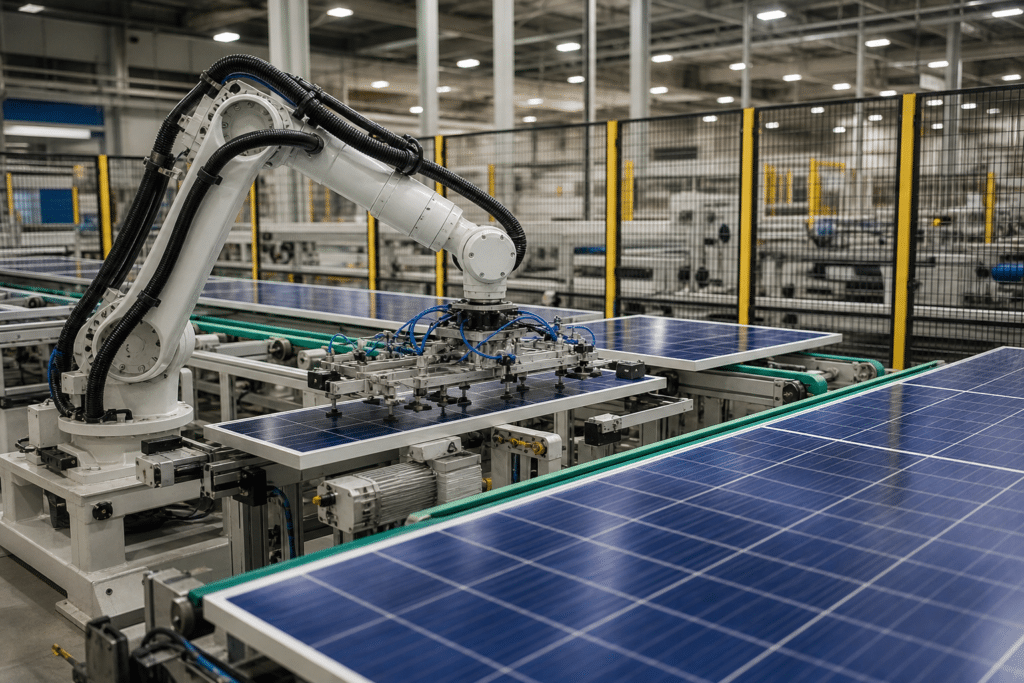
The agency is backing robotic panel installers, automated piling systems, drones for project monitoring and modular arrays. Luminous Robotics has autonomous robots called Lumis that can move through solar fields and place modules on racks. Mr Miller said robotic work could improve safety where workers would otherwise repeatedly lift panels weighing more than 30 kilograms in temperatures above 40 degrees.
Adelaide-based 5B is also using prefabricated, concertina-style solar arrays that are trucked to sites and unfolded by forklift. Chief of staff Alice Lang said some users have installed about one megawatt of solar in a day with four people after site preparation and logistics were organised. Its technology has been used at the Bellevue Gold project in Western Australia as part of a hybrid system using solar, wind and storage.
ARENA’s white paper argues that ultra-low-cost solar could support green iron, hydrogen production and critical minerals processing, rather than only decarbonising electricity supply. Australia has about 12 gigawatts of utility-scale solar connected to the National Electricity Market, while Mr Miller envisages thousands of gigawatts in remote areas for mining and manufacturing. He said planning, coordination, transmission social licence and environmental approvals were among the barriers to faster deployment.