












Reading in English | Read in العربية (Arabic)
For local business owners and lean startup teams, winning customers often feels harder than it should because the message keeps shifting from conversation to conversation. The core tension is simple: real small business challenges demand steady revenue, yet customer acquisition strategies break down when sales pitch techniques sound generic, marketing strategies for startups chase the wrong attention, and brand storytelling for small business fails to make the value feel obvious. When the pitch, plan, and story don’t match, even strong products get overlooked. A clearer, buyer-first message creates momentum that sales and marketing can actually build on.
Build a Buyer-First Message in 6 Simple Steps
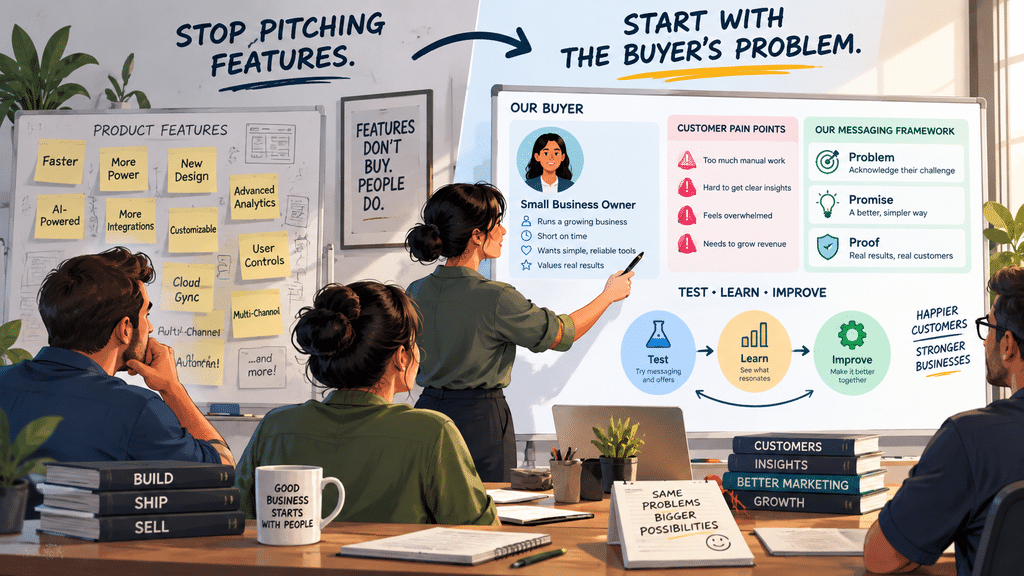
A tighter pitch and marketing plan start with one decision: lead with the buyer’s problem, not your product. Use these steps to turn target audience analysis into a clear, emotionally resonant message your whole team can deliver consistently.
- Define one “primary buyer” per offer: Write a 5-line snapshot: role, situation, budget range, decision power, and what success looks like in 30–90 days. Then list your “secondary buyer” separately so you don’t try to speak to everyone at once. This works because a focused audience makes your pitch sharper, your marketing plan easier to target, and your story more believable.
- Map pains, triggers, and stakes (not just features): Collect 10 real phrases from calls, emails, reviews, or quick interviews and sort them into three columns: pain (what’s hard), trigger (what made them look), and stake (what it costs if nothing changes). The stake is where emotion lives, stress, lost time, risk, embarrassment, so your team can talk about the problem in the customer’s language. Aim for one “top pain” you can solve better than alternatives.
- Build a problem-solving narrative with a simple arc: Draft a 6-sentence story: (1) buyer context, (2) problem shows up, (3) why it’s hard, (4) what changed, (5) the result, (6) what they’d tell a peer. Keep it specific, realistic timelines, constraints, and trade-offs, so it sounds like a customer, not an ad. Emotional storytelling works because attention follows story, a 2025 study published in Frontiers in Communication found that viewers most often select story as the narrative element with the greatest emotional impact in social media ads.
- Translate your story into a repeatable pitch “spine”: Turn the narrative into three parts your team can memorize: Problem (1 sentence), Promise (1 sentence), Proof (1–2 sentences). Add one concrete example of how you remove friction, fewer steps, faster turnaround, clearer guidance, so it connects to your marketing plan and your day-to-day delivery. If the pitch can’t be said in 20–30 seconds, cut anything that doesn’t help the buyer decide.
- Lock in brand voice with a mini style guide: Choose 3 voice traits (e.g., “plainspoken, optimistic, no-hype”) and write do/don’t examples for each. Create a “message house” with: one core message, three support points, and five approved phrases pulled from customer language. This prevents your website, social posts, and sales conversations from sounding like different companies.
- Run one engagement experiment per week: Pick one audience engagement tactic, one channel, and one metric. Examples: test two headlines that reflect different pains, ask a single-question poll tied to a stake, or send a short email that opens with the buyer story before the offer. Review results in 15 minutes with your team and update your pitch spine and message house, small iterations compound into clearer positioning and stronger business communication habits.
Pitch and Marketing Plan Questions, Answered
Q: How do we keep a pitch from sounding pushy?
A: Lead with the customer’s problem, then ask one clarifying question before you propose anything. Use “If this is true for you…” language to invite, not pressure. End with a small, low-risk next step like a short demo or a sample.
Q: What’s the fastest way to handle sales objections without getting defensive?
A: Treat it as information, not rejection, since objection handling frames objections as concerns about price, timing, trust, or clarity. Repeat the concern in your own words, then share one proof point or example that addresses it. Close by asking what would make them feel confident moving forward.
Q: How can a small team choose what to test in marketing first?
A: Start with the lever closest to revenue: your offer, your headline, or your call to action. Test only one change at a time, run it long enough to collect a meaningful sample, and write down what you expect to happen before you launch.
Q: Should we test content with A/B tests or customer interviews?
A: Use interviews to discover why people care and A/B tests to confirm what works at scale. If you have low traffic, interviews and small pilots often beat slow experiments.
Q: When should we prioritize digital channels over offline tactics?
A: When your buyers research online, a digital-first approach is practical: a Gartner survey on the B2B buying journey found that among buyers already familiar with a product or service, 64% preferred a fully digital buying experience over engaging a sales rep. Pick one channel you can sustain weekly, then add a second only after you can measure results consistently.
Build a Simple Test → Learn → Improve Loop
This workflow keeps your pitch and marketing plan evolving without constant reinvention. It turns feedback, small experiments, and simple measurement into a steady cadence, so your team learns what works and repeats it. That matters because markets change and even solid messaging can drift as competitors and customer needs shift.
| Stage | Action | Goal |
| Listen | Collect 5 notes from calls, emails, demos, comments | Spot patterns in objections and desired outcomes |
| Clarify | Rewrite problem, promise, and proof in plain language | One shared message the whole team can repeat |
| Test | Run one A/B test on headline, CTA, or opener | Find a version that improves a key metric |
| Pitch | Use the new version in real conversations and campaigns | Create consistent delivery across channels |
| Review | Track one metric tied to sales performance weekly | See what actually moves leads toward purchase |
| Adjust | Keep the winner, document the lesson, set next test | Build a library of proven phrasing and offers |
Each step feeds the next: listening gives you hypotheses, testing proves or disproves them, and review prevents “gut feel” decisions. Over time, your docs become your advantage because new teammates can follow the same loop.
Build Pitch Confidence and Brand Clarity With Three Weekly Moves
When the calendar is packed, it’s easy for a marketing strategy summary to turn into scattered efforts and a pitch that changes every time. The steadier path is the approach outlined here: a clear brand story, a focused offer, and a simple test → learn → improve loop that keeps decisions grounded. Do that consistently and sales pitch confidence rises, brand narrative impact becomes easier to spot, and actionable marketing steps stop feeling like guesses. Clarity wins when you commit, test, and adjust, week after week.