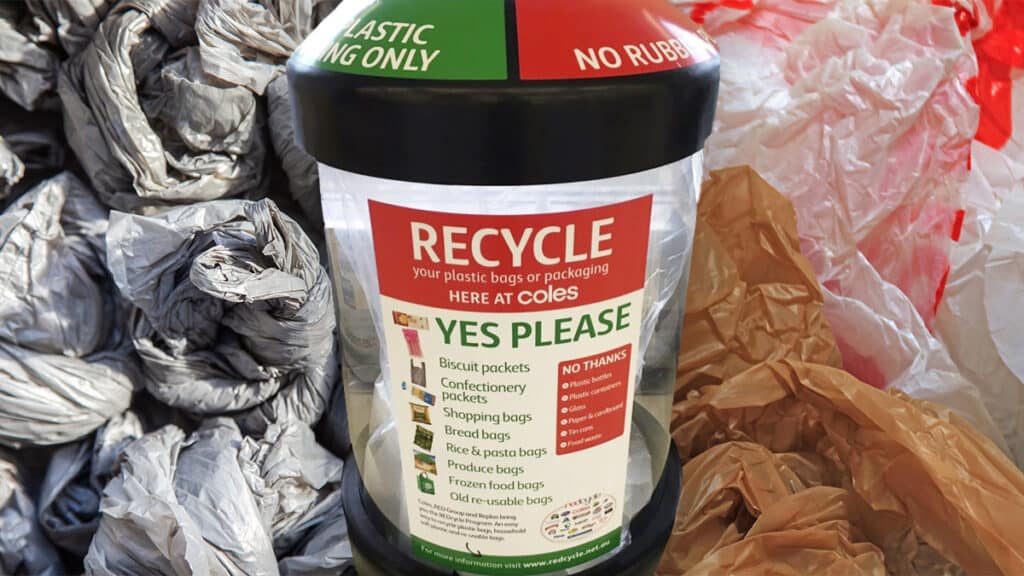












Australia’s three major supermarkets have promised to “urgently” revive the failed soft plastics recycling scheme, but still face a mountainous problem.
Coles, Woolworths and Aldi announced they would resume collecting and recycling soft plastics by the end of 2023 in a staged rollout that could take until 2025.
But the promise is contingent on first dealing with a 12,000 tonne mountain of plastic stored in warehouses, unbeknown to consumers who thought the waste was being recycled.
The private company behind the REDcycle program is being wound up after it emerged the plastics that consumers had diligently returned to grocery stores had been stockpiled, not recycled.
REDcycle has denied being involved in a cover up, saying it was holding onto the waste while trying to ride out problems including the lack of recycling capacity.
In the latest announcement, Coles, Woolworths and ALDI released their plan to get soft plastics recycling back on track, but warned it would be a slow, staged process.
It’s hoped a pilot scheme at a select number of stores will be operating “from late 2023”, provided that REDcycle’s existing soft plastic stockpiles can be cleared prior, the supermarket taskforce said.
The new program would then be gradually rolled out nationwide next year.
“While the Taskforce is working to launch in-store collections urgently, it is severely constrained by Australia’s limited access to domestic soft plastic recycling,” said a joint statement.
“At present, it would not be possible to recycle the volume of household soft plastics collected in a supermarket program using domestic infrastructure.
“Accordingly, the Taskforce has plotted out the projected gradual increase in Australian soft plastic recycling capacity over the next year, as new operators launch, and existing processors expand.
“From late 2023, the Taskforce will meet the newly available processing capacity with a staged re-introduction of in-store collections so that the volume of incoming household soft plastics does not exceed the amount that can be recycled — as occurred with REDcycle.
“Restoring public trust in soft plastic recycling is paramount, and the Taskforce will reintroduce soft plastic collections when it can be confident that it will be properly recycled.”
The three supermarkets said the best way to accelerate nationwide access to soft plastic recycling was through continued investment in recycling facilities in Australia.
Federal Environment Minister Tanya Plibersek said the supermarkets’ plan was a welcome step and the government was investing heavily in the nation’s recycling capabilities.
But she also said she was prepared to regulate “if industry does not fix this”.
Ms Plibersek said the government had set aside $250 million for new recycling facilities, with $60 million of that specifically for hard-to-recycle plastics like soft plastics.
She said 48 recycling plants were currently being built or upgraded and 11 facilities opened.
“We see we have a role but I tell you what, so do the companies that are generating all of this waste,” she said in a Twitter video.

Circular economy experts said Australia has been reluctant to introduce government-mandated and -regulated schemes, despite overseas experience showing that’s how to get the quick results.
Veteran campaigner Jeff Angel leads the Boomerang Alliance of 55 of Australia’s leading community and environment groups and questions the decision to let industry resolve the problem.
“I don’t think the community trusts the supermarkets and packaging sector to get it right on their own,” Mr Angel says.
“It’s absolutely vital that government regulates the sector to lock in broadscale collection systems for households; funding by producers and big retailers; and recycled content or less plastic or other alternative materials, in new packaging.”
The supermarket task force agrees Australia needs a long-term, national soft plastic recycling strategy and said more waste could be diverted if systems were more convenient, and offered at the household level.
It pointed to a new kerbside collection model, outlined under the National Plastics Recycling Scheme and under development by the Australian Food and Grocery Council with funding from the federal government.
The model would see food and grocery manufacturers pay a levy to support the recycling of the soft plastics they create.
The Australian Packaging Covenant Organisation has estimated the REDcycle scheme collected less than five per cent of the soft plastic waste Australians generate.
The post Supermarket giants promise to ‘urgently’ resume soft plastics recycling appeared first on The New Daily.