










Reading in English | Read in العربية (Arabic)
China no longer sees Morocco as a market at the far western edge of the Arab world, nor merely as a bright spot on the map of North Africa. Something else is happening quietly — something like redrawing the route between East and West. But this time the maps are not on paper; they’re being drawn inside factories, ports, and supply chains. When Chinese capital enters Morocco it does not arrive alone: it brings technology, industrial know-how, production chains, and export ports. It also leaves a question larger than the investment itself: will Morocco become China’s new gateway to Europe and Africa?
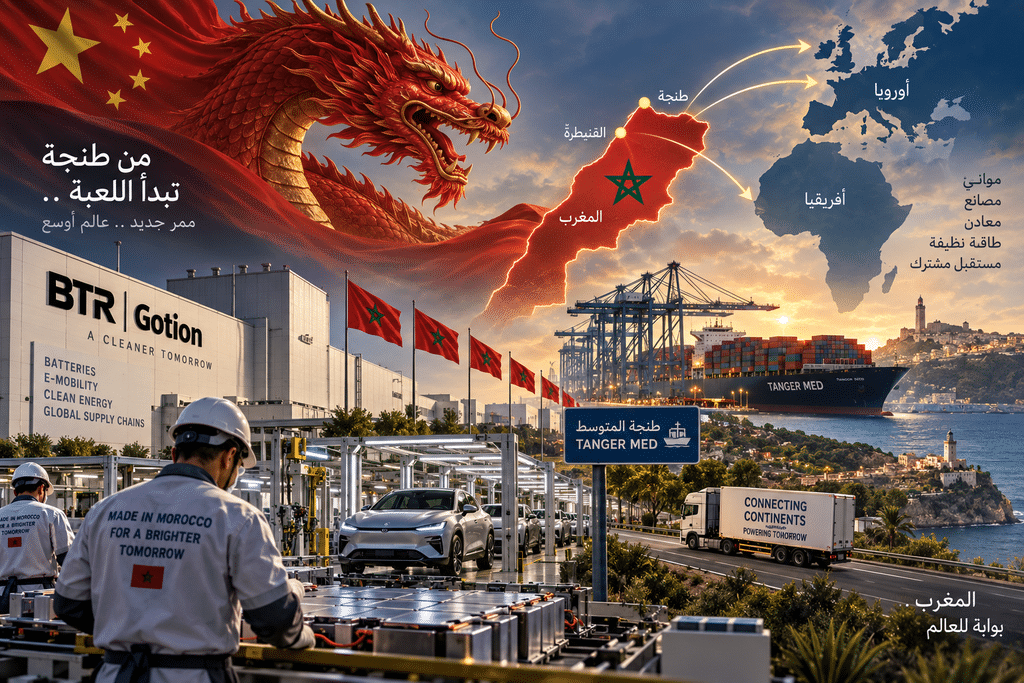
In recent years Chinese investment has pushed strongly into the heart of future industry — batteries, electric vehicles, energy components, and strategic metals. The BTR cathode plant in Tangier, several Chinese battery-related projects, and the giant Gotion project in Kenitra are not isolated economic islands but parts of an emerging ecosystem. In July 2026 Gotion secured financing from the African Development Bank to build an integrated lithium iron phosphate battery factory with an initial capacity of 10 GWh and plans to expand to 100 GWh.
Economics thus becomes another language of geopolitics. Morocco doesn’t just have a location — it has the location China needs: proximity to Europe, access to the Atlantic, connections to Africa, an industrial base, the Tangier-Med port, and a network of trade agreements that give it exceptional ability to link distant markets. Economic studies increasingly describe Morocco as transforming into a geo-economic node that ties Chinese capital to European and African production chains.
But behind the factory lies a deeper story. China is not merely building a conventional battery plant; it is shortening the distance between its factories and the markets it wants to reach. In a world where the United States and Europe are rethinking their reliance on Chinese supply chains, relocating part of manufacturing to a country with Morocco’s commercial and political profile is more than an economic decision. It is an attempt to adapt to a new reality in which customs, rules of origin, the notion of economic security, and the limits of free trade are all changing. That is why some European voices view Chinese expansion in Morocco’s automotive and battery sectors with concern, fearing the country could become a Chinese industrial platform close to the European market.
Morocco, however, is not merely a piece on someone else’s board. Rabat is trying to turn its geography into a bargaining chip rather than a fate: it opens its doors to China while preserving ties with Europe and the United States, seeking a place inside global value chains rather than remaining on their margins. The striking paradox is that China is looking for a gateway to the world just as Morocco is looking for the world within its gate. Their interests intersect, but intersection does not mean identical goals. Beijing wants a more flexible access to markets, an industrial foothold near Europe and Africa, sources of critical materials, and new trade corridors. Morocco wants manufacturing, jobs, technology transfer, an industrial deepening, and to convert its geography into economic and political value.
That is why Tangier and Kenitra are today more than industrial cities; they are part of a larger global question: who will hold the keys to industry when the battery becomes more important than oil, metals more important than sea lanes, and the factory itself an element of foreign policy? We should not read China’s presence in Morocco only through an economic lens. In the last century great powers sought ports and military bases; the new century seeks ports, factories, minerals, data, and supply chains. Influence has changed: the dragon no longer needs to plant a flag on foreign soil — sometimes placing a factory is enough. In Morocco it seems the factory has begun to write policy in another language: a language that does not shout but reaches Europe across the sea, Africa by land, and the future through a small battery that stores something far greater than electricity — the century’s struggle over who will build the world to come.