












Reading in English | Read in العربية (Arabic)
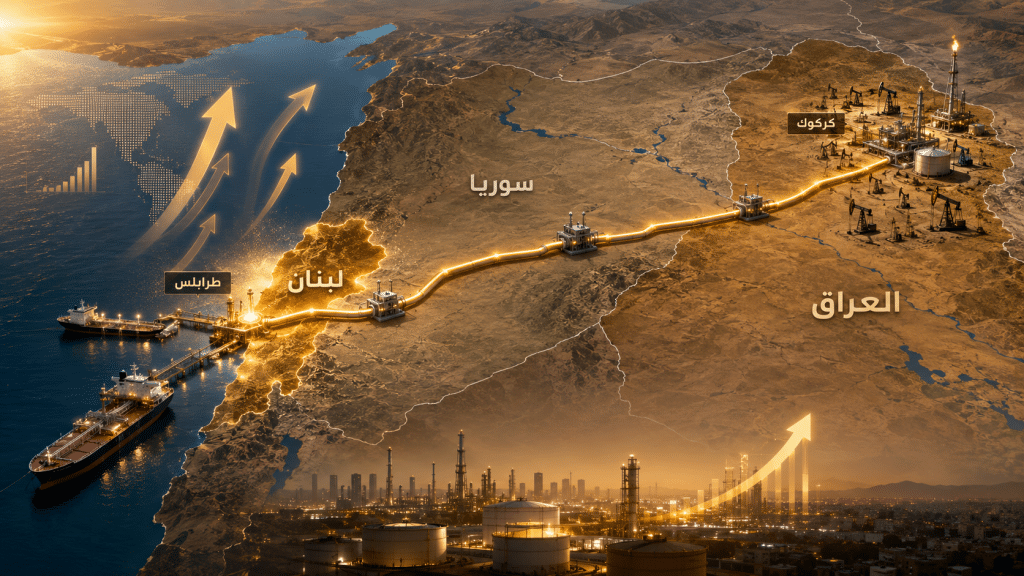
Iraq’s announcement of the formation of a high-level committee to negotiate with Turkey regarding the extension of the crude oil export agreement via the Iraqi-Turkish pipeline to the port of Ceyhan has raised questions about the fate of the Kirkuk-Tripoli pipeline. This pipeline runs from Iraq through Syria to Lebanon and its potential reactivation is significant for both Lebanon and Iraq. Notably, recent shipments of Iraqi oil to Lebanon have been transported overland through Syrian territory using tankers from the Iraqi transport fleet, owing to the conflict in the Gulf region and the closure of the Strait of Hormuz, which has heightened tensions.
The Iraqi-Turkish negotiations come at a time when the targeting of a Singapore-flagged vessel, along with subsequent attacks on other ships, has highlighted the fragile security situation in the Strait. Renewed U.S.-Iranian confrontations threaten to undermine any ceasefire and diminish the chances of achieving a lasting agreement between Washington and Tehran. This situation keeps maritime navigation hostage to military and political developments, underscoring Iraq’s need, like other Gulf countries, for alternative routes to the Strait of Hormuz.
On the other hand, the negotiations between Iraq and Turkey are at a critical juncture, particularly since the current agreement expires on July 27, 2026. While Iraq aims to increase its exports through the Turkish port of Ceyhan to exceed 350,000-400,000 barrels per day—currently limited to about 200,000 barrels—Turkey insists on new negotiating terms to resume oil flow through the pipeline covered by the agreement.
It’s important to note that the primary capacity of the Iraqi-Turkish pipeline to the port of Ceyhan on the Mediterranean Sea is around 1.6 million barrels per day. However, its actual capacity has diminished due to the wars in Iraq and the halt in pumping during years of economic sanctions.
In this context, the reactivation of the Kirkuk-Tripoli pipeline emerges as a strategic option that enables Iraq to diversify its export outlets and reduce dependency on the Turkish route alone. This becomes particularly relevant after Iraqi oil exports plummeted during the crisis in March 2026, dropping from approximately 4.3 million barrels per day to merely 800,000 barrels, resulting in financial losses estimated at around $300 million daily.
The Kirkuk-Tripoli pipeline has a capacity of about 900,000 barrels per day, utilizing three main lines with diameters of 12, 16, and 30/32 inches, in addition to a storage capacity of nearly 2.7 million barrels (430,000 cubic meters) at oil facilities in Tripoli. The increase in oil exports that Iraq seeks in its negotiations with Turkey remains modest compared to the decline in exports, thereby enhancing the prospects for reactivating the Kirkuk-Tripoli pipeline, especially after economic sanctions against Syria were lifted, which previously hindered the passage of Iraqi oil to Lebanon across its territory.
The cooperation between Lebanon and Iraq in the oil sector is not new; it dates back to July 2021 when the two countries signed an agreement to supply Beirut with one million tons of heavy fuel oil (which increased to one and a half million tons in 2022), with payment to be made through services and goods. Recently, an Iraqi official announced that the new government would continue to honor the agreement with Lebanon without modifications.
Furthermore, the Iraqi Ministry of Oil announced, during the visit of the Syrian Minister of Energy to Baghdad in August 2025, that it is considering exporting oil via the Lebanese port of Tripoli and reviving the Kirkuk-Tripoli pipeline, which stretches approximately 250 kilometers through Syrian territory.
The Kirkuk-Tripoli pipeline has been a focal point for discussions between Lebanese Prime Minister Judge Nawaf Salam and Ihsan Al-Awadhi, the special envoy of the Iraqi Prime Minister, during Salam’s reception of him at the end of 2025. During this meeting, Salam emphasized that reactivating this pipeline is a top priority for his government. Additionally, General Security Director Major General Hassan Shuqair continued discussions on this matter with the new Iraqi Prime Minister Ali Al-Zaydi, and both sides confirmed their commitment to the issue.
The significance of reactivating the Kirkuk-Tripoli pipeline lies in providing an additional outlet for Iraqi exports, granting Iraq greater flexibility in managing its exports and reducing geopolitical risks associated with the closure of maritime chokepoints, particularly the Straits of Hormuz and Bab el-Mandeb, or the disruption of other export lines. It also enhances Baghdad’s negotiating power with the countries through which its export routes pass, affording it a broader margin for marketing its oil according to regional and international changes.
For Lebanon, reactivating the Kirkuk-Tripoli pipeline represents an irreplaceable economic and strategic opportunity, granting Lebanon direct access to energy sources. It contributes to transforming Tripoli into a regional hub for oil storage and re-exportation, paving the way for the rehabilitation and operation of its refinery.
Reopening the pipeline could revitalize the city’s port operations, create hundreds of direct and indirect job opportunities, and provide steady revenues in hard currency to the Lebanese treasury from transit, storage, and logistics services. It would also allow the Tripoli refinery to produce oil derivatives locally and meet domestic demand at reasonable prices.
In light of the global energy system’s transformations and the growing trend towards diversifying supply routes and minimizing geopolitical risks, the reactivation of the Kirkuk-Tripoli pipeline stands out as a strategic choice dictated by energy security and regional economic considerations. It offers Iraq safe and stable new outlets for exporting its oil, particularly towards European countries.
This also benefits Syria through transit fees for oil crossing its territory and reinstates Lebanon on the economic map of the region. Additionally, it opens the door for joint projects to develop the energy sector and strengthens economic ties among the three countries, evolving from mere trade to a strategic partnership in energy security.
Thus, the success of this project requires a shared political will and the completion of the necessary legal, technical, and financial frameworks, alongside the time needed to accomplish the reactivation efforts. This is all pending Lebanon’s investment in its oil wealth hidden beneath its soil and within the waters of its exclusive economic zone.