












Reading in English | Read in العربية (Arabic)
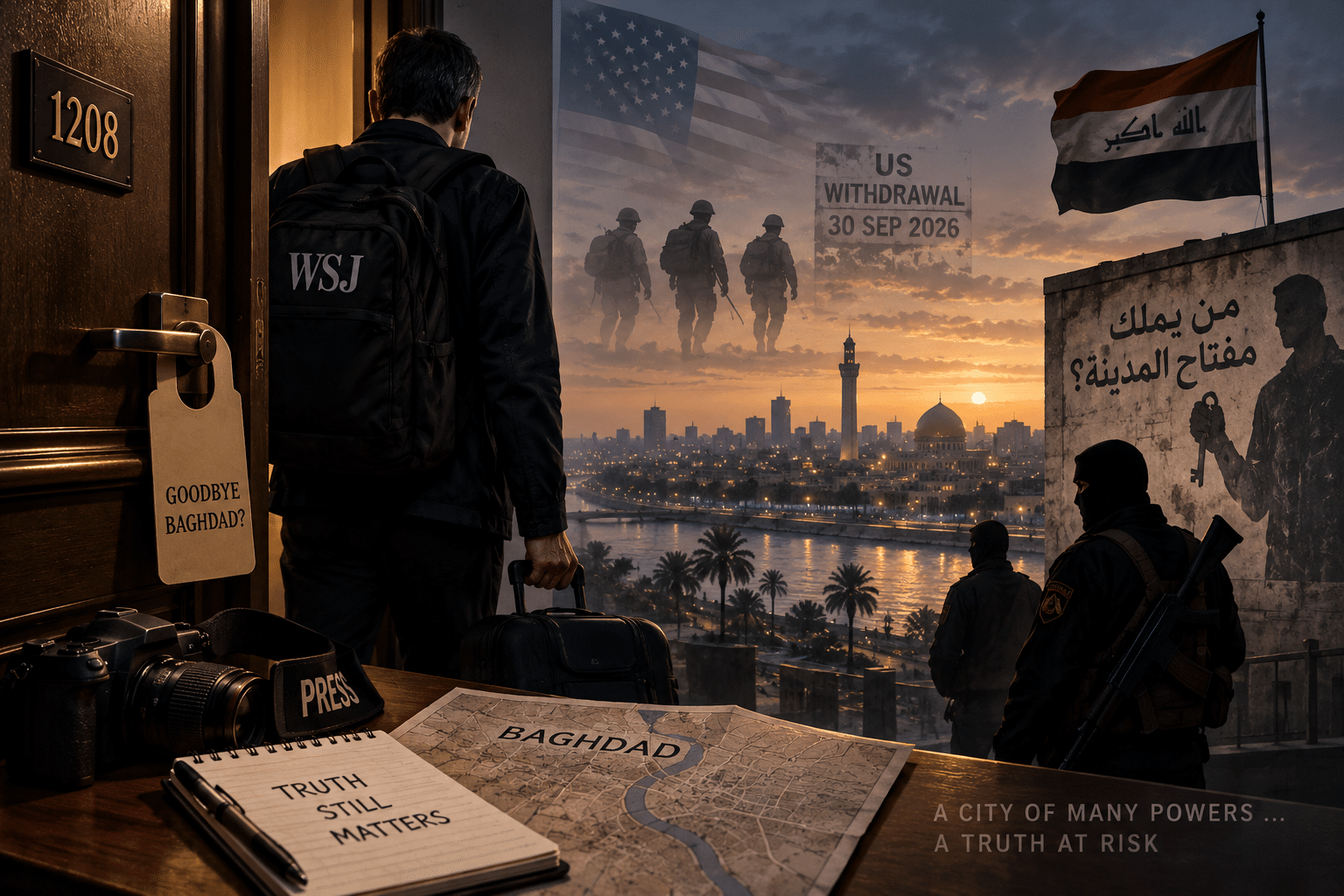
In Baghdad, the city does not need to fire a shot to signal that something has changed. Sometimes it is enough for journalists to hurriedly leave a hotel room, for a bag to be zipped shut ahead of schedule, or for a reporting assignment to turn into a route of return, for you to understand that the city’s security map has been redrawn in places the cameras cannot see.
That was how a team from The Wall Street Journal found itself deciding to leave Baghdad barely two days after arriving, following security warnings. The timing was especially sensitive: the U.S. military withdrawal from Iraq was completed on September 30, 2026. This scene is more than the story of reporters leaving a troubled country; it raises the question: who has the power to force the press itself to withdraw? When a journalist leaves under threat, they carry more than a suitcase—they carry mute evidence that a force exists which can make information more dangerous than a weapon.
Worse still, this incident did not come out of nowhere. On March 31, American journalist Shelly Kittleson was kidnapped in Baghdad after armed men seized her from a city street. She was released on April 7 after negotiations that included the freeing of detained operatives and the condition that she leave Iraq. The abduction thus became more than a security crime; it became a political message. A foreign journalist in a conflict environment does not represent only themselves—their presence is an external eye, a set of questions that cannot be easily steered, a notebook that might end up in Washington, London, or Paris. For that reason, freedom of movement for journalists in some armed settings becomes part of a battle over who controls the narrative.
But why now? The answer lies in the moment itself: Iraq stands on the threshold of a new phase. On September 30, 2026, the U.S. military withdrawal was completed, ending a presence that began after the 2003 invasion and returned in a different form in 2014 to fight the Islamic State. Washington has kept some intelligence and training support inside the country, but responsibility for internal security has been placed more squarely on the Iraqi state.
The paradox is that the day American forces left Iraq was not necessarily the day American power disappeared from the Iraqi equation. Power is not always measured by troop numbers: a base can close while influence endures; forces can withdraw while networks of weapons, politics, and economics remain. A soldier might shut his camp gate for the last time while questions of sovereignty linger in the streets. That is precisely where Iraq’s knot appears.
The Iraqi government wants to appear as the authority on weapons policy, but Iran-backed armed factions are not merely marginal, isolated groups. Some hold military strength, political influence, and positions inside Iraqi territory. Recent reports indicate many factions have shown no real readiness to give up their arms. So the question left by the U.S. departure is not simply “who left Iraq?” but “who stayed?” Who now determines where a journalist can go, who can enter Baghdad without fear of kidnapping, which stories can be told, and which stories are themselves a risk?
This is a delicate equation involving the state, arms, politics, and regional influence. In this gray zone, journalists sometimes notice change before politicians do: they do not need an intelligence report to know something is happening. A warning, a hotel change, a canceled interview, or an early departure can be enough. From this scene, Baghdad becomes a mirror of the post-withdrawal phase: a state that wants to monopolize security decisions; factions that hold weapons and influence; a deep Iranian presence in the equation; a military exit by Washington and continued oversight from a distance; and international journalism recalculating the distance between truth and danger.
The great irony is that the United States spent more than two decades in Iraq, while Baghdad still seeks an answer to a question that seems simpler than all the wars: who holds the key to the city? The key might be in the hands of the government, in those who carry weapons, or distributed among regional capitals, international powers, and political networks not all visible in the picture. Yet a press team departing in fear of kidnapping says something deeper: when access to truth becomes hazardous, the fight is no longer only on the ground—it is a struggle over who has the right to tell the story of the land. In the new Iraq, that may be the battle that has just begun.