Reading in English | Read in العربية (Arabic)
In American politics, shifts in the balance of power do not always follow the rhythm of presidential elections. Other venues quietly redraw maps of influence and rearrange the positions of players inside the state. A seat that seems far from the spotlight of the White House can sometimes be more capable of disrupting its calculations than many realize. Washington, which has long presented the world with the image of authority from the presidential window, conceals another face of decision-making in the halls of Congress, where words become legislation, votes become positions, and seats become keys that open or close doors of governance.
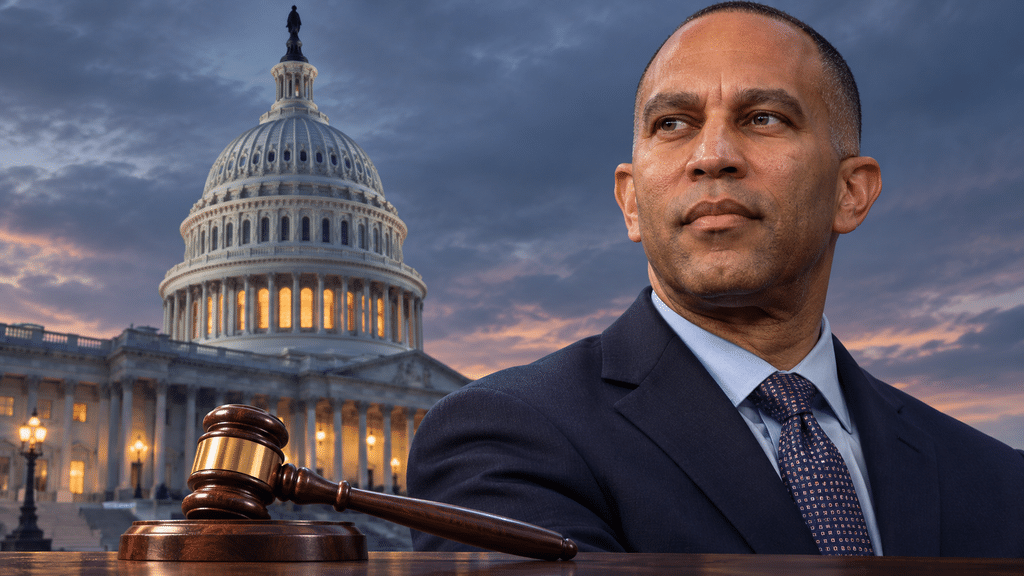
That is why the Democrats’ return to control of the House of Representatives in the 2026 midterm elections matters beyond a routine partisan change. It places Hakeem Jeffries before a major political test: moving closer to the speakership. This position would give him broad authority to manage the legislative agenda, set parliamentary priorities, and open a new phase in the relationship between the legislative branch and President Donald Trump’s administration. Jeffries, who has moved from leading the Democratic minority to the forefront of the majority, faces a moment in which his party’s ambitions intersect with the complexities of statecraft. The expected speakership would not merely hand him a gavel to run sessions; it would place on his shoulders the responsibility to direct the legislative calendar, manage debates, influence committee investigations, and lead negotiations over the budget, spending, and public policy. It is a procedural power with wide political implications, but it remains constrained by the Constitution and the balances among institutions.
On the other side stands the White House with its executive authority. Donald Trump understands that holding the presidency does not mean having an unobstructed path to implementing his political agenda. When the majority in the House changes, the distance between presidential decisions and the ability to turn them into law changes as well. Legislation can become a long negotiating field, budgets can turn into tests of strength, and congressional oversight gains increased importance in scrutinizing administration performance and holding officials accountable. Herein lies a quintessential American paradox: institutions are built on a distribution of power, yet those boundaries are constantly tested. The White House seeks more room to enact its program while Congress has constitutional tools to review, debate, and constrain parts of that program. Between them forms an equation not resolved by louder voices but by each institution’s ability to exercise the powers the Constitution grants it.
The deeper question is not only what Jeffries can do within the chamber but what his leadership would mean to the world watching Washington from beyond its borders. While U.S. foreign policy is largely shaped by the president and the executive branch, it does not operate in a vacuum. Congress holds influential levers over funding, oversight, and legislation, and plays a central role in debates over military and economic aid, treaties, and strategic issues. In the Middle East specifically, discussions could expand over U.S. assistance, relations with Israel, developments in Iran, regional security, and the future of American military commitments. In Europe, questions about security support and transatlantic relations could resurface. Meanwhile, China and Russia will remain central to considerations about defense, trade, technology, and international security.
What makes Jeffries’s moment particularly interesting is the dual equation he faces. He must manage a party majority that includes divergent currents while also proving his capacity to lead a legislative institution where local interests intertwine with international calculations. Domestic issues—healthcare, the cost of living, taxes, and Social Security—are no less important than matters of security and foreign policy. Any failure to manage these files could reflect badly on Democratic leadership. If Jeffries’s election to the speakership is confirmed, it will also carry historic significance: he would be the first African American to hold the post, adding a dimension tied to the history of political representation and the evolution of American institutional life. That significance, however, does not erase the reality that the office will remain governed by vote counts, coalitions, and the ability to manage dissent.
The gavel that awaits Jeffries is not just a tool for keeping order in the chamber; it is a symbol of political responsibility that reaches beyond the room. Whoever wields it faces questions about who sets the nation’s priorities, who holds power to account, and who can turn a partisan vision into legislative reality. Conversely, the White House cannot ignore that the path to implementing many of its initiatives runs through an institution that does not speak with a single voice and does not hand out an open-ended mandate. Thus Washington is entering a new chapter of checks and balances: it is not sufficient for a man to sit in the Oval Office for every institution to bend to him, nor does a change in congressional majority instantly redraw the map of the state overnight. Power in the American experience is distributed among constitutional texts and political will, between official pronouncements and what institutions allow.
Perhaps the real story is that the world is less interested in the name of a new House speaker than in what will happen when two political wills meet inside a country that exerts influence across continents. When the balance of seats in Washington shifts, its echoes are not confined to the walls of the Capitol; they reach capitals awaiting decisions on funding, armament, and alliances, markets watching economic trends, and nations measuring the gap between American rhetoric and political action. Ultimately, the question is not who holds the Congress gavel but how far the holder can turn the legislative branch into a negotiating force and a means of accountability in the face of an executive that seeks to expand its maneuvering room. Political history is not made by seats alone, however different they may be; it is made by moments when institutions demonstrate their ability to preserve their balance—moments when decisions become a real test of what power means and where its limits lie.