












Reading in English | Read in العربية (Arabic)
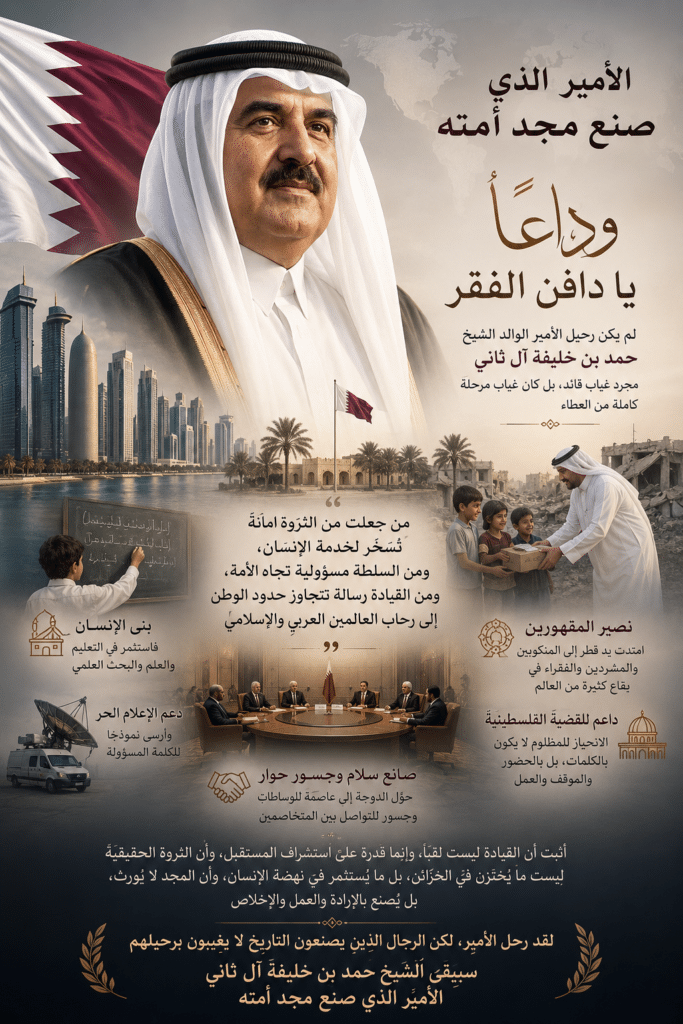
The departure of the Father Emir, Sheikh Hamad bin Khalifa Al Thani, was not merely the loss of a leader but the end of an entire era of giving. He was a man who believed a ruler’s worth is measured not by the power he holds but by the legacy he leaves in people’s lives. Farewell to the one who eradicated poverty, who treated wealth as a trust to serve humanity, who saw authority as a responsibility to the nation, and who practiced leadership as a mission reaching beyond national borders to the Arab and Islamic worlds.
At a time when politics often operated on the cold calculus of narrow interests, Sheikh Hamad chose to put ethics at the heart of decision-making. He did not regard Qatar as a small state merely seeking influence, but as a nation with a mission capable of producing impact beyond geography, size, or population. Under his rule, Qatar became a frequent name in international forums, a country whose views were counted and whose positions were awaited on major issues.
He understood early on that true strength is not built by arms alone but through people, knowledge, the economy, the media, and the ability to build bridges of dialogue between adversaries. His project was comprehensive: he did not limit himself to domestic development but sought to make his country a platform for peace, a bridge for communication, and a refuge where opponents could meet when politics failed to bring them together.
Perhaps his greatest distinction was that he did not confine his concerns to his own borders. He bore the cares of the Muslim world in his heart and treated its problems as moral obligations before political commitments. He stood with peoples exhausted by war, and during his reign Qatar’s hand reached out to the afflicted, the displaced, and the poor across many parts of the world. Qatari humanitarian aid became a symbol of solidarity and a message of hope to those whose lives had grown narrow.
The Palestinian cause was at the core of this vision. For him it was not a mere line in political statements but the struggle of a people entitled to life and dignity. Qatari support remained consistently political, humanitarian, and relief-focused, and his historic visit to the Gaza Strip showed that siding with the oppressed requires presence, stance, and action—not words alone.
He believed dialogue was stronger than rupture, and that bringing adversaries closer could be greater than defeating them. For that reason Doha became, in his time, a capital of mediation and a place where rivals could find the opportunity to sit around one table at a moment when wars devoured the region and divisions deepened.
His project was not about influence for its own sake but about building stature through achievement. He invested in education and scientific research, supported a free media, opened the doors to global investment, and established a model that proves a country’s greatness lies not in its territory but in its vision, the opportunities it creates, and the imprint it leaves on the history of nations.
Sheikh Hamad bin Khalifa Al Thani showed that leadership is not a title but the ability to anticipate the future; that true wealth is not what is locked in treasuries but what is invested in the advancement of people; and that glory is not inherited but forged through will, work, and sincerity.
People will differ in judging political stances—such is the fate of any leader who leaves a mark in a time of great change—but it is hard to deny that the Father Emir transformed his country’s standing in both the regional and international systems. He established its presence as an initiative-taking state that makes its own decisions and believes that serving humanity, making peace, and building the future are the real paths to influence and respect.
Farewell, you who buried poverty; farewell, champion of the oppressed; farewell, you who believed the nation had a right to its renaissance, the individual a right to dignity, and the homeland a right to development and pride. Your name will remain vivid in the memory of everyone who saw in your rule a model of a leader who combined wisdom and courage, vision and accomplishment, loyalty to his people, and care for his nation’s causes.
The Emir has passed, but men who make history do not disappear with their deaths: their deeds remain as testimony, and nations preserve the names not of those who lived for themselves but of those who lived for their homelands, their peoples, and humanity. For many, Sheikh Hamad bin Khalifa Al Thani will remain the Emir who created his nation’s glory and proved that great leadership can make a small state a great homeland in the conscience of the world.