Reading in English | Read in العربية (Arabic)
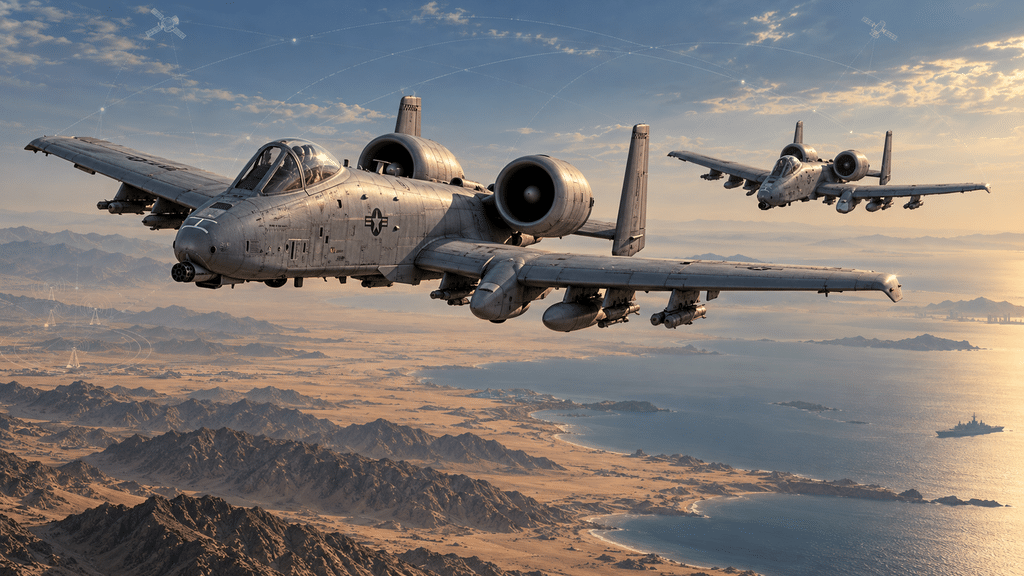
When U.S. Central Command published photos on October 24 of two A-10 Thunderbolt II aircraft—known as the “Warthog”—flying over the Middle East during scheduled daytime sorties, the image was more than two planes cutting through the sky. It was a window onto a broader military equation that goes beyond aviation to deterrence calculations, demonstrations of readiness, and the limits of force Washington can keep present in a region where major powers’ interests and anxieties continue to intersect.
On the surface, the A-10 looks like a rugged attack machine whose design embodies a clear military philosophy: reach the battlefield, support ground forces, and strike ground targets according to the mission and surrounding conditions. With its heavy cannon and ability to carry various munitions, the A-10 is one of the direct faces of American power when it shifts from watching the field to affecting it. But the deeper question isn’t what this aircraft can do alone; it’s about the system behind it and the capabilities that information, support, coordination, and decision-making provide. No weapon, regardless of its efficiency, operates in a vacuum—there is a network of reconnaissance, communications, command, and planning, and air, sea, and land capabilities can integrate at once to change the situation on the ground.
Describing the flights as “scheduled” confirms a declared U.S. aerial presence in the region and raises the question of what assets can be put at the service of military decision-making if conditions change. The United States does not draw its military influence from a single aircraft or base but from a wide system that includes fighters, reconnaissance and refueling planes, aircraft carriers, warships, air defense systems, satellites, and command and information networks. The nature, readiness, and locations of these capabilities vary, and gathering them for a single mission remains subject to political decisions and operational considerations. That is why invisible power takes on special importance: what appears in official photos is only part of the picture, while mission details, readiness levels, deployment plans, and certain intelligence are not necessarily made public. The absence of information does not mean there are necessarily secret, miraculous capabilities; it means the published image alone is insufficient to fully understand the military apparatus. This is the most thought-provoking gap between what militaries declare and what they keep to themselves: the former present the world with an image of presence and readiness, while the latter remain governed by military secrecy, as other states try to read the signals and distinguish between a fleeting deterrent message and an actual shift in preparedness.
In the Middle East, this image cannot be separated from American calculations about Iran, the security of maritime routes and strategic interests, and the web of tensions that make any military move subject to close scrutiny. Caution is essential: the appearance of two A-10s does not by itself determine the direction of a confrontation or reveal whether the flights are routine or a prelude to another mission. When air power is engaged in real operations it can influence troop movements, target specific sites, and alter the cost of military options for an adversary. Thus the question raised by the “Warthog” image goes beyond the aircraft: if this declared force represents one face of U.S. presence, how should we understand the rest of the system that photos alone do not disclose? And what effect could that system have if it moves from a state of readiness to active operations?
The image reminds us that modern power is not measured only by what we see in the sky but by the information, capabilities, and decisions that surround it. Between a plane crossing the scene, the system standing behind it, and the ground awaiting the results of what unfolds above, the most dangerous question remains open: Is military capability enough to create a new reality? Or is possessing force fundamentally different from possessing the future?