












Reading in English | Read in العربية (Arabic)
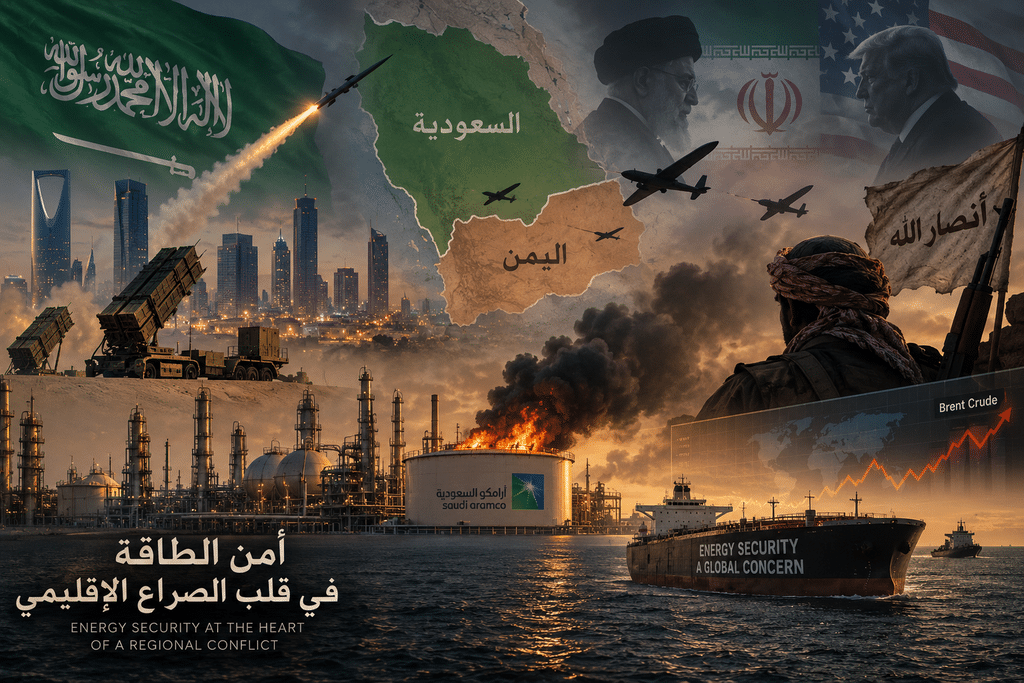
The escalation between Yemen and Saudi Arabia is no longer simply an extension of the long-running border confrontations. Rapid developments across the region, and the accompanying tensions between Iran and the United States, place this conflict before more complicated possibilities—especially if attacks move beyond the border zone to target critical infrastructure, airports, and energy routes. In that case, the consequences will not be confined to Riyadh and Sanaa; they will ripple through oil markets, international trade, and regional and global power calculations.
The danger of this phase lies in the convergence of several conflict trajectories at once. Saudi Arabia seeks to protect its internal security and economic interests, while the Houthis aim to increase pressure and raise the cost of any Saudi action or potential involvement in a wider regional confrontation. In this environment, each strike on a vital facility or civilian service becomes a test of the parties’ ability to control escalation and a measure of how much the region can endure before the confrontation turns into a crisis that extends beyond the immediate actors.
From Border Attrition to Threats Deep Inside Saudi Arabia
If confirmed and widespread, attacks on airports and critical infrastructure would mark a significant shift in the confrontation’s character. Strikes confined to border areas can be relatively contained within established rules of engagement; strikes on strategic sites deep inside Saudi territory confront Saudi leadership with a different equation—protecting civilians, infrastructure, and the economy, while preserving the image of a state capable of securing its land.
The importance of such attacks goes beyond immediate physical damage; it includes psychological and economic effects. Disrupting airports or sowing doubts about the safety of oil facilities can affect travel, investment, and insurance markets—even when actual damage is limited. In modern conflicts, a persistent threat can impose tangible costs without the need for large-scale destruction each time.
Still, we must distinguish between specific attacks and circulating claims about extensive damage or long-term shutdowns. Strategic assessment cannot rely on unconfirmed reports; it must be based on verified losses, the duration of any disruption, and the targeted state’s capacity to resume operations. This distinction is crucial to understanding events beyond media exaggeration or downplaying the danger.
Houthi Calculations and the Deterrence Equation
Broadening the scope of targets may be part of a strategy to shift the burden of the conflict onto Saudi soil and signal to Riyadh that continued military pressure will have consequences for its security and economy. In this sense, the strikes are not simply military operations; they are a way to influence Saudi political decisions and raise the cost of any direct or indirect involvement in a wider confrontation with Iran.
But the success of this strategy is not guaranteed. Military pressure might push the targeted party toward a settlement, yet it could also provoke the opposite reaction if Saudi leadership concludes that continued attacks undermine state prestige or its ability to protect vital interests. In that case, a broader military response—or an expansion of operations—cannot be ruled out.
The dilemma is that a limited response may fail to achieve deterrence, while a broad response could open the door to a more dangerous escalation. Between these options, Riyadh will try to balance protecting its security and avoiding being drawn into a protracted war that drains resources and disrupts its economic and development priorities.
The Houthis’ ability to sustain attacks, and the clarity of information about their sources of support and arms, will also shape Saudi calculations. The longer the threat persists and resists containment, the lower the chances of returning quickly to previous rules of engagement.
Iran and the United States: the Local Conflict in a Broader Regional Context
The Yemen–Saudi escalation cannot be read in isolation from the wider tensions involving Iran and the United States. The Houthis’ position in this equation gives any confrontation with them consequences beyond Yemen’s borders, though it does not necessarily mean that every Houthi action is a direct Iranian order or that Tehran controls every detail.
Nonetheless, the coincidence of this escalation with broader regional confrontations opens the possibility of using the Yemeni arena within a wider struggle over influence and deterrence. Some parties may see pressure on Saudi Arabia as a means to affect its stances or to deter it from supporting operations against Iran. Conversely, Riyadh may view continued attacks as a threat transcending national security, prompting broader coordination with regional and international partners.
Washington faces conflicting calculations as well. On one hand, it has an interest in protecting international navigation, critical facilities, and the stability of energy markets. On the other, direct military involvement in an open confrontation could widen the war and give other actors incentives to target U.S. interests or its allies.
For this reason, talk of a broader American intervention should remain within the realm of possibilities unless a clear operational decision is announced. Political statements, however forceful, are not the same as an operational decision; the nature of any possible intervention will depend on the scale of attacks, the losses incurred, allies’ positions, and Washington’s assessment of the costs and benefits of escalation.
Oil at the Heart of the Confrontation
Saudi oil facilities are more than national economic assets. As a major player in the global energy market, any significant disruption in Saudi production or exports would have effects far beyond the region. Targeting an oil facility is therefore measured not only by physical damage but also by its effect on market expectations and the confidence of shipping, insurance companies, and buyers.
Sensitivity increases when processing, aggregation, or export facilities are hit, since disruption at a strategic node can affect flows even if the producing fields remain operational. At the same time, a fire or limited attack does not necessarily mean long-term shutdown or a large loss of Saudi output. The real impact depends on damage extent, repair speed, availability of operational alternatives, and the kingdom’s ability to reroute supplies.
Estimates that production will be halted for months or that huge quantities of oil are lost require clear evidence and should not be treated as fact simply because they are widely circulated. Markets respond to expectations as much as to realities: prices may rise from fear of shortages before any real shortfall occurs, but they may fall if damages prove limited and exports continue.
Alternative export routes are also crucial in determining how severe the crisis might become. The more Saudi Arabia can shift some exports to routes not exposed to the threatened corridors, the less likely attacks are to cause wide supply interruptions. But if damage to oil facilities coincides with disruptions to transport lines, ports, and sea lanes, the market’s ability to absorb the shock will be much weaker.
The Red Sea and the Strait of Hormuz: a Danger Beyond the Confrontation’s Borders
The Red Sea and the Strait of Hormuz are both vital for global trade and energy flows, but each has different geographic and security characteristics. A threat to navigation in one does not automatically mean the other will close, and a declaration by a party that it is imposing a blockade is not, by itself, proof that a sea lane is effectively shut.
The real danger lies in the shift from statements and limited operations to actual disruption of ship movements—whether through direct attacks, a rise in security risks and insurance costs, or shippers’ reluctance to use certain routes. The result can be higher transport costs and delays, even without any official closure of a passage.
If navigation in the Red Sea and the Strait of Hormuz were simultaneously disrupted, the crisis would take on a much graver dimension. It would affect not only oil but also gas, petrochemicals, essential goods, and supply chains. Importing economies would face rising prices and budget pressures, while exporting countries would struggle to deliver their output to markets.
This scenario is not a foregone conclusion, but it remains one of the most dangerous possibilities and should be closely monitored given the potential shock to energy markets and global trade.
Is the Region Heading Toward a Wider War?
The region faces three main pathways, whose likelihood depends on the nature of military responses, the scale of damage, and the ability of the parties to keep the confrontation within controllable limits.
The first path is containment: limited responses combined with political and security back-channel communications that allow each side to show it can respond without triggering open war. This option remains possible if attacks do not cause major losses and if communication channels can prevent miscalculation.
The second path is prolonged mutual attrition. In this scenario, attacks and military responses continue at varying intensities without a decisive outcome or final settlement. This may seem less severe than all-out war but imposes cumulative security and economic costs on Saudi Arabia and increases energy market sensitivity to any new development.
The third path is expansion of the confrontation to include regional and international actors directly, coinciding with substantial disruption to oil facilities or export routes. This is the most dangerous scenario because it could combine military escalation with economic shock, making the crisis much harder to contain.
Determining which path is most likely requires more than reading statements or media coverage. Key indicators include the nature of Saudi responses, whether attacks increase in frequency, verified damage to critical facilities, continuity of exports, impacts on shipping, and any clear shift in U.S. or Iranian engagement.
Potential Repercussions for Arab Economies and Libya
The effects of escalation will vary across Arab economies depending on each country’s role in the energy market, dependence on imports, and capacity to absorb higher transport and insurance costs. Oil exporters might gain from higher prices in the short term, but those gains are not assured if exports are disrupted or shipping costs surge. Energy importers could face added pressure on budgets and higher prices for goods, transport, and electricity.
For Libya, higher oil prices could increase revenues if production and exports remain at usual levels. But benefiting from that increase is not automatic: it depends on steady exports, prudent public spending, and the financial sector’s ability to prevent uncontrolled expansion of expenditures.
A global rise in energy prices does not necessarily translate into balanced domestic economic improvement. Disruptions in international trade and higher transport and insurance costs may raise the cost of imports, while oil windfalls can be dissipated by persistent fiscal imbalances, falling production, or unchecked spending.
For Libya, current developments underscore the need to treat oil revenues as an opportunity to strengthen financial stability rather than a reason to postpone reforms. Global markets may provide producer countries with additional resources, but they do not replace sound economic management and institutions that can translate revenues into tangible benefits for citizens.
What to Watch in the Coming Phase
The decisive indicator in the coming days will not simply be the number of attacks or the intensity of rhetoric, but whether the confrontation begins to measurably affect Saudi Arabia’s production and exports or the safety of maritime navigation. The character of Saudi responses will be especially important, since any shift from limited deterrence to a wide military campaign could alter other actors’ calculations and invite further interventions.
It will also be necessary to distinguish between declared threats and actual constraints on ship and aircraft movements, and between temporary damage and long-term shutdowns of facilities. Treating every report as proof of imminent collapse can lead to misjudgments, just as downplaying the effect of repeated attacks can obscure accumulating risks.
General Assessment
The danger of the Yemen–Saudi escalation lies not only in the exchange of strikes but in its coincidence with a highly tense regional environment where Iran’s and the United States’ calculations intersect with Gulf security and the future of international navigation. If attacks remain limited and do not sustainably affect oil production or exports, the parties may be able to contain the confrontation despite ongoing security and political risks.
However, if escalation moves to repeated targeting of critical facilities and coincides with real disruptions to energy export routes and sea lanes, the crisis could transform from a regional confrontation into an international shock hitting oil markets, trade, and economic growth.
In short, the region still stands at a crossroads: either the cost of escalation will push parties toward a settlement that prevents a wider war, or the logic of reciprocal strikes will broaden the confrontation. In either case, energy will remain a primary field of impact—not only because of its economic importance, but because the stability of its supplies is directly linked to regional security and political-military balances.