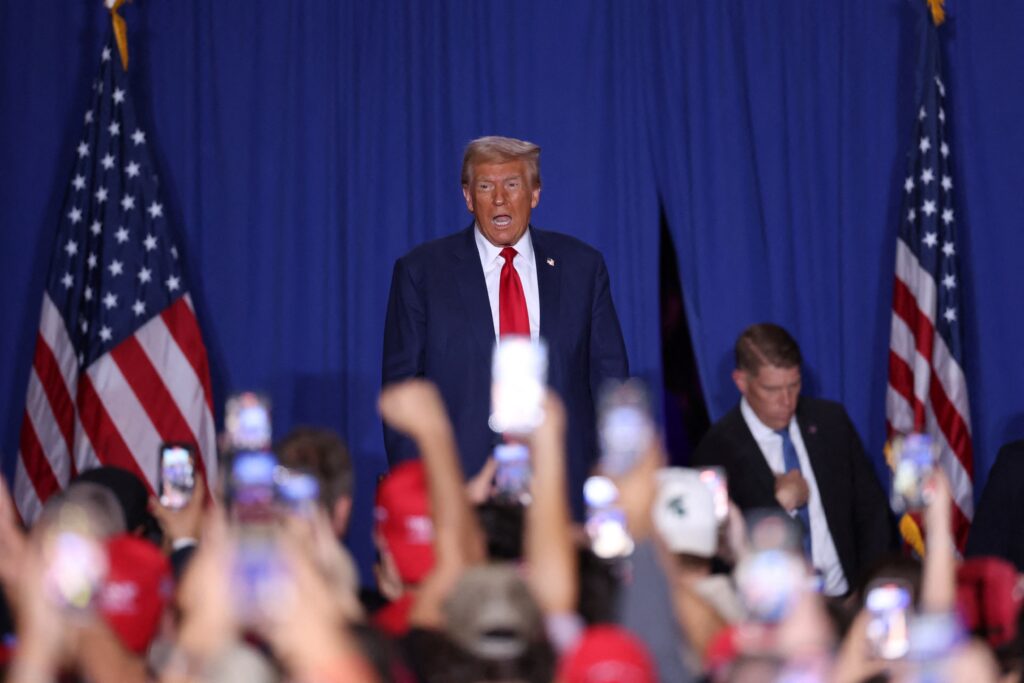














On October 11, Donald Trump took the stage in Aurora, Colorado, delivering an impassioned 80-minute speech that painted a dystopian vision of the United States, claiming it was “occupied” by waves of violent criminal migrants. The former president’s rhetoric, centered on escalating fears of an immigrant crime wave, served as the backbone of his campaign’s closing message as the US presidential race neared its final stretch. With his Democratic opponent Kamala Harris pledging to work toward a bipartisan future, Trump has leaned heavily on incendiary rhetoric, hoping to galvanize his largely white, working-class base through exaggerated narratives of immigration and crime.
Despite a close race that remains too tight to call, Trump’s strategy has been a stark departure from any conciliatory or unifying messaging, opting instead to drive a wedge between voters by depicting immigrants as a force of destruction. At the rally, Trump declared that November 5, 2024, would be “Liberation Day in America,” a promise he made as he ramped up false narratives about immigration and public safety.
In Aurora, Trump’s speech revolved around the idea that the country is under siege, claiming that the United States has become “Occupied America.” He suggested that criminal migrants are flooding into the country to rape and murder American citizens, painting an apocalyptic picture of lawlessness and chaos. “We’re being occupied by a criminal force,” Trump asserted, though no evidence supports such a claim. He continued his appeal to fear by pledging to his supporters that he would rid the country of what he called “foreign criminal elements,” a promise intertwined with nationalist themes that have become characteristic of his rhetoric.
While the US has faced challenges in managing its southern border, Trump’s hyperbolic claims go far beyond the reality of the situation. Migrant encounters at the southern border, after peaking in December 2023, have stabilized to levels seen in the final year of Trump’s own presidency. Yet, Trump continues to push the narrative of an “invasion,” using racially charged language to provoke anxiety among his supporters.
Trump’s attacks were not limited to immigrants. He also lashed out at Kamala Harris, accusing her of being complicit in the supposed criminal activity of migrants. Calling Harris a “criminal,” Trump falsely claimed that gangs in Colorado had been given permission to shoot police officers. These statements not only lack any basis in reality but also demonstrate Trump’s willingness to sow fear for political gain.
One of the more chilling moments of Trump’s speech was his proposal of a new deportation drive he dubbed “Operation Aurora.” He referenced the Alien Enemies Act of 1798, which allows the federal government to detain and deport foreigners from enemy nations, suggesting that he would use this outdated law to deport migrants en masse. Such inflammatory statements play into the fears of a significant portion of his base, even though statistics show that migrants commit fewer crimes proportionally than the native-born population.
Trump’s claims were immediately met with backlash from local leaders. ProgressNow Colorado, a left-leaning advocacy group, condemned Trump’s speech, calling his remarks “racist lies about Aurora.” Aurora’s police department also refuted Trump’s statements, noting that there had been only isolated incidents involving Venezuelan gangs, far from the sweeping criminal conspiracy Trump implied. Even the city’s Republican mayor, Mike Coffman, criticized Trump’s remarks, describing them as “grossly exaggerated.”
Trump’s misleading rhetoric has not been confined to Aurora. He has pushed similarly baseless stories in other states, including a false claim that Haitian migrants in Springfield, Ohio, are eating residents’ pets. Such sensationalist claims seem designed to stoke fear and anger in communities already grappling with economic hardships and shifting demographics.
In stark contrast to Trump’s divisive tone, Kamala Harris has framed her campaign around themes of unity and bipartisanship. While Trump uses fear of the “other” to galvanize his base, Harris has called for collaboration and cooperation. Campaigning in Scottsdale, Arizona, Harris emphasized the importance of working across party lines to find common ground, pledging to include a Republican in her cabinet and to establish a bipartisan council of advisors.
Harris also acknowledged the political and social divisions that have deepened in recent years, but she sought to reassure Americans that “we have more in common than what separates us.” Her message, while optimistic, faces an uphill battle against the pervasive fear and division that Trump has nurtured over his years in public life.
Polls show a neck-and-neck race, with the latest Wall Street Journal poll indicating that Harris holds slim leads in four of the seven key swing states. However, all of these contests remain within the margin of error, meaning that both candidates have everything to fight for in the final weeks leading up to the election.
Trump’s focus on immigration, despite the lack of an actual “crime wave” linked to migrants, highlights his determination to weaponize the issue for political gain. While violent crime spiked during Trump’s presidency, it has steadily declined each year under President Joe Biden. Nevertheless, Trump continues to blame migrants for America’s woes, despite ample evidence to the contrary.
It is a strategy that worked for him in 2016, and one he is doubling down on as the 2024 election approaches. By falsely portraying immigrants as a threat to public safety, Trump hopes to energize his supporters and tip the scales in his favor. Yet, as Aurora’s local leaders have made clear, Trump’s claims are not only divisive but also dangerous, fueling racial tensions in an already polarized nation.
With less than four weeks to go until the election, the battle between Trump’s politics of fear and Harris’ message of unity will intensify. The outcome will hinge not only on who can persuade the swing voters in key battleground states but also on the broader narrative that defines this election: fear of the “other” versus hope for a united future.
For now, Trump’s campaign strategy appears to rest on the former, and his apocalyptic warnings about an “occupied” America will likely only grow louder as November 5 approaches.
The post Trump’s apocalyptic immigration rhetoric escalates as election looms appeared first on BLiTZ.