











Mon, 01/15/2024 – 14:09

UK Home Secretary James Cleverly has said the British government will seek to ban the Islamic political organisation Hizb ut-Tahrir following claims the group is antisemitic.
Cleverly laid a draft order before parliament on Monday to proscribe the group under the Terrorism Act 2000.
If agreed by parliament, the draft order will come into force on Friday.
It means belonging to, inviting support for and displaying articles in a public place in a way that arouses suspicion of membership or support for the group will be a criminal offence.
“Hizb ut-Tahrir is an antisemitic organisation that actively promotes and encourages terrorism, including praising and celebrating the appalling 7 October attacks,” Cleverly said, according to a statement published on the UK government website.
“Proscribing this terrorist group will ensure that anyone who belongs to and invites supports for them will face consequences. It will curb Hizb ut-Tahrir’s ability to operate as it currently does.”
The proscription of Hizb ut-Tahrir includes the global organisation, as well as all regional branches, including Hizb ut-Tahrir Britain.
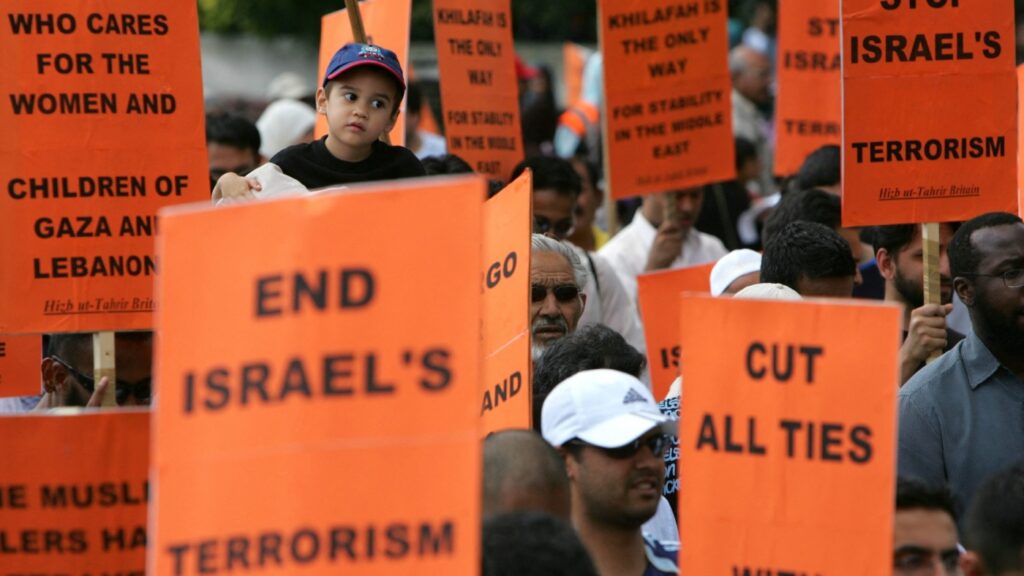
The draft order comes amid criticism of the group following demonstrations held in London against Israel’s war on Gaza.
The group – whose name means “The Islamic Liberation Party” – was established in Jerusalem in 1953 and uses non-violent means to achieve its goal of a Caliphate in Muslim lands.
“The Hizb works to create a public opinion in the Muslim countries in favour of the Islamic political system, the Khilafah [Caliphate], through emulating the example of Prophet Muhammad,” the group says on its website.
“This involves presenting the Islamic solutions to address contemporary problems, political activism and ultimately working for political change in the Muslim countries in a non-violent way.”
Hizb ut-Tahrir, also known as HT, is banned in Middle Eastern countries such as Saudi Arabia, but is active in dozens of others including Kuwait, Tunisia, Lebanon, India, Kenya, Australia and the United States.