












Reading in English | Read in العربية (Arabic)
Today, Ambulance Victoria celebrates an extraordinary 55 years of the Mobile Intensive Care Ambulance (MICA) service and its legacy of clinical excellence, innovation and compassionate care that has transformed paramedicine and helped save countless lives.
For more than half a century, Ambulance Victoria’s MICA service has been there for Victorians at their most critical moments – delivering world-class intensive care when and where it’s needed most.
It’s a legacy that continues today, with MICA remaining at the forefront of pre-hospital critical care and continuing to advance what is possible for patients before they reach hospital.
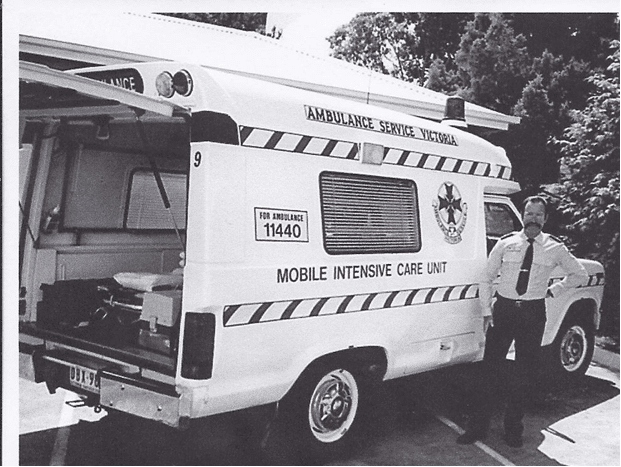
Ambulance Victoria was the first in Australia and third anywhere in the world to establish a MICA service, with a converted Dodge vehicle hitting the road on 9 September 1971.
The pioneering model brought hospital-level intensive care directly to patients at the scene for the first time, revolutionising the pre-hospital treatment and care available to Victorians.
It paved the way for today’s MICA paramedics, who provide highly skilled treatments to save lives and improve patient outcomes across the state, including care that was once only possible inside a hospital.
From one pioneering unit in 1971, MICA has grown to a statewide service of approximately 600 highly trained paramedics today.
Ambulance Victoria CEO Jordan Emery said the 55-year milestone was an opportunity to celebrate both the extraordinary history of MICA and the people who have built its reputation for excellence.
“Few services have had such a profound and lasting impact on paramedicine in Victoria, Australia and internationally, and that is something of which every member of the MICA community should be incredibly proud,” he said.
“For 55 years, our MICA paramedics have been there for Victorians on some of the most difficult days of their lives, bringing exceptional skill, calmness and compassion to patients and families when they need it most.
“I’m enormously proud of our MICA road and MICA flight paramedics and the world-class care they provide every day, but this anniversary is also about recognising those who came before them.
“From the people who pioneered MICA in 1971 to every clinician, educator and team member who has strengthened the service since, generations of people have contributed to the MICA service Victorians know and rely on today.”
Ambulance Victoria MICA paramedics’ skillsets include advanced treatments such as rapid sequence intubation, a highly skilled procedure where a critically injured or unwell patient is placed into medically induced unconsciousness so paramedics can support their airway.
Some of the most highly qualified MICA road and MICA flight paramedics can perform a finger thoracostomy – a life-saving procedure where a surgical incision is made in the side of a patient’s chest and a finger inserted to create an opening, allowing blood and air to be released from the space around the lungs.
MICA paramedics’ expertise also includes managing complex trauma injuries, administering intra-osseous (into bone) medications, treating life-threatening respiratory conditions and providing advanced management of cardiac conditions.
The advanced MICA training greatly increases paramedics’ capacity to make complex clinical decisions and provide exceptional clinical leadership in the pre-hospital environment.
MICA Team Manager Lisa Powell said Ambulance Victoria’s MICA paramedics share an unwavering commitment to achieving the best outcomes for their patients.
“It’s humbling to be part of a team of like-minded clinicians who are motivated, passionate and incredibly clever, and strive for the same purpose – best patient care.
“It’s an unwavering motivation that commenced 55 years ago and has never ceased.
“When we attend a complex scene and treat a critically unwell patient and we get that patient to hospital, it is incredibly satisfying. It gives me goosebumps just thinking about it.”
MICA Area Manager Andrew Burns said Victoria has an incredible MICA system.
“Our MICA paramedics work in extremely challenging environments, making complex decisions in high-pressure situations to achieve the best possible outcomes for their patients,” he said.
“They are an incredibly qualified, diligent and dedicated workforce. I’m very proud to call myself a MICA paramedic and lead a team of MICA clinicians.”
Dr Graeme Sloman and John Blosfelds were two of the people who pioneered MICA in Victoria, when it began as a three-month pilot with doctors and ambulance officers.
During that pilot in late 1971, the crew responded to 93 cases, mainly coronary care and road trauma patients.
Before long, the MICA unit was responding without doctors on board and, within a few years, was attending 250 cases a month.
Three other MICA units were soon established at Frankston Hospital, the Alfred Hospital and the Western General Hospital.
While the equipment, treatments and clinical capabilities have evolved enormously over those 55 years, the purpose at the heart of MICA has remained the same – giving critically ill and injured Victorians the best possible chance.