











Reading in English | Read in العربية (Arabic)
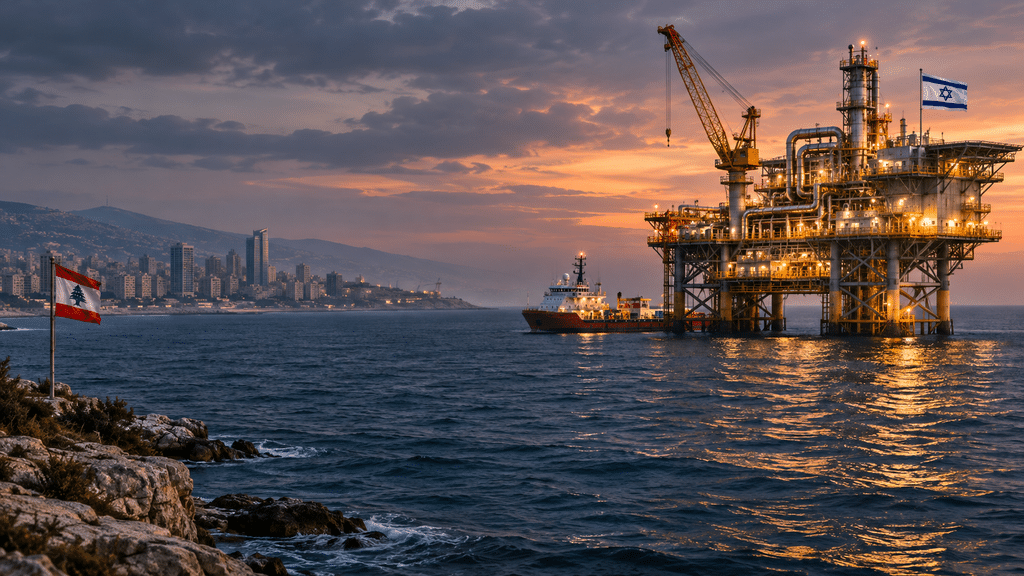
The war waged by Israel in Lebanon, Gaza and the West Bank — and tensions extending to Iran — has not deterred efforts to explore new oil and natural gas resources beneath the exclusive economic zone in the eastern Mediterranean. Natural gas remains a strategic resource for the region.
In this context, U.S. company Murphy Oil secured six licenses to explore for oil and gas in Block “G” off the Israeli coast, covering roughly 1,700 square kilometers. This marks Murphy’s first entry into the East Mediterranean and is a notable development in offshore exploration off Israel.
Separately, Murphy Oil has also expanded its exploration activities by contracting with Mauritania’s Ministry of Energy and Petroleum on a production-sharing agreement for Block C-10 and the Tiof Field in Mauritania’s Atlantic coastal basin, offshore the capital Nouakchott.
The area covered by Murphy’s new Israeli licenses lies about 25 kilometers southwest of the Leviathan field—one of the largest gas fields in the eastern Mediterranean and a key pillar of Israel’s gas exports and supplies to domestic and neighboring markets, notably Egypt and Jordan.
Under the agreement, Murphy Oil will hold a 50% stake, while the remaining 50% will go to Israeli Ratio Energies. The two companies will carry out further studies and assessments to determine the area’s potential ahead of any exploration. A Murphy subsidiary will operate the new licenses. Ratio Energies’ 15% stake in the Leviathan field adds particular significance to its involvement in these blocks.
The awarding of these licenses comes as Israel works to meet its commitments to Egypt. Gas export deals between the two countries are a central element of their economic and strategic cooperation. Under an agreement renewed in December 2025, Israel committed to supply roughly 130 billion cubic meters (bcm) of natural gas to Egypt through 2040, or until the agreed quantities are delivered—about double the amount specified in the original 2019 agreement.
Most of this gas is expected to come from the Leviathan offshore field in the eastern Mediterranean, which is central to plans to increase Israeli gas exports to Egypt through new investments aimed at boosting production capacity and providing additional supplies for importing markets.
Earlier this year, Leviathan’s license holders decided to increase investments in the field by approximately $2.36 billion to raise its annual production capacity. The expansion is expected to begin producing in 2029 and reach about 21 bcm per year, enabling the field to meet domestic demand and export obligations.
For its part, Egypt seeks through these arrangements to close the gap between its natural gas production and rising domestic consumption—production that has recently declined—and to ensure the continued operation of its liquefaction plants while reinforcing Egypt’s role as a regional energy trading and liquefaction hub.
There is also talk of another deal to export about 80 bcm of Israeli gas to Egypt from the Tamar field, valued at up to $20 billion, covering 2031–2038. This is described in a memorandum of understanding signed by Isramco—holding a 28.75% stake in Tamar—and Mubadala Energy, which holds an 11% stake in the field.
Israeli gas export agreements with Egypt provide flexibility in handling contracted volumes, including reselling gas outside the domestic market and directing it to the Idku and Damietta liquefaction plants for re-export to global markets, particularly Europe. This enhances Egypt’s status as a regional center for gas trade and liquefaction, leveraging its existing infrastructure.
Ramping up Israeli gas exports to Egypt requires expanding infrastructure, chiefly by increasing pipeline capacity—such as the Nitzana line, the Arab Gas Pipeline through Jordan, and the recently commissioned offshore pipeline between Ashdod and Ashkelon, which entered service to boost export capacity to Egypt.
By contrast, Lebanon remains in an exploratory phase and has yet to make a commercial discovery that would allow a transition to production. Drilling in Blocks 4 and 9 did not yield commercial finds. The agreement Lebanon signed in January 2026 with a consortium of TotalEnergies, Eni and QatarEnergy to explore Block 8 includes an initial three-year 3D seismic survey program to evaluate the block’s potential.
The comparison highlights differing sector progress and priorities: Israel treats gas as an established resource for meeting domestic demand, expanding exports, and strengthening regional economic ties—as reflected in the Leviathan expansion linked to increased supplies to Egypt. Lebanon still faces the task of proving commercially viable resources before discussing revenues or earmarking potential gains to address financial and economic crises.
That said, Lebanon bears responsibility for ensuring continuity of operations, accelerating procedures, and improving transparency and regulatory stability to attract investment. What is needed is a realistic approach that moves the issue from promises of unproven wealth to a systematic exploration program that ties any future discoveries to a clear plan for serving the economy and energy security.
The region’s expanded gas exploration demonstrates a continuing bet on natural gas as both an economic asset and a tool for strengthening regional relations, despite the wars and instability affecting the area. Converting licenses, investments and agreements into reliable and sustained supplies, however, depends on successful exploration and expansion, the readiness of infrastructure, and the ability to secure production facilities and export routes amid growing security risks.