












Reading in English | Read in العربية (Arabic)
“Forcing Palestinians to flee does not only mean losing shelter; it is uprooting roots and erasing memory and identity. A home is no longer just a dwelling but the last witness to a life being buried under the rubble. When displacement becomes repeated and imposed amid the lack of basic conditions to survive and live in tents, the tragedy goes beyond humanitarian suffering and reveals the core aim of this course: using the deprivation of everyday life as a political tool to empty the land and make forced migration seem inevitable.”
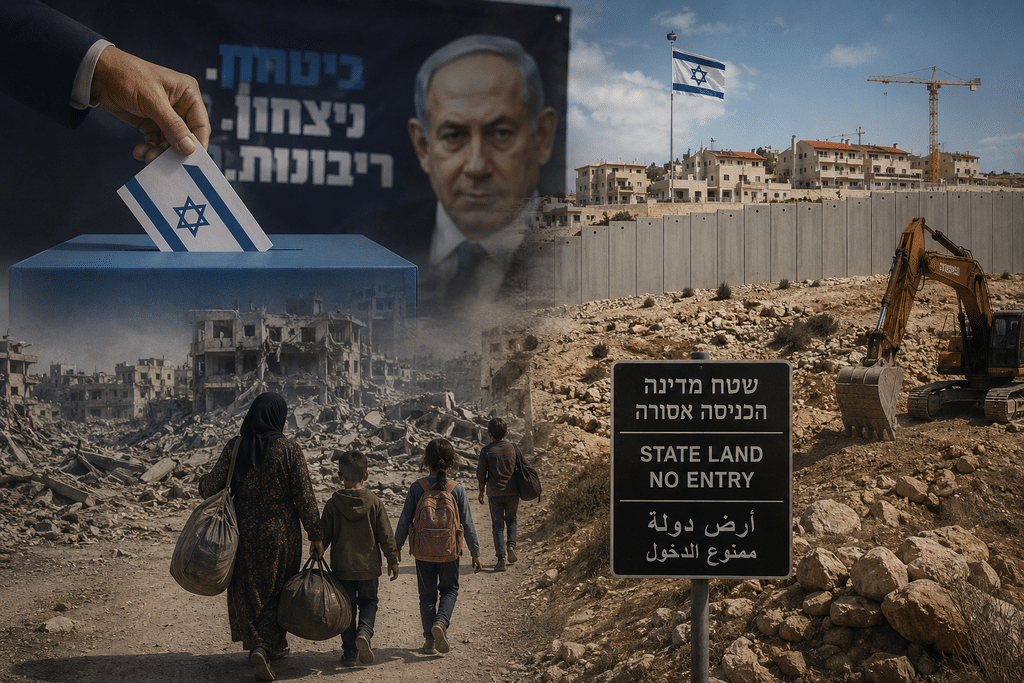
The pace of Israeli practices and military escalation in the Palestinian territories has intensified, and these actions are exploited as winning cards during election seasons to gather votes and appease the right-wing public with fiery rhetoric. Yet this escalation is not tied solely to whether elections are taking place; it reflects a steady political and security trajectory that continues regardless of the next government’s shape or its leader’s identity. What is happening in Gaza and the West Bank fits into a comprehensive strategy aimed at redrawing demographic and security maps.
Gaza: continuous displacement and the dismantling of communities
Despite ceasefire agreements, displacement remains a constant source of fear and anxiety for Gaza’s residents and a continual pattern visible in daily behavior on the ground. This indicates there is no genuine desire to resolve the humanitarian crisis; rather, the tragedy and daily pressure on living conditions are being used as a political tool to dismantle Palestinian society.
In this context, proposals to re-engineer Gaza’s geography and reorganize its areas have been put forward. Some plans are being designed to isolate population centers and construct new towns and residential zones that reallocate people into separated areas and make parts of the Strip less interconnected. This geographical partitioning, together with a systematic obstruction of reconstruction and a denial of basic services, does not just fracture social fabric; it seeks to create a repelling reality that robs residents of hope for returning to normal life. Waiting then becomes a pressure mechanism that gradually pushes toward “voluntary migration” — in reality, a coerced exodus disguised by unbearable living conditions.
West Bank: settlement expansion and gradual depopulation
In the West Bank, displacement follows a different pattern of “direct and indirect emptying.” Repeated announcements of settlement expansion and the legalization of outposts go hand in hand with financial restrictions, home demolitions, and daily settler attacks. These measures create an environment hostile to life, forcing families into an unpleasant choice: either endure impossible conditions or gradually relocate. This dynamic serves the objective of changing the demographic map without the need for overt mass evacuation orders.
In this context, Israel’s finance minister Bezalel Smotrich said today that his government “has the honor of correcting the mistakes of displacement in northern West Bank,” adding that it will “soon correct the mistakes of displacement in the Gaza Strip as well.”
Renouncing regional understandings and its impact on regional security
This political course extends beyond the Palestinian borders and affects the entire regional environment. Renouncing understandings and agreements in Gaza, Lebanon, and Syria, and disregarding the announced pressures or preferences of the U.S. administration, indicate that strategic calculations about demographic and security change take precedence over any temporary political arrangements. The continuation of assassinations and escalations without yielding to international political pressure shows these policies are not tactical maneuvers but a sustained trajectory aimed at reshaping the region’s security and demographic equation, with deep long-term implications for regional stability.
Between electoral exploitation and a fixed strategy
The severe pressure on Palestinians’ everyday lives — from food and medicine shortages to restrictions on movement — is clearly used in electoral debates to demonstrate decisive strength to the Israeli public. But reducing this behavior to mere “electoral propaganda” is an incomplete reading; elections are only a temporary cover for a long-term plan designed to impose a new reality that will make it harder to implement fair political solutions in the future.
Ultimately, while these policies may be emphasized during election seasons and the rhetoric may rise, what is happening in Gaza and the West Bank goes beyond elections. The ongoing war in Gaza, settlement expansion, and gradual displacement in the West Bank continue within a changing reality on the ground day by day.
Therefore, the real challenge is not only to halt an escalation or survive an election season, but to prevent this reality from becoming permanent — a remaking of land and population that will be difficult to reverse.