












Reading in English | Read in العربية (Arabic)
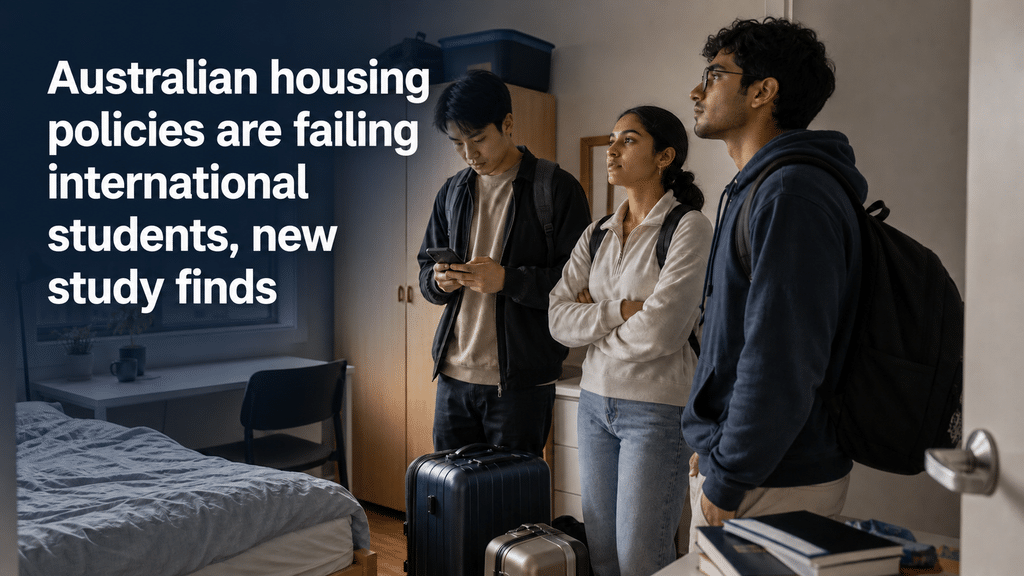
Researchers say layers of government regulation create an appearance of action while leaving many students exposed to unaffordable rents, unsafe housing and exploitation.
Australia’s international students are being left to navigate an increasingly unaffordable and insecure housing market despite extensive government policies and regulation, according to new research from the University of Sydney.
The study, published in the peer-reviewed Australian Journal of Public Administration, concludes that international student housing remains an area of effective “policy inaction”.
Researchers Gaby Ramia, Rishi Gujarathi and Pranita Shrestha examined strategies, laws and regulatory instruments across the federal government, New South Wales Government and City of Sydney.
They found that although governments frequently acknowledge housing as essential to student wellbeing, existing measures generally stop at providing information, expressing policy intentions or facilitating private development. They do not require governments or education providers to ensure international students can access safe and affordable accommodation.
The researchers argue this creates a gap between the language of government policy and its practical effects.
“Current policy and regulatory instruments within the three levels of government in Australia do not mandate the provision of affordable or safe accommodation for international students,” the paper states.
Students left to compete in a difficult market
International students make a major economic and social contribution to Australia, but most must find accommodation in the private rental market because the country has no subsidised student housing system.
That can expose students to high rents, housing shortages, discrimination and insecure or overcrowded living arrangements.
Purpose-built student accommodation has expanded, but the study says supply remains limited and is generally offered at market rates. Research cited in the paper estimates that Australia has only one purpose-built accommodation bed for every nine higher education students, falling to approximately one bed for every 11 students in NSW.
In Sydney, purpose-built studio apartments were reportedly renting for as much as $800 a week in 2023.
Students unable to afford these options may turn to informal share houses, subletting arrangements, boarding houses, hostels or rooms in private homes. The researchers warn that some of these arrangements fall outside standard tenancy protections or leave occupants without a formal agreement establishing their legal rights.
This can make it harder for students to challenge sudden rent increases, unlawful evictions or unsafe conditions.
Education rules provide information, not housing
At the federal level, the researchers examined the Education Services for Overseas Students framework and the Australian Strategy for International Education 2021–2030.
Education providers must give prospective international students information about accommodation options and indicative living costs. However, they are generally not required to help adult students secure housing.
Stronger accommodation protections apply in some circumstances to students under 18, but the paper notes that these measures concentrate largely on safety and regulatory compliance—not housing affordability or general access.
The national international education strategy also identifies accommodation as part of student wellbeing, yet does not impose enforceable obligations on governments or institutions to meet students’ housing needs.
The result, the researchers say, is a system that places greater emphasis on protecting Australia’s reputation as an education destination than on guaranteeing suitable living conditions for the students supporting the sector.
Responsibilities fragmented across governments
The study identifies fragmentation between different levels of government—and between housing and international education policy—as a central obstacle.
Federal authorities regulate international education, while state governments exercise much of the control over tenancy law and planning. Local councils influence development and respond to housing conditions within their communities.
In NSW, international students generally have the same rights as other tenants under the Residential Tenancies Act 2010. However, those protections do not extend equally to every form of accommodation students commonly use.
Planning instruments can facilitate purpose-built or co-living developments, but the researchers found few provisions specifically designed to ensure international student housing is affordable, accessible or safe.
The City of Sydney’s International Education Action Plan goes further than many other policies by recognising housing stress, supporting tenancy education and committing to reducing illegal accommodation. Nevertheless, the study says it lacks enforceable mechanisms to increase affordable housing supply or provide direct assistance to students experiencing housing insecurity.
The researchers characterise the overall result as governmental “buck-passing”, with responsibility ultimately devolved to students and private housing providers.
Nationally coordinated action recommended
The paper calls for Australia to replace rhetorical commitments with a coordinated national framework connecting housing, international education and social policy.
Such a framework could establish enforceable standards for affordability, accessibility and safety, supported by formal collaboration among governments, education providers and other stakeholders.
The researchers also recommend systematic collection of data on student housing costs, availability, quality and wellbeing outcomes. Better evidence could support measures including affordability incentives for purpose-built accommodation, stronger oversight of informal rental arrangements and expanded legal protections for students in non-standard housing.
The authors acknowledge that their documentary study focuses on NSW and the City of Sydney and examines the content of publicly available policies rather than how they are implemented in individual cases. Other states and local government areas may have different approaches.
Even with those limitations, the central message is stark: Australia has built a highly regulated international education industry without establishing an equally effective system to house the students on whom that industry depends.
The full open-access study, titled Is limited regulation supporting policy inaction? International student housing in Australia, was first published online on 7 August 2026.