












Reading in English | Read in العربية (Arabic)
There is a common misunderstanding of Islam that reduces belief in the Hereafter to an idea that, at first glance, seems comforting to the oppressed but ultimately diminishes the faith itself. According to this view, it is enough to tell the downtrodden to be patient and wait for heaven’s justice; whatever happens in this world of tyranny, humiliation, and dispossession is merely a delayed test to be judged on the Day of Reckoning. As if belief in the Hereafter gives the oppressor more time and gives the oppressed a dose of patience, then asks them to withdraw from the struggle of life.
But the Islam revealed by its foundational texts and shown in its historical practice says something entirely different.
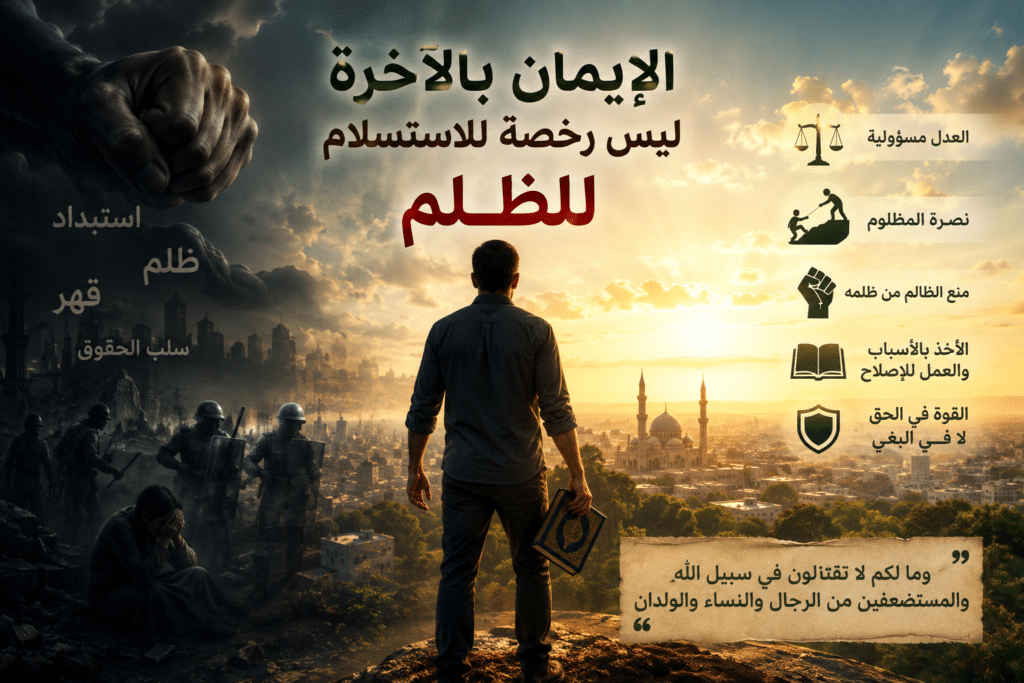
Belief in the Hereafter is not a call to surrender to injustice, nor a spiritual narcotic for the oppressed, nor a substitute for justice in this world. It is part of an ethical system that makes a person responsible for his stance toward injustice: required to do what he can to remove it, to help the oppressed, to prevent the oppressor from committing injustice, to work for the reform of the land and its people, and then to believe that what humans failed to achieve of justice will not be lost with God.
Here lies the paradox often overlooked by contemporary discourse. Belief in the afterlife does not negate a person’s responsibility in this world; it gives it a deeper meaning. You do not resist injustice because you think this world is everything and therefore must cling to it; nor do you abandon people’s rights because there is an afterlife. Rather, you work in this world because you believe you will be asked about what you did and what you left undone, about what you were able to change and what you chose to keep silent about.
So the correct question is not whether belief in the Hereafter makes a person more ready to submit to injustice, but whether we ourselves understand the meaning of belief in the Hereafter as Islam truly intended it.
God, exalted be He, did not tell the believers that the existence of the final account absolves them of the duty to resist injustice in this world. He addressed them in the Qur’an with language of direct responsibility toward the weak, saying:
“Why do you not fight in the cause of Allah and for the oppressed among men, women and children who say, ‘Our Lord, take us out of this town whose people are oppressors, and appoint for us from Yourself a protector, and appoint for us from Yourself a helper?’”
This single verse is enough to rethink the conception that renders religion merely a spiritual refuge for the oppressed to endure their suffering. The Qur’an does not simply tell the weak to be patient and wait for the afterlife; it directs the community with a harder question: why do you not move to help the oppressed? This is a tremendous shift from mere sympathy for the victim to taking responsibility for their support, from feeling the tragedy to seeking a way to end it.
The Qur’an does not present justice as merely an individual virtue, but as the foundation of social life. God says:
“Indeed, Allah commands justice and good conduct and giving to relatives, and forbids immorality, wrongdoing and oppression.”
He also says:
“O you who have believed, be persistently standing firm in justice, witnesses for Allah, even if it be against yourselves or your parents and relatives.”
And He says:
“Let not the hatred of a people prevent you from being just. Be just; that is nearer to righteousness.”
Justice in the Qur’an is not an ethical luxury or an inner feeling one keeps to oneself; it is a responsibility that must be established in society even when doing so means confronting the powerful, even when a person must bear witness to the truth against himself or his closest relatives. Hence belief in the Hereafter does not cancel a person’s responsibility in this world; it multiplies it, because one who believes he will be held accountable for what he did and left undone, and for the injustice he committed or witnessed and kept silent about, realizes that his stance toward tyranny is not a trivial personal matter.
The Prophet Muhammad, peace be upon him, made this responsibility very clear when he said: “Help your brother, whether he is an oppressor or oppressed.”
When the Companions asked how one could help him if he was an oppressor, he replied: “Hold him back or prevent him from wrongdoing, for that is helping him.”
The meaning here is unmistakable: supporting the oppressed is not the only form of moral responsibility; even the oppressor must be stopped from his injustice. Islam does not treat injustice as a problem only of the victim; it views it as a disease that infects the whole community. The oppressor needs someone to restrain him, the oppressed need someone to support them, and the community needs systems that prevent injustice before it becomes entrenched.
Thus the authentic hadith warns: “Beware the supplication of the oppressed, for there is no barrier between it and God.”
This hadith does not turn the oppressed into passive people who wait for divine revenge; rather, it places the oppressor before the reality that the power he wields in this world is not absolute, and that behind this life there is an account that neither authority, wealth, weaponry, nor influence can bar. This is the deep ethical function of belief in the Hereafter: it does not relieve a person of responsibility in this world, but prevents the oppressor from thinking that escaping earthly justice means escaping all justice.
In the Prophet’s tradition there is also the saying: “The best jihad is a word of justice in the presence of a tyrannical ruler.”
Thus speaking the truth before an unjust authority becomes a moral stance of religious value, which makes it impossible to reduce Islam to blind obedience to rulers. Islamic texts do not place the ruler above truth or justice; they place authority itself within the circle of responsibility and accountability, and make confronting oppression with just words one of the highest forms of moral courage.
The Qur’an goes further, saying: “And those who, when tyranny strikes them, they retaliate.”
Note the Qur’anic expression “they retaliate” or “they are victorious.” The Qur’an does not describe believers as surrendering to aggression, becoming habituated to injustice, or granting the oppressor legitimacy simply because they believe in the Hereafter. Rather, it affirms their right to prevail over aggression within a framework of justice and ethical constraints.
In another passage God says: “But if they (one party) transgress against the other, then fight those who transgress until they return to the command of Allah.”
The aim is not warfare for its own sake but to halt aggression and restore justice. This is an important principle because Islam does not sacralize power merely for being power, nor does it sanctify revolt merely for being a revolt. It situates force within an ethical context whose purpose is to end aggression, establish justice, and prevent the aggressor from continuing his wrongdoing.
Even the command “And prepare against them whatever you are able of power” reveals that Islam does not build its system on waiting for danger and then searching for remedies after calamity strikes; it calls for preparedness and taking the means. Strength here should not be reduced to weapons alone; it can include knowledge, education, organization, economic capacity, political and social ability, and institutions that protect society, prevent tyranny, and preserve independence and dignity.
Faith does not mean abandoning causes; reliance on God does not mean leaving action to chance; prayer does not mean relinquishing responsibility; belief in the Hereafter does not negate this world. Rather, Islam presents this life as the field of trial in which human responsibility is revealed before the Day of Reckoning.
Therefore the most dangerous reading of religion is the one that turns belief in predestination into an excuse for surrender, turns patience into acceptance of humiliation, and turns waiting for the afterlife into exempting the oppressor from confrontation. Islam does not tell the oppressed to be weak; it tells him to be just even toward those he dislikes. It does not tell him to accept injustice; it commands the community to remove it. It does not tell people to do nothing because God will punish the oppressor, but rather tells each person that he is also responsible for what he can do.
This idea is clear in the life of Imam Ali ibn Abi Talib, may God be pleased with him, who did not see governance as a personal privilege nor authority as booty. He considered rule a responsibility and the ruler a trustee for the people. One of his most famous instructions to Malik al-Ashtar reads:
“Let your heart feel mercy for the subjects, love them and be kind to them; do not be a predatory wild beast devouring their flesh. They are of two kinds: either your brother in religion or your equal in creation.”
This sentence encapsulates a profound political and ethical philosophy: the ruler is not the owner of people, people are not material for exploitation, authority is not a license to prey, and a person deserves justice because he is a human being before any other consideration.
In Imam Ali’s legacy there is also a deeply meaningful discourse about his responsibility in the face of injustice, poverty, and social fragmentation—a vision that made governance an ethical mandate rather than a personal privilege. Thus he is remembered in Islamic memory for the idea of justice and for the question of authority’s responsibility toward the weak and deprived, and for the limits of obedience when power becomes an instrument of oppression.
Then Imam Husayn ibn Ali, may God be pleased with him, offered one of the most influential experiences in Islamic consciousness about the relationship between religion and despotism. Husayn did not move to Karbala seeking a symbolic death or a desire to end his life; he moved within a political context in which the question of authority had ceased to be merely a dispute over the person of the ruler and had become about legitimacy, justice, and whether the caliphate had turned into a throne and power that no longer felt bound by the moral standards upon which the religion was founded.
That is why Karbala has remained present in the Islamic memory for centuries: it is not just a battle that ended in 61 AH, but a recurring moral question about a person’s stance when authority becomes stronger than he is. What should a person do when authority is capable of crushing him? Does one legitimize injustice by silence because one knows the oppressor will be held to account in the Hereafter? Or does one do what one can so that silence itself does not become part of the perpetuation of injustice?
Husayn chose the latter path. He knew the balance of power was not in his favor, yet he did not consider the imbalance a sufficient reason to abandon his moral stance. Here one of Karbala’s greatest messages is revealed: victory is not always measured by the number of armies, and defeat is not always measured by the number of dead. One may lose the military battle but win the moral and historical struggle; arms may triumph in a moment yet lose to human memory for centuries.
The same lesson appears in the experience of Zayd ibn Ali ibn Husayn, who rose against the Umayyad rule in Kufa in 122 AH and whose movement ended with his killing. Zayd’s name became associated in Islamic history with political activism and revolt against injustice, to the point that the Zaydi denomination took its name from him and made uprising against tyranny a prominent element of its political thought.
Then there is the experience of Muhammad ibn Abdullah, known as Muhammad al-Nafs al-Zakiyya, a descendant of Hasan ibn Ali, who led a movement against the Abbasid caliph al-Mansur in 145 AH that also ended in his death. These historical experiences should not be turned into ready-made prescriptions for violence in the modern era, nor should they be used to justify chaos or attacks on innocents. At the same time, they confirm that absolute surrender to authority was not the only model known in Islamic history.
There has always been a question about the limits of obedience, the responsibility of rulers, the right of people to resist oppression, and the duty of scholars and society to speak truth. Remembering these experiences does not mean calling to repeat them literally; it means reviving the moral question they carried: how can a person preserve his dignity and moral responsibility when authority becomes an instrument of tyranny?
Islam does not shape a person around the idea that this world is everything so that preserving one’s material life becomes the ultimate goal. Nor does it build a person on contempt for the world or on surrender to those who make his life a hell. Rather, it gives him a more complex balance. The world matters because it is the field of action; the human matters because God honored him; justice matters because God commanded it; dignity matters because oppression and aggression are forbidden; and the Hereafter matters because it gives these responsibilities their ultimate meaning and puts oppressor and oppressed alike before a scale that no one can buy or falsify.
Perhaps the real difference between the religious view and some materialist conceptions of life is less simple than quick debates suggest. Saying that a person who does not believe in the Hereafter will give greater value to life is not a necessary outcome, and belief in the Hereafter does not necessarily mean contempt for this worldly life. A believer can value human life in this world as part of divine honor and as an unending ethical responsibility. Belief in accountability gives an extra dimension to resisting injustice: the oppressor is not free to do as he pleases merely because he evaded the law, and the oppressed are not forgotten simply because earthly justice failed to reach them.
This is, in fact, one of the strongest ethical functions of the idea of the Hereafter: it prevents history from being the sole court, prevents force from being the criterion of truth, prevents the oppressor from believing that temporary success proves the rightness of his deeds, and gives the oppressed a meaning that transcends material defeat.
But all of this should not turn into a religious narcotic. Here lies the responsibility of religious discourse itself. If a religious leader tells the oppressed, “Be patient; God will take revenge for you on the Day of Judgment,” and then allows the oppressor to do as he pleases, he does not serve the spirit of Islam but offers a deficient version of it. When, however, he tells the oppressed to be patient in the sense of remaining steadfast, preserving one’s humanity, and not becoming a new oppressor, while at the same time instructing him to resist injustice as much as he can, to seek his rights, to speak truth, and to pursue reform, that is closer to the essence of the Islamic framework.
The Hereafter is not a waiting room, religion is not a shelter for the defeated, patience is not surrender, reliance is not helplessness, and fate is not an excuse to abandon action. In the Islamic view a person is commanded to act and then leave the results to God. That perhaps summarizes the proper relationship between faith and action: do what you can as if the responsibility to reform rests on you, and at the same time recognize that not all results are in your hands.
You may not be able to remove all injustice, but you can avoid being part of it. You may not save everyone, but you can save those within your capacity. You may not change the entire system, but you can speak a true word, and use knowledge, law, media, civil and political action, and social reform to confront what you can. Sometimes the greatest thing you can do is to prevent injustice from becoming normalized in people’s minds, because injustice often begins when silence becomes a habit, becomes more dangerous when it turns into a culture, and becomes entrenched when people begin to justify it.
Here the message of Islam confronts that danger. The Qur’an commands justice and forbids aggression; the Prophet commands the support of the oppressed and the prevention of the oppressor’s wrongdoing; the prophetic biography and Islamic history present multiple models of scholars, reformers, imams, and political figures who did not see belief in the Hereafter as a reason to distance themselves from people’s concerns or let injustice spread.
Islam does not tell a person that his task is to lie on the margins of history waiting for the Day of Judgment. It wants him to be a witness to his age, responsible for his society, and required to make his existence in this world have an impact. Belief in the Hereafter should not be a reason to accept injustice but a reason to refuse to let injustice be the last word in a person’s life.
If a person can remove injustice in this world, it is his duty to do so. If, after exerting his best efforts, he fails, his faith that God does not let the oppressed’s right be lost gives him the strength not to become a broken, embittered person devoid of meaning. Thus the Hereafter becomes an extension of justice rather than a substitute for it; belief becomes an ethical force rather than a social narcotic; and faith in God becomes a motive for action, not an excuse to escape reality.
Perhaps the real question today is not whether belief in the Hereafter makes a person submit to injustice, but how belief in the Hereafter can make a person more responsible for the world he lives in. How can religion become a force that drives people to reform their lands and their communities, to build just institutions, to protect the weak, to resist tyranny by legitimate means, and to refuse to accept injustice as something normal that does not deserve opposition?
This is the task that falls upon the human being in this world. Judgment is scheduled with God. The difference between the two is that the true believer does not wait for the Day of Judgment to begin resisting injustice; he begins today, does what he can, speaks the truth as much as he can, reforms what he can, and if he cannot change all of reality he at least refuses to be part of the oppression, then leaves what he could not change to the justice of God, which nothing can thwart.