













Reading in English | Read in العربية (Arabic)
When Oz Arab Media previously published Better Late Than Never? Not According to NSW Bus Contracts, the focus was on a frustrating and deeply familiar problem for many local commuters: buses that were scheduled, listed as departed, yet never arrived.
That article examined the impact of cancellations, unreliable real-time tracking, and the broader question of whether NSW bus contracts were doing enough to protect passengers from service failures.
Now, with new bus timetables being introduced from Sunday, 21 June 2026, the conversation is shifting.
The question is no longer only about what went wrong. It is also about whether the new network design can help make public transport more reliable, more frequent, and more useful for the communities that depend on it.
But while the NSW Government says the changes will deliver more services, better connections and improved reliability, some local residents and opposition MPs have raised concerns about consultation, route changes and the impact on vulnerable passengers.
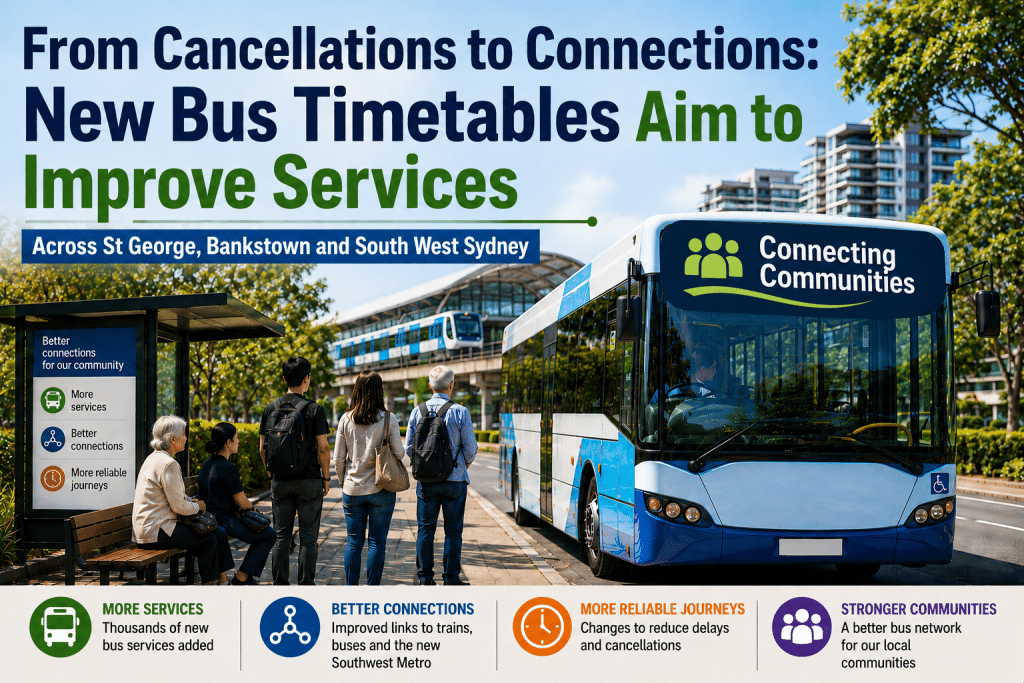
More than 1,600 new weekly bus services are being added to the service region covering St George, with changes aimed at cutting down delays and cancellations that have inconvenienced passengers.
The improvements will also strengthen connections to the new Sydney Metro Southwest line between Bankstown and Sydenham, which is expected to open later this year.
According to the NSW Government, Region 10 has been one of the worst-performing private bus contract regions set up by the former Liberal government, with one in three buses late to timetable by the end of the trip on some routes.
From 21 June, suburbs including Hurstville, Oatley, Penshurst, Mortdale and Peakhurst will benefit from targeted timetable changes designed to make services more reliable, improve connections, and support longer routes to Bankstown.
Minister Says Region 10 Was “Set Up to Fail”
Minister for Transport John Graham said passengers in the St George area deserved better than the service they had been left with.
“The Liberals created these problems by signing a region 10 deal that failed to put passengers first, so Mark Coure should be apologising not criticising,” Mr Graham said.
“Bus passengers in the St George area deserve better than the service they were left with by the former Liberal government.
“Contract Region 10 has been beset by delays and cancellations under a timetable that results in one in every three buses running late on some routes. The area was set up to fail.”
Mr Graham said the latest changes were based on recommendations from the Bus Industry Taskforce and would be followed by further improvements later in the year.
“These changes are based on recommendations of our Bus Industry Taskforce and will be enhanced with more improvements later in the year,” he said.
“We are adding thousands of bus services, improving connections to other public transport modes like the new Southwest Metro and delivering new buses so passengers in the St George region spend less time waiting at the bus stop.
“Across Sydney the Minns Labor Government is increasing bus services at a rapid rate. From this Sunday we will have delivered 3,279 additional bus services since coming to office and we’re just getting started.”
Mark Coure Calls for Changes to Be Paused
However, Member for Oatley Mark Coure has criticised the changes, saying local communities have not been properly consulted before major adjustments are made to bus services.
“The NSW Labor Government are cutting bus services across our local community without first properly consulting the people who rely on them,” Mr Coure said.
He said commuters were more concerned about the practical impact of the changes than political arguments over responsibility.
“Commuters aren’t interested in Labor’s blame game. They are extremely concerned about how these massive changes to our local bus services will affect them and their commute,” he said.
Mr Coure said he had heard from hundreds of concerned residents, including school students, seniors and people with disabilities.
“I have heard from hundreds of concerned local residents, including school kids, seniors and those with disabilities who have been blindsided by these changes which will leave them worse off,” he said.
“I am calling on the Minister for Transport to immediately pause these changes until he can actually hear from the communities which are going to be affected by them.”
His comments highlight a key tension in the bus network redesign: while the government is promoting the changes as a major service uplift, some passengers remain worried about whether their existing travel patterns, direct connections and local access will be affected.
The New 950: A Major Bankstown to Hurstville Link
One of the most significant changes is the introduction of the new 950 route, replacing the M91.
The new 950 will operate between Bankstown and Hurstville, running more directly along Forest Road for a faster and more reliable journey.
This change is important because Bankstown and Hurstville are both major transport hubs, linking passengers to trains, future metro services, shopping centres, schools, jobs and medical services.
For passengers travelling through Padstow, Riverwood and Hurstville, the changes should mean stronger connections and a more dependable service along one of the most important corridors between South West Sydney and St George.
In practical terms, this could mean less waiting, better connections, and a greater chance that a missed bus will not derail a person’s entire trip.
However, for some passengers, the replacement of familiar routes may require adjustment. That is why clear communication, updated journey planning information and support for affected commuters will be essential.
Route 940 and 941 Improvements
The new timetable also delivers important upgrades to routes connecting Bankstown and Hurstville.
Route 940, which operates between Bankstown and Hurstville, will have its weekend frequency doubled to every 30 minutes between Riverwood and Hurstville.
Route 941, also operating between Bankstown and Hurstville, will receive a major improvement during weekday peak periods, with frequency doubled to every 15 to 20 minutes. Sunday services will also improve to every 30 minutes.
These changes are particularly important for passengers who rely on buses not only for weekday commuting, but also for shopping, family visits, weekend work, sport, worship, medical appointments and social activities.
Public transport should not be designed only around the Monday-to-Friday peak-hour commuter. A growing and diverse region needs reliable seven-day public transport, and these frequency improvements are a step in that direction.
Route 450: Extra Services Between Strathfield and Hurstville
Route 450, operating between Strathfield and Hurstville, will receive 10 new weekly services to better meet passenger demand.
While this may appear smaller than some of the other timetable changes, additional services on a busy corridor can still make a meaningful difference, particularly for passengers connecting to rail, shopping centres, schools and employment areas.
Route 956: More Frequent Local Connections
Route 956, operating between Mortdale and Peakhurst Heights, will be improved through a new loop service, with frequency increased from every 30 minutes to every 15 minutes.
This is a significant local improvement, particularly for passengers who rely on buses for shorter trips within the area.
More frequent local services can make public transport more practical for everyday needs, including shopping, appointments, school travel and connecting to other transport routes.
Better Connections to the Southwest Metro
A key part of the timetable changes is improving connections to the new Sydney Metro Southwest line between Bankstown and Sydenham.
For communities across Bankstown, St George and South West Sydney, this matters because buses will play a major role in helping passengers access the wider public transport network.
A good bus network is not only about individual routes. It is about how well those routes connect with trains, metro services, schools, hospitals, workplaces and town centres.
If the new timetables are delivered properly, passengers should see better integration between buses and other modes of public transport, making trips more efficient and less stressful.
At the same time, passengers who currently depend on specific direct services will want reassurance that the new network does not make their journeys harder, especially for seniors, people with disabilities, students and those who cannot easily walk longer distances or transfer between services.
Do More Frequent Services Fix Cancellations and Delays?
While the new timetables bring many clear improvements, one question remains central: how do frequency increases address the long-standing problem of bus cancellations and delays?
Frequency is not the only answer, but it is an important part of the answer.
When services are too far apart, one cancellation can leave a passenger stranded for half an hour, an hour, or even longer. By improving frequency on key routes, the impact of a single disruption can be reduced, giving passengers more realistic options when something goes wrong.
However, more frequent timetables do not remove the need for strong contract enforcement, accurate real-time information and transparent reporting.
Oz Arab Media’s earlier article raised a serious concern: public transport reliability is not only about how many services are scheduled, but whether those services actually arrive.
If buses continue to be cancelled without warning, if apps continue to show “departed” services that never arrived, or if operators are not properly held accountable, public confidence will remain fragile.
That is why the new timetables should be welcomed, but also watched carefully.
Passengers will judge the system not by announcements, maps or scheduled improvements, but by what happens at the bus stop.
Consultation Now Becomes a Major Test
Beyond the number of services being added, consultation has now become one of the most important issues in the debate.
For the government, the changes are being framed as a necessary correction to a poorly performing contract region and a step towards rebuilding the bus network.
For critics, including Mr Coure, the concern is that some residents feel they have not had enough say before the changes take effect.
Both issues matter.
A bus network can be more frequent on paper, but still fail some passengers if route changes remove a direct trip, create difficult transfers, or make journeys harder for people with mobility challenges.
Equally, a network that keeps existing routes unchanged may continue to leave passengers exposed to delays, cancellations and unreliable services if the underlying system is not improved.
The real test will be whether Transport for NSW can respond quickly to community feedback after the new timetable begins, identify problem areas, and make adjustments where needed.
Tackling the Bus Driver Shortage
The timetable changes are part of the Minns Labor Government’s broader work to respond to Sydney’s bus driver shortage and rebuild the bus network following the recommendations of the Bus Industry Taskforce.
According to the NSW Government, the bus driver shortage has been reduced from around 500 drivers to less than 180.
The government also says it has ordered 923 new buses, including 575 new zero-emission buses, while rebuilding local manufacturing with an average of 50 per cent local content.
As of this Sunday’s timetable change, the Minns Labor Government says it will have delivered 3,279 additional weekly bus services across Greater Sydney since coming to office.
These broader improvements are important because better timetables require enough drivers, enough buses and proper operational support to make the services work in practice.
A Better Network, But Accountability Still Matters
The new bus timetables are not perfect.
As with any network change, some passengers may need to adjust their travel patterns, and some direct connections may change.
The government says the overall direction is positive, with stronger corridors, better hub connections, improved weekend services, better frequency, and stronger integration with major transport modes including the future Southwest Metro.
Critics argue that the changes should not proceed without stronger consultation and clearer answers for affected passengers.
That tension will not be resolved by political statements alone.
It will be resolved by the lived experience of passengers after 21 June.
For too long, many residents across South West Sydney and St George have felt that bus services were designed around minimum coverage rather than genuine convenience. The new changes may represent a shift towards a more connected and usable network, but only if the benefits are felt by the people who rely on buses every day.
Reliability, transparency, accessibility and accountability remain essential.
Conclusion
The new bus timetables mark a significant change for communities across St George, Bankstown and South West Sydney.
More than 1,600 new weekly services are being added in the St George service region. The new 950 strengthens the Bankstown to Hurstville corridor. Routes 940 and 941 receive important frequency improvements. Route 450 gains additional services. Route 956 becomes more frequent through a new loop service. Connections to the new Southwest Metro are also expected to improve.
These are real gains.
But they come amid genuine community concern.
Minister for Transport John Graham says the changes are necessary to fix a bus region that was “set up to fail” and to give passengers more reliable and frequent services.
Mark Coure says the changes should be paused until affected communities are properly heard.
Oz Arab Media’s earlier article highlighted the frustration of passengers waiting for buses that never came. This update shows that change is now coming to the network, but also that consultation and community confidence remain unresolved.
The next test is whether these new services deliver not just better timetables, but better journeys.
For local commuters, that is what truly matters.