Reading in English | Read in العربية (Arabic)
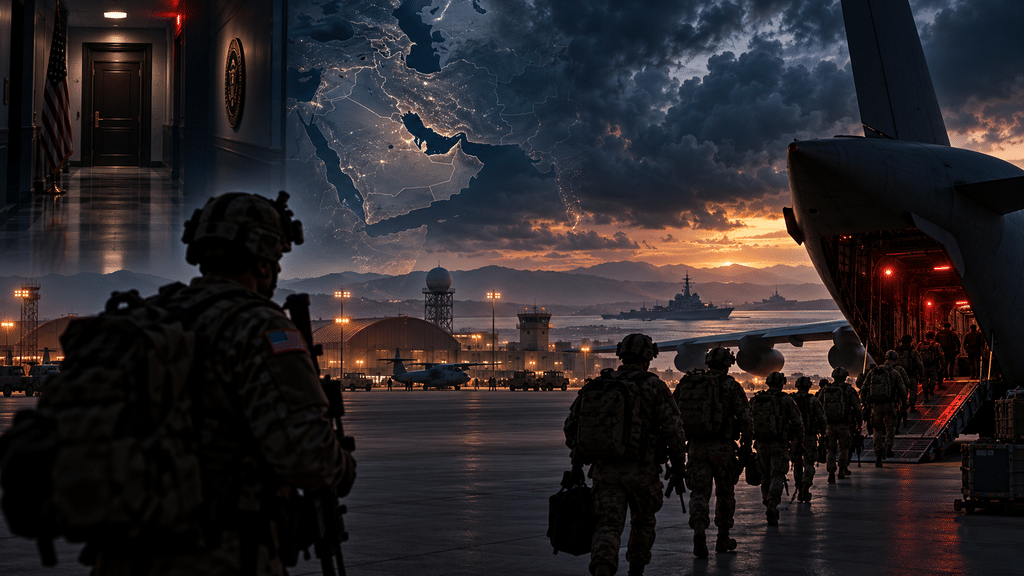
In the Middle East, armies do not move across the ground alone; they carry with them shadows of fear, calculations of power, and secrets not fully revealed by military statements. When reports say the United States is withdrawing personnel from bases in Jordan, Qatar, and Kuwait while also reducing its diplomatic presence, the question goes beyond how many soldiers are leaving to the deeper meaning behind the move: why now, where are the forces headed, and what is Washington trying to avoid in a region where the prospects of war intersect with deterrence calculations?
For years the United States has built its military presence in the Middle East as a network of influence that protects interests, monitors strategic routes, and provides the ability for rapid intervention. Yet bases that give a power geographic reach can, at moments of escalation, become fixed targets that are easily threatened. Here lies the paradox: the force that seeks to protect its influence may find itself compelled to reduce its direct presence in order to protect the instruments of that influence from attrition. The deeper question is: why is Washington pulling forces back instead of merely observing?
The answer lies in a reassessment of risk, especially amid tensions linked to Iran and attacks on U.S. facilities and interests in the region. Modern wars are no longer measured only by the size of armies but by the ability of rockets, drones, and electronic warfare to bypass defensive distances. Thus a military base is no longer an absolute guarantee of safety but part of a constantly shifting security equation. That said, moving forces does not necessarily mean a strategic withdrawal: it can be a temporary redeployment, an effort to disperse personnel and equipment to less vulnerable sites, or a prelude to a broader review of the nature of the U.S. permanent presence. These forces may be redistributed to other bases or used to bolster a more mobile naval and air presence, enabling Washington to retain intervention capability without keeping all troops in exposed locations. Political calculations are involved as well: Washington wants to protect its troops, reassure allies, and avoid being drawn into an open confrontation that exceeds expected bounds. Reducing presence at some sites can therefore be a way to contain escalation while preserving response options. If such measures persist and expand, they could, however, become part of a long-term reconfiguration of the U.S. footprint in the region.
The simultaneous diplomatic moves also take on special significance. Cutting the numbers of non-essential staff and their families in parts of the Middle East signals a higher assessment of security risk. This raises the more urgent question: what awaits the Middle East in the coming hours? While these measures alone cannot determine the course of events or predict the timing of a decisive military escalation, the indicators—wider troop movements, fresh security warnings, ship and aircraft maneuvers, and the tone of diplomatic statements—are not actions Washington would take hastily or in a vacuum. Taken together, these signals suggest that a zero hour could come at any moment.
The central strategic question behind these moves is: how will Washington preserve its influence in a region where the cost of a direct presence is rising? Forces may be repositioned and bases may change roles, but strategic interests, shipping lanes, and energy security will keep the Middle East central to the calculations of great powers. A quiet pullback today does not mean an end to American influence but an attempt to recalibrate the balance between power and risk. What the next hours reveal will depend on the steps Washington takes to sound the drums of decision, not on the movements that preceded them, however significant those signals may have seemed. In political-military decision-making, the place from which armies prepare to return matters far more than the place they left.