












Reading in English | Read in العربية (Arabic)
One of the issues that has occupied Arab and Muslim thought over the past two centuries is the relationship between Islam and modernity. Over time this question has shifted from an intellectual inquiry about whether religion and the age can be reconciled into a cultural struggle between those who see modernity as a salvation from the past and those who regard it as a threat to identity and belief. Amid the two camps the real question has been lost: how can a Muslim live in his time without losing his roots, and how can he preserve his roots without becoming a prisoner of the past?
The problem in many debates about Islam and modernity is that both sides often start from contradictory assumptions before the dialogue even begins. Some treat Islam as a closed historical system that cannot interact with change; others treat modernity as a complete Western package that must be imported in every detail, as if an Arab cannot be modern unless he abandons his memory, culture, and faith.
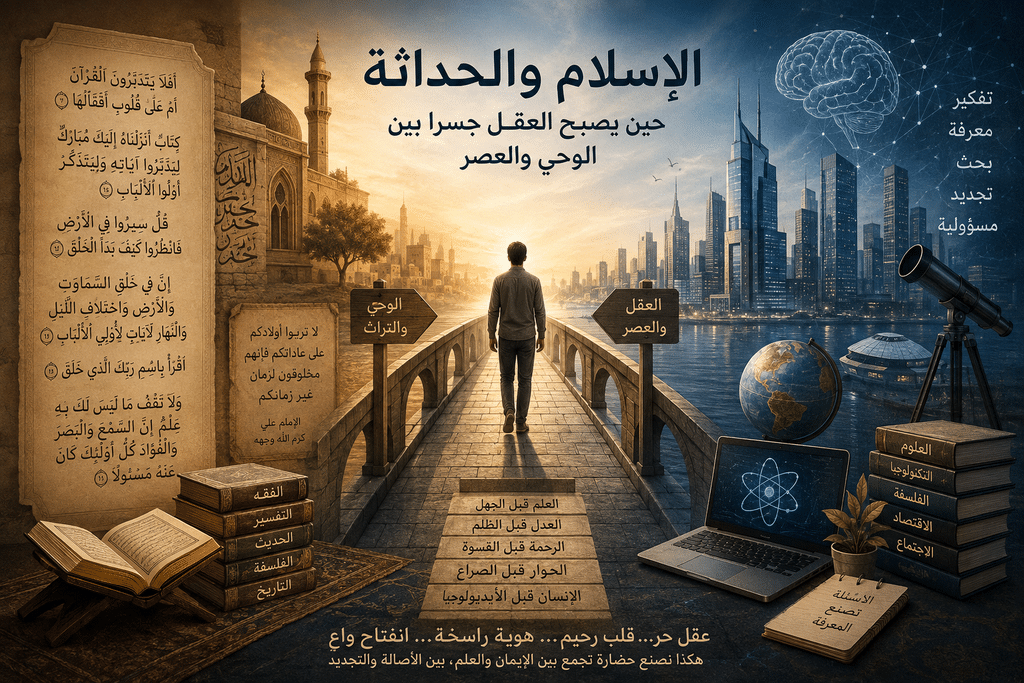
The truth is that Islam, at its core, did not present man as a being forbidden from thinking; rather it presented him as responsible for his reason, choices, and stance toward life. Thus the Qur’anic discourse was not addressed only to the instincts but to the mind, the heart, and the conscience together. As God says: “Do they not then reflect on the Qur’an? Or are there locks upon their hearts?” This verse alone opens a wide door to the role of reason in Islam, for tafakkur (reflection) is not mere repetition of words but an attempt to understand meaning, consider purposes, and link the text to life and reality.
The Qur’an does not simply ask humans to read; it asks them to reflect. It does not only tell them to listen; it asks them to understand. It does not ask them to look at the universe as mere spectators but invites them to take heed, observe, and contemplate. As the Book itself says: “A blessed Book which We have revealed to you, that they might ponder its verses and that those endowed with understanding may take heed.” Therefore the crisis is not the presence of reason within Islam but the way some Muslims have treated reason throughout history.
When religion turns into a set of ready-made answers that may not be questioned, the intellect becomes passive instead of inquisitive. The person is required to memorize more than to understand, to repeat more than to reflect, and to defend the opinions of predecessors even when the circumstances that produced those opinions have changed. Here the confusion between religion and history begins. Revelation is divine, but human understanding of religion is a human experience shaped by time, place, culture, language, and political and social conditions.
That confusion is one reason some Muslims view any attempt at reform as an attack on religion, while the truth is that many reform efforts are not attempts to change the religion but to distinguish between the sacred text and human readings of it.
Modernity, in its deeper meaning, is not merely new clothes, technology, or skyscrapers, nor is it simply imitation of the Western model. True modernity begins when a person is able to think beyond ready-made molds, question his ideas, reassess his mistakes, and acknowledge that human knowledge is not complete. In that sense Islam is not necessarily opposed to modernity, for Islam itself placed mankind under the responsibility to look and reflect. As the Qur’an commands: “Say, ‘Travel through the land and see how He began creation.’” And: “Indeed, in the creation of the heavens and the earth and the alternation of night and day are signs for those of understanding.”
Islam did not ask the believer to fear knowledge; it placed him in a continual search for truth. Hence the first revealed word was “Read in the name of your Lord who created.” “Read” was not a mere command to read, but a sign that knowledge would be part of the human relationship with the Creator, with the world, and with the self.
Thus the real struggle is not between Islam and modernity but between stagnation and life: between a mind that fears questions and a mind that sees questioning as a path to knowledge; between those who want to turn tradition into a prison and those who want to turn it into material for understanding, critique, and reconstruction. Here the words of Imam Ali ring true: “The worth of every person is what he does best.” Value is not age, appearance, or slogans but the amount of knowledge, understanding, and good a person adds.
He also said: “Do not raise your children on your customs; they have been created for a time different from yours.” This statement is hugely important in the discussion of modernity because it reminds us that humans live in changing times, and an education that does not recognize temporal change may produce a person fit for a world that no longer exists.
The problem, then, is not that the world changes but that the world changes while people insist on using the same intellectual tools that suited a previous era. That does not mean every new thing is right, nor does openness mean accepting everything that comes from the West or the East without critique. The mind that rejects blind imitation in religion must also reject blind imitation in modernity. Likewise, the Muslim who refuses to imitate his predecessors without reason should not imitate the West without reason. As the Qur’an warns: “Do not follow that of which you have no knowledge; indeed, hearing, sight and the heart—all of those will be questioned.” This verse establishes a great principle: a person is responsible for the ideas he adopts, and hearing, sight, and heart are instruments of responsibility, not merely tools for receiving information.
Therefore the contemporary Muslim does not need to choose between his identity and his age; he needs to rebuild the relationship between them. We do not need a new Islam; we need a new reading capable of understanding the text without imprisoning it in a single interpretation, and of understanding reality without surrendering to it. We need a mind that knows the text is sacred, while recognizing that human understanding of the text is not necessarily sacred.
We need a religiosity that returns the human being to the center of concern: a faith that makes ethics more important than outward appearances, justice more important than slogans, mercy more important than enmity, knowledge more important than ignorance, and the human being more important than winning an argument. The Prophet said: “I was sent only to perfect noble character.” If religious practice produces people who are harsher, less merciful, more bigoted, and less capable of dialogue, then something has gone off course even if religious slogans remain unchanged.
Islam does not fear modernity because it is not a fragile human idea that will collapse in the face of a new question. The Qur’an does not fear reason because it addresses reason itself. What fears reason is the reading that built its authority on forbidding questions. What fears modernity is the rigidity that can live only within the past.
An Islam grounded in its ethical and human essence can live in every age, for it was not sent to produce people who live only in the seventh century but to guide humanity in every time. The real challenge for Muslims today is not to prove that Islam is against or with modernity, but to present a model showing that a person can be faithful, modern, rational, and open without being a mere imitator; can hold to identity without being its captive; can respect heritage without worshiping it; and can honor reason without turning it into a new god.
The modernity we need is not one that severs people from their roots. The religiosity we need is not one that severs people from their age. We need a human who stands between revelation and reason, between tradition and reality, between authenticity and renewal, knowing that the truth is too great to be monopolized by an individual, a group, or an institution.
Then reason becomes a bridge, not a wall. Religion becomes a force to liberate the human being, not a means to subjugate him. Modernity becomes a tool to develop life, not a pretext to uproot identity. Only then can a genuine dialogue between Islam and the age begin.