











Reading in English | Read in العربية (Arabic)
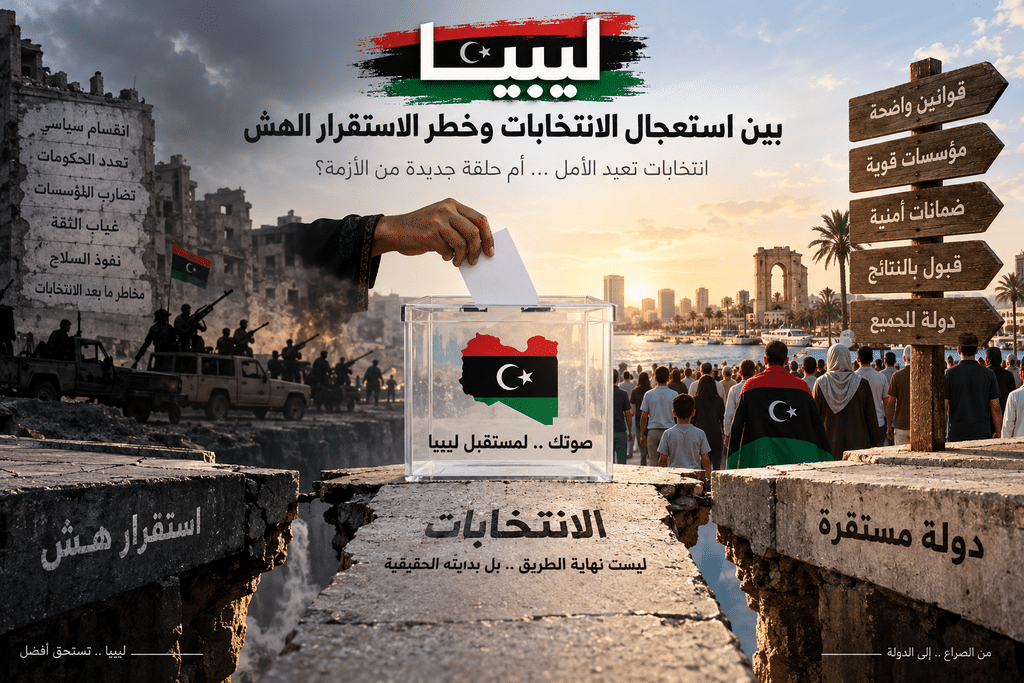
From my perspective, what stands out most in the debate about Libya’s future is that almost everyone talks about elections as the sole way out of the crisis, while no one wants to confront the harder question: what will happen the day after the vote? Does the country already have the political, security and institutional conditions that would make ballot-box results enforceable and sustainable? The ordinary Libyan who follows the scene through statements, press releases and political interviews sees that elections have been delayed long enough, that the transition period has become a burden on state and society, and that holding elections as soon as possible could restore some stability to political life, give the economy a chance to escape uncertainty, and open the way to building legitimate institutions capable of running the country. This view is not mistaken; it naturally reflects a society exhausted by years of political division, competing governments, institutional conflict and declining trust in political elites. It is therefore understandable that many citizens see elections as the most direct exit from this situation.
But the problem arises when we move from the citizen’s perspective to that of the statesman, who does not view elections as simply a day for people to go to the polls but as a full political process that begins before voting and continues after the results are announced. From this angle, holding elections quickly in an environment where a language of domination still prevails and power balances can influence political decisions may produce temporary, fragile stability rather than a truly stable state. Elections alone cannot end division, compel losing forces to accept the outcome, or prevent political, economic or security influence from being used after the vote if there are no clear rules applying to everyone and no guarantees that political disagreement will not turn again into fighting on the ground.
This is precisely why we must understand why Libya has not reached elections yet. The problem was not that Libyans did not understand the importance of elections, nor that a technically capable electoral commission was missing. The core issue has been the absence of political agreement on the rules governing the vote, on the form of authority that would result, and on the guarantees that could prevent the reemergence of conflict after the results are announced. The 2021 elections were the clearest example: the country reached the brink of voting but could not pass the final stage because disputes over the rules, the candidates and the authority that would govern after the vote turned into deep political and legal conflicts that ultimately derailed the whole process. Since then, elections have been a frequent theme in political rhetoric and official statements but have remained absent from reality because competing forces could not agree on an equation that would secure all of them a continued role in the political scene after the transition ends.
In this context, the 4+4 agreement is an attempt to revive the political track and set a framework to address some of the knots that have prevented elections over the years. But the agreement’s importance is not only in talking about elections; it lies in its ability to create a political ground that would allow elections whose results all parties can accept. If the agreement remains merely a political understanding without institutional and legal implementation and without real solutions to the question of executive power, security guarantees and acceptance of the vote, Libya will face the same problem as before, merely with a new election date.
That is why I believe the debate about the 4+4 agreement should not be limited to whether it will lead to elections or not; it must move to a more important question: can this agreement change how political conflict is managed in Libya? Elections cannot be an endpoint if parties still see power as a political and economic prize, and if tools of force can influence the balance of power. A modern state rests on a simple principle: power is transferred through institutions and political disagreements are settled by rules, not by force. In Libya, this principle still needs to be firmly established before we can seriously talk about elections capable of ending the transition.
The real danger is not that a political side will lose an election, but that it will lose and then refuse to recognize the result while still possessing the means to paralyze state institutions or impose a new reality. In stable countries there are institutions able to protect election results from any attempt to overturn them politically or militarily. In Libya, the state itself remains part of the political struggle, so holding elections before dealing with this issue could produce the opposite of the intended effect. We could move from pre-election political division to an even deeper post-election split if there are no rules ensuring everyone understands that the ballot box is the only route to power, and that losing an election does not mean losing the state nor excluding the losing side from political life.
For this reason, calls to hold elections as quickly as possible need to be tempered by political realism. Yes, Libya urgently needs elections because it cannot remain indefinitely in a transitional phase and a stable state cannot be built on temporary, contested institutions. But haste is not by itself a guarantee of success. Elections held in an unstable environment may grant temporary electoral legitimacy but not lasting stability. The solution is not to postpone elections until perfect consensus is achieved—that would be unrealistic and could become another pretext for delay—but to reach a minimal level of agreement that makes elections possible and sustainable and ensures that all parties will treat the results as a new basis for governing the country, not as a temporary outcome that can be overturned by force.
The international community’s approach to the Libyan file must change accordingly. Pressure for elections matters but is not enough. The international community should press equally to create the political and security environment that protects election results, and should make clear to Libyan parties that using force, institutions or public funds to reject the ballot will not be acceptable. Elections without real political and security guarantees can become an occasion to reproduce the crisis instead of resolving it.
Libyan political elites also bear a historic responsibility greater than ever before. They cannot continue to talk about elections while at the same time searching for conditions that would guarantee their staying in power or give them the means to obstruct results that run against their interests. Nor can concerns about security and political risks be used as an open-ended excuse to postpone elections indefinitely. We must distinguish between the necessary preparations for elections and deliberate obstruction. Preparation means building guarantees, rules and institutions; obstruction means keeping the country in a perpetual transition because some parties prefer the status quo to protect their interests.
In the end, I believe Libya has reached a moment when the key question should no longer be when elections will be held but whether we are ready to live with their results. That is the real test for any new political agreement, including the 4+4. If the agreement can shift the country from a logic of domination to a logic of political competition, from the logic of force to the logic of institutions, and from the logic of holding onto power to the logic of transferring it, then it can be a genuine step toward ending the crisis. If the current equation persists and every political force continues to plan how to protect its interests in case of electoral loss, setting a new election date will be nothing more than another postponement of the crisis.
Libya does not need only quick elections; it needs elections that can live with their results. That is the issue a statesman must consider before the citizen, the politician or the international community. True stability does not begin on election day—it begins when the voter’s will is stronger than the will of the gun, when the winner understands that he must respect the rules of the state, and when the loser understands that political defeat is not the end of his existence and does not give him the right to undo the whole process. Only then can elections transform from another station in the transition to a genuine beginning of building a stable, sustainable state.