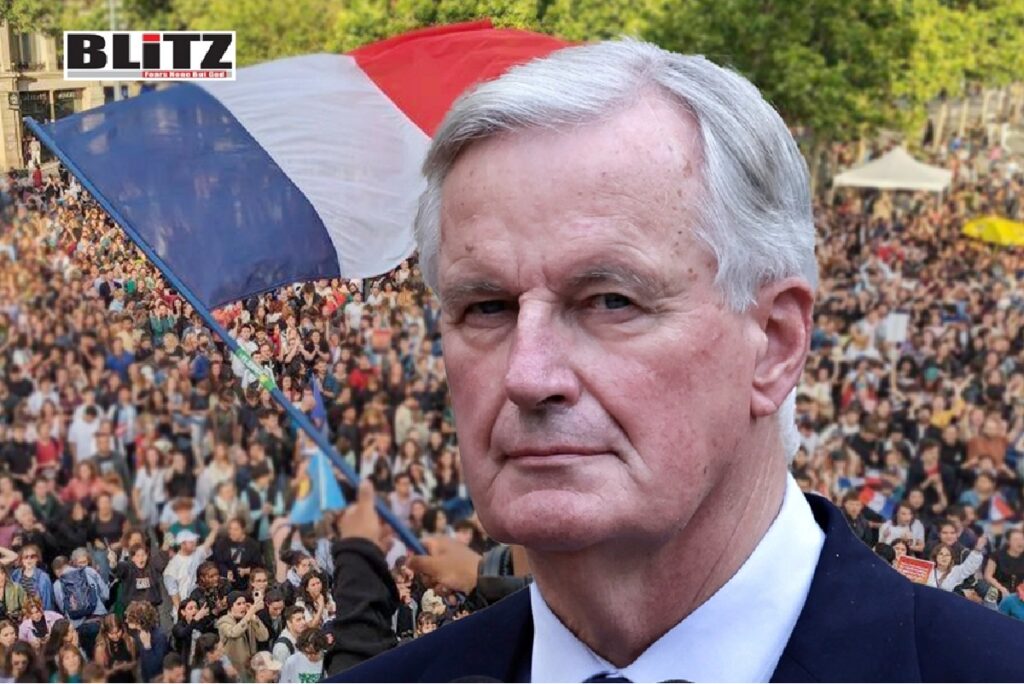













France’s recent political turbulence reached a temporary resolution with the appointment of Michel Barnier as prime minister, tasked with forming the next government. Barnier’s selection, though not without complications, marks a strategic step toward stabilizing the country’s fragmented political landscape. His appointment represents a deliberate choice by President Emmanuel Macron, designed to navigate the intricate balance of power among France’s four dominant political forces, none of which hold a clear majority.
To understand the significance of Barnier’s appointment, one must first appreciate the political upheaval that has taken place in France since the emergence of Emmanuel Macron on the national stage. Macron’s rise to power in 2017 disrupted the traditional left-right divide that had shaped French politics since the founding of the Fifth Republic by General Charles de Gaulle. The two political forces that dominated the French scene for decades-Gaullism on the right and Mitterrandism on the left-have been sidelined, leaving a political vacuum that Macron’s centrist, pragmatic En Marche! sought to fill.
The collapse of traditional politics became even more evident in the 2022 presidential election, where Macron’s re-election was seen more as a rejection of far-right candidate Marine Le Pen than a full endorsement of Macron’s policies. Voters, disillusioned with his unfulfilled promises, were not convinced that he had a clear solution to the country’s deepening problems. Yet, Macron retained power, albeit in a weakened state.
The subsequent parliamentary elections further highlighted this fragility. Macron’s party failed to secure a majority, and France’s National Assembly became a fractured body, divided among four major political blocs: the New Popular Front, a left-wing coalition with 182 seats; Macron’s Ensemble coalition with 168 seats; Marine Le Pen’s far-right National Rally with 143 seats; and the Republicans, the traditional right-wing party, with 61 seats. This division has created an impasse, as no party can govern without forming alliances with others-a scenario that Macron has been struggling to navigate.
The decision to appoint Michel Barnier, a seasoned diplomat and prominent figure in The Republicans, is a calculated move by Macron. Barnier’s long-standing reputation in both French and European politics, particularly his role as the European Union’s chief negotiator during the Brexit process, makes him a well-respected figure across the political spectrum. His experience and political acumen provide him with the ability to manage France’s complex parliamentary landscape.
Barnier hails from the traditional right, a faction that once dominated French politics but has since diminished in influence. De Gaulle’s legacy shaped this political camp, which produced influential leaders like Valery Giscard d’Estaing, Jacques Chirac, and Nicolas Sarkozy. The Fifth Republic was built on the foundations laid by these leaders, with de Gaulle steering the country away from the instability of the post-World War II period, particularly during the loss of France’s colonies in Indochina, Algeria, and West Africa.
However, the traditional right’s grip on power has weakened considerably in recent years, with the rise of centrist and far-right forces. Macron, who broke away from the Socialist Party under President François Hollande, disrupted this long-standing political order. While his pragmatic, ambiguous political movement successfully garnered support in the 2017 and 2022 elections, it has struggled to maintain cohesion and stability in the face of growing opposition from both the left and the right.
Macron’s appointment of Barnier reflects his recognition of the delicate balance required to govern in the current political climate. The left-wing New Popular Front remains a formidable force, with its coalition of Socialist, Green, and Communist parties presenting a united front. Macron, never comfortable with the left’s strong parliamentary presence, has been betting on internal divisions within this coalition. He understands the risks of aligning too closely with the far right, particularly Marine Le Pen’s National Rally, which continues to gain ground in French politics.
By appointing Barnier, Macron aims to appeal to the center-right while maintaining an open door to potential alliances with more moderate factions on the left. Barnier’s established credibility makes him a palatable choice for many within the political spectrum, including those in the far right, who may view him as a more acceptable figure than Macron himself. Moreover, Barnier’s diplomatic skills, honed during his time negotiating Brexit, equip him to navigate the treacherous waters of French parliamentary politics.
While Barnier’s appointment may temporarily ease the deadlock, significant challenges remain. The current political landscape in France is defined by deep divisions and competing interests. The far-left and far-right forces have grown stronger, capitalizing on the discontent of voters who feel left behind by Macron’s centrist policies. At the same time, the traditional right and left have been relegated to the margins, struggling to assert their influence in a political environment that has shifted dramatically since Macron’s rise to power.
For Macron, the key challenge will be leveraging the immense powers of the French presidency to break down the barriers between these political blocs. He will need to exploit the contradictions within the left-wing coalition and the far right while preventing the Republicans from drifting too far into the arms of Le Pen’s National Rally. Barnier’s role will be crucial in this effort. As a figure of the traditional right, he can serve as a bridge between the Republicans and Macron’s centrist coalition, while also holding out the possibility of cooperation with more moderate elements of the left.
The appointment of Michel Barnier as prime minister represents a tactical move by Macron to temporarily stabilize France’s political deadlock. However, it is far from a long-term solution. The divisions within the National Assembly remain deep, and the future of French governance is uncertain. Macron will need to employ all of his political skills, and Barnier will need to draw on his extensive experience, to steer the country through this turbulent period.
The formation of the next government will be a delicate balancing act, with Macron and Barnier working to keep their coalition intact while fending off challenges from both the far left and the far right. The outcome of this political experiment will shape the future of France and the broader trajectory of European politics in the years to come.