











Reading in English | Read in العربية (Arabic)
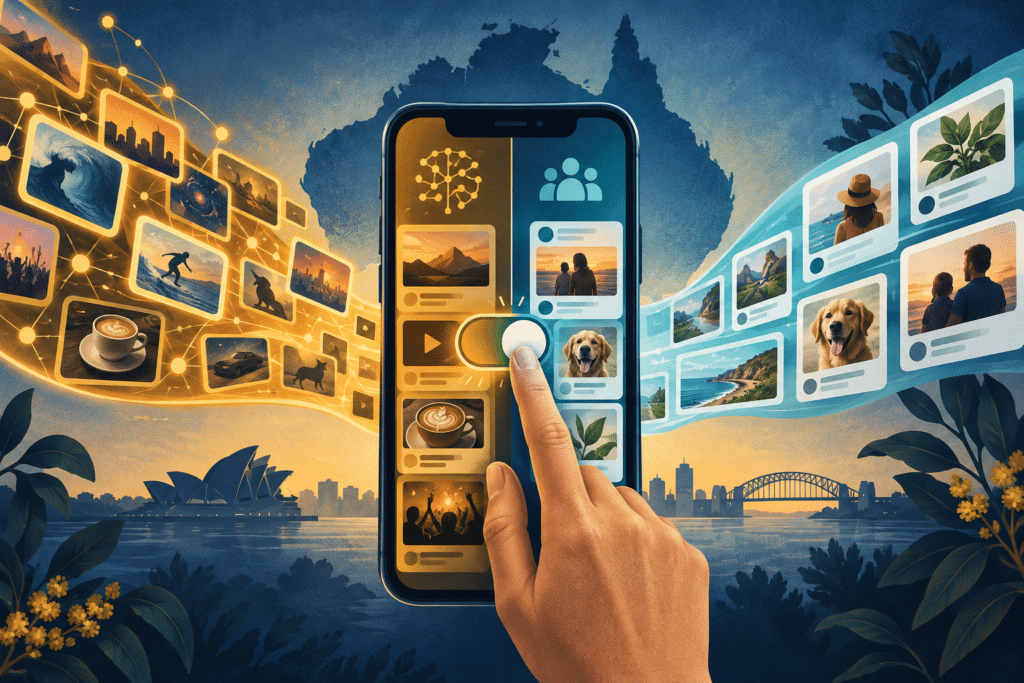
Australians would gain a choice over personalised social media recommendations under the Albanese government’s proposed “My Feed, My Way” initiative, announced on 8 September as part of draft Digital Duty of Care laws.
The government’s announcement outlines notifications for new and existing users, allowing them to choose algorithmically recommended content or posts from friends and creators they follow.
A choice users could change
Communications Minister Anika Wells said users could change their minds repeatedly, ABC News reported. People who prefer personalised recommendations could keep them. The proposal would therefore make the default feed a deliberate user choice, rather than require everyone to abandon recommendations.
Safety obligations beyond social media
The proposed duty would also cover services such as games, apps and AI chatbots. Providers would need to protect under-18s against harmful design features and content, including material encouraging eating disorders, misogyny, pornography, dangerous stunts and serious abuse.
Platforms would document their responses to identified risks and check their effectiveness. The government says breaches could attract penalties of up to A$109.2 million, enforced by the eSafety Commissioner.
The draft also proposes removal-notice powers for nudify services and changes intended to speed up responses to cyberbullying and adult cyber abuse.
Butterfly calls for protections at every age
The Butterfly Foundation welcomed the draft and its explicit recognition of disordered eating as an online harm. However, the charity said limiting the specific protections to children would leave an important gap.
Butterfly intends to urge the government to extend protections against eating-disorder content to people of all ages. Its chief executive, Jim Hungerford, said the organisation’s helpline regularly hears from people encountering idealised, weight-focused material in their feeds.
The foundation linked such content to body dissatisfaction and argued that the risk does not disappear when someone becomes an adult. Its response puts the scope of the protections, alongside the ability to choose a feed, at the centre of the consultation debate.
Business accounts also need fair treatment
According to Dr. Charbel Tadros, many businesses and business owners have also called for stronger government oversight and enforceable controls over how platforms manage, restrict, suspend or ban business-related accounts. Losing access can interrupt advertising, customer communication and the management of linked business pages.
Tadros, the author of this article, set out a proposed framework in his Digital Platforms Fair Access and Business Support Bill policy paper, dated 13 July 2026. It calls for clear written reasons for account restrictions, timely human review, appeals accessible outside a disabled account, safeguards for linked business assets and independent external dispute resolution. Regulatory enforcement would hold platforms accountable for systemic failures.
The proposal also seeks notice and an opportunity to address non-severe historic content before account-level penalties disrupt a business. Platforms would retain the ability to act urgently against serious harm, with rapid human review to correct mistakes. The paper is a separate legislative reform proposal prepared for a federal parliamentarian’s consideration; it is not part of the government’s announced draft laws.
The wider accountability gap is documented by the Telecommunications Industry Ombudsman, which reported in December 2025 that 36 per cent of digital-platform complaints it received concerned account access, including blocks and bans. It called for expanded jurisdiction to resolve such disputes.
Draft laws still face Parliament
The measures are proposals, not rules already in force. Targeted consultation is underway with platforms, industry organisations, civil society and advocates. The government plans to introduce legislation to Parliament in 2026.
Featured image: AI-generated editorial illustration.