












Reading in English | Read in العربية (Arabic)
In Libya the problem is not always signing agreements; it is what happens afterward.
Recent Libyan political history is full of documents, understandings, maps and agreements that some hailed as historic breakthroughs while others attacked as conspiracies or concessions — only for many of them to end up producing the same result: another transitional phase, another temporary authority, and a new form of division without any real change to the rules of the game.
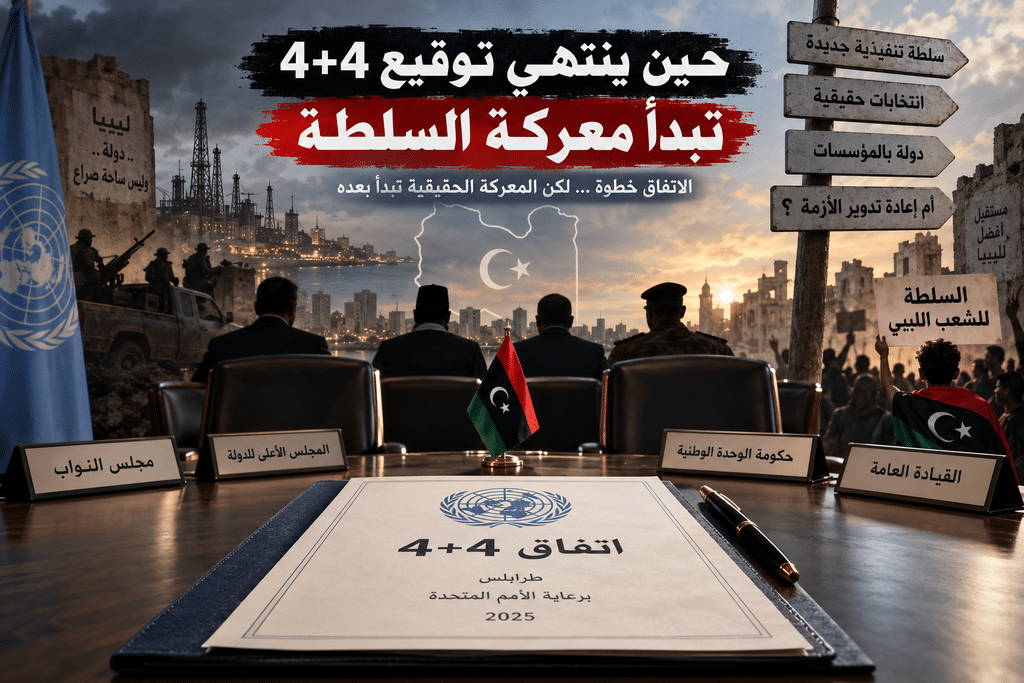
For that reason the 4+4 agreement signed in Tripoli under the auspices of the UN Support Mission in Libya should not be read as the end of the crisis or as a victory of one side over another. Its true significance is both simpler and more complex: it removed an obstacle on a long road, but the road has not yet reached its end.
The agreement addressed a number of files that had long blocked the political process, foremost among them the completion of the legal status of the Board of the High National Elections Commission and the handling of several issues related to electoral laws and the constitutional framework.
That may seem to some like a technical or procedural detail, but in Libya it is not. Every detail related to elections quickly becomes part of the struggle over the shape of the state and who will hold the keys in the next phase.
More importantly, the 4+4 agreement cannot be separated from the broader UN-led track that began with the roadmap announced by the UN mission in August 2025, a track that from its earliest stages collided with the inability of both the House of Representatives and the High Council of State to achieve the required breakthrough amid ongoing institutional division, multiple centers of power, and de facto authorities competing for legitimacy, resources and influence.
When progress through traditional channels proved impossible, the mission turned to alternative pathways — from the Advisory Committee to the structured dialogue and then to the 4+4 committee.
That sequence is very important.
Reaching 4+4 does not mean the crisis is over; it means a new track has begun to overcome the deadlock.
So the question must change.
Instead of asking: Who “won” 4+4?
We should ask: Who wants Libya to win after 4+4?
The agreement everyone wants to interpret their own way
Perhaps the agreement’s most revealing feature is the degree of polarization that still shapes the Libyan scene.
Some read it as a political victory for one side, others as a loss for another, while still others see it as an opportunity to be seized.
These readings are not entirely neutral; each side views the agreement from its position within the conflict.
The Government of National Unity and its supporters are looking for guarantees to preserve their influence or, at least, a safe place in upcoming arrangements. After years in power and the accumulation of crises, their concern is no longer only governing but exiting the transitional phase with as few political losses as possible.
On the other side, the Libyan National Army leadership and the political forces aligned with it see a reordering of the political scene as potentially opening the door to translating the influence they hold on the ground into clearer political and institutional power — and perhaps into presidential ambitions that have long been part of eastern calculations.
But a clear limit must be set on attempts to load the agreement with more than it can bear.
4+4 does not grant Dbeibeh a certificate of permanence, nor does it hand his opponents a certificate of access to power.
The agreement does not pre-determine who will be head of state, who will lead the next government, nor does it give any side an open mandate to run the next phase.
Those who present it as doing so are not explaining the agreement; they are interpreting it to fit the scenario they want.
This is crucial because the most dangerous thing that can happen in Libya is for political documents to become different texts depending on how many parties read them.
Rejection is a right… but war is not politics
On the other side, there has been vehement rejection of the agreement from political and religious forces and figures, notably actors linked to Dar al-Ifta and its political orbit.
In principle, there is nothing wrong with rejecting the agreement.
Opposition, disagreement and criticism are a normal part of any political process.
The problem begins when arms or threats of war become an alternative language to politics.
Libya has paid a heavy price in recent years for that logic. Whenever politicians failed to reach an understanding, there has been someone ready to turn disagreement into armed confrontation, after which a new agreement would be reached that did not solve the problem but only postponed it.
You cannot build a state that way.
Nor can every political settlement be the prelude to a new military battle.
Any party has the right to say “no” to the agreement, but no party has the right to say “no” to the state simply because the outcome does not match its interests.
Genuine welcome must be conditional
The most reasonable stance, in my view, is to welcome the agreement as a step that can be built on while rejecting any attempt to treat it as a blank check for any party.
This is the position expressed by Mr. Mohamed Sawan, leader of the Democratic Party, which can be read as viewing the agreement as a step to break the deadlock and continue the political track, not as a final settlement of the crisis.
That distinction is vital.
Welcoming the step does not mean agreeing to everything that may follow.
Supporting the track does not mean abandoning the right to monitor and criticize it.
If anything, the opposite is true: as we approach the most sensitive stage, national forces need to be more vigilant, because the real struggle will not be over interpreting 4+4 but over what comes after it.
Here the real battle begins
After some electoral obstacles are removed, the political confrontation will automatically move to the more sensitive question: Who will govern Libya before the elections?
That will be a much tougher fight.
Forming the new executive will not be merely about choosing a prime minister and a few ministers.
At its core it is a redistribution of political, economic and security influence.
Every party will therefore try to shape the form of the next authority and secure a significant share of it.
That is the danger.
If the aim is simply to replace one government with another, change ministers’ names while the same networks of influence remain, Libya will not have moved forward.
It will only have recycled the crisis.
What Libya needs is not another transitional government that lasts additional years, but a unified executive with a fixed mandate and defined powers whose primary mission is clear: unify state institutions, provide the appropriate political and security environment, address the distortions that hinder elections, and then proceed to genuine general elections.
Any authority without this clear timeframe is likely to turn from a transitional phase into a permanent provisional system — the strangest expression reality has produced in Libya in recent years.
We do not want to change faces only
Libya’s experience has shown that changing people is much easier than changing the system.
A government can be formed in days.
Ministers can be swapped.
Positions can be distributed.
Statements about a new era can be issued.
What is harder is dismantling the networks of interest that have made the transitional period a permanent source of influence and wealth.
Therefore the success of the next phase should not be measured by how many individuals leave their posts, but by the extent to which it changes the rules of state administration.
If corruption networks remain intact, if public institutions continue to be used as instruments of conflict, if oil and financial resources remain bargaining chips, and if weapons remain outside institutional control, changing the government will be little more than political cosmetic surgery.
Libyans do not need another cosmetic makeover.
They need genuine change.
Who has the right to take part in shaping the future?
There is another question that must not be ignored.
Who will take part in shaping the next authority?
Will Libya remain hostage to limited arrangements among a number of forces and figures who control the tools of power and influence, or will the political process open its doors to a wider circle of political, social and national forces?
Building new legitimacy cannot be done through closed arrangements.
If the United Nations truly wants to end the crisis, the next phase needs a broader, more inclusive national dialogue that allows political, civil and social forces to be part of building consensus, not just recipients of its results.
The wider the circle of participation, the greater the chances of protecting any agreement from collapse.
When a large part of the political community feels excluded, any settlement remains vulnerable to challenge, obstruction and possibly explosion.
And the international community must stop managing the crisis
This may be the greatest test for the international community.
Libya no longer needs its crisis managed as much as it needs the crisis ended.
There is a huge difference between the two.
Managing the crisis means maintaining a balance between competing forces and preventing a major explosion.
Ending the crisis means changing the conditions that make the conflict persist in the first place.
That requires the international community — and particularly the UN mission — to be clearer in dealing with those who obstruct the transition to a state, and to tie political support to a clear path toward unified institutions and elections.
It also requires taking seriously the issues that have been repeatedly raised in UN reports: fuel smuggling, corruption, the seizure of resources, and violations that affect Libyans’ rights.
You cannot build a democratic state while the state’s resources are being turned into fuel for political conflict.
You cannot speak of free elections if networks of money and influence can still buy political power.
4+4 is an opportunity, not the end of the story
It may be premature to celebrate the 4+4 agreement as if Libya has already entered a new phase.
It would also be wrong to treat it as a disaster or a conspiracy simply because some of its outcomes do not match the interests of one side or another.
The truth is simpler and more important.
The agreement is a step.
A step deserves support if it leads forward.
But it deserves oversight and criticism if it is used to take a step backward.
The real value of 4+4 will not be determined by the statements made after the signing or by the declarations that praised or attacked it.
It will be defined by the next phase.
If it leads to a unified executive with a fixed mandate and a clear mission, and then to genuine elections, it will have fulfilled its historic function.
If it becomes a gateway to a new allocation of positions, the reproduction of influence networks, and an extension of the transitional phase, it will be just another agreement added to a long archive of accords that produced temporary calm but failed to produce a state.
That is why the real battle did not begin on the day 4+4 was signed.
The real battle begins after it.
It is not a fight between east and west, between one government and another, or between figures jockeying for a place in power.
It is a much deeper struggle:
Will Libya finally manage to move from a state run by temporary understandings and the division of influence to a state governed by institutions, law and elections?
This is the test.
This is the question Libyans should be asking now.
What matters is not who will inherit power after 4+4.
What matters is whether power will remain an inherited legacy passed between rivals, or whether it will finally return to its rightful owner: the Libyan people.