












Reading in English | Read in العربية (Arabic)
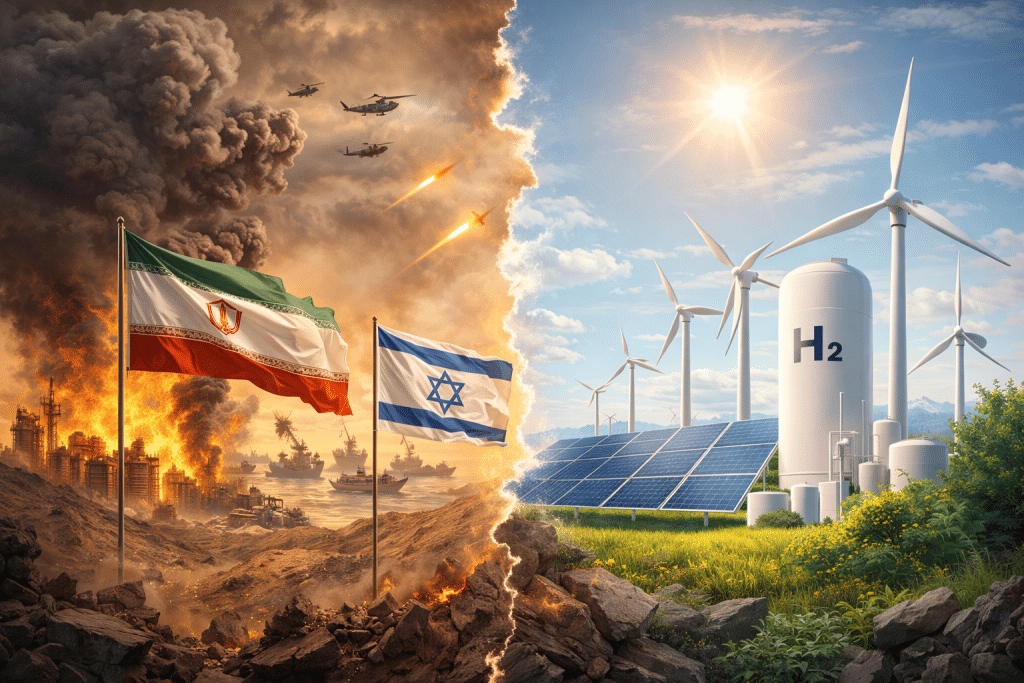
Over the past two decades, the challenges posed by climate change have been the primary driver for investment in renewable energy. Recently, however, a new challenge has emerged that is equally significant: energy security and the assurance of continuous supply. This challenge arises in the context of escalating geopolitical tensions, particularly the ongoing war between the United States and Israel on one side, and Iran on the other, which has entered its second month, leaving profound repercussions on global energy supplies.
**Strait of Hormuz and Energy Security**
In this context, Iran’s imposition of navigation restrictions in the Strait of Hormuz, through which more than 20% of the world’s oil supplies pass, has heightened the risks threatening energy security. Many Western analysts view this as a de facto economic blockade on oil-producing Gulf Arab states. Consequently, the repercussions of this blockade extend beyond the producer countries, impacting the global economy as a whole and exposing it to sharp structural shocks.
Some analysts have drawn parallels between the current crisis and the oil crisis experienced in the 1970s, particularly the Arab oil embargo of 1973, which targeted the United States and other Western countries due to their support for Israel in its war against Egypt and Syria. However, current indicators suggest that this crisis could be more severe and complex, given the profound changes that have occurred in the structure of the global economy.
**Searching for Alternative Sources**
According to a report by The New York Times, disruptions in supplies and the growing risks associated with importing oil and gas from a region that has traditionally been a key supplier for European and Asian markets have prompted these countries to reassess their energy mix. They are exploring multiple alternatives, including coal, renewable energy (solar and wind), hydrogen, and nuclear energy, in order to maintain stability in the industrial sector and ensure long-term planning.
Many European and Asian countries are increasing their investments in wind and solar energy, along with other renewable sources, and in battery technology. However, they may also increase their reliance on coal, an inexpensive yet environmentally harmful fossil fuel, raising concerns about climate change.
**Intense Competition Among Technologies**
In light of the escalating challenges posed by climate change and the urgent need to transition to more sustainable energy sources, there is a fierce global competition among various energy production technologies. This includes options like nuclear fusion, which is still under development, as well as hydrogen and natural gas as viable energy generation sources that could see significant growth in the coming decade.
These technologies are subject to extensive discussions to determine their ability to balance economic feasibility with environmental requirements, as well as their role in enhancing energy security by compensating for supply shortages in an international environment characterized by high levels of uncertainty.
Notably, solar and wind energy have grown rapidly during the first half of 2025, enabling them to meet the entire increase in global electricity demand. As a result, renewable energy has surpassed coal for the first time as the primary source of electricity generation worldwide, according to a report by the research center Ember Energy, released in October 2025.
**Houston Conference and the Flexible Energy Mix**
In response to the evolving dynamics of oil and gas supplies, the CERAWeek Energy Conference convened from March 23 to 27, 2026, during the annual Sera Week in Houston, organized by S&P Global. The conference saw wide participation from energy sector leaders, decision-makers, and executives to assess the geopolitical implications of the current crisis on global energy markets and explore pathways to address it.
Discussions highlighted the rapid shift in energy policy priorities, with security of supplies and market stability taking precedence over long-term climate change goals. In this context, several participants noted that excessive reliance on geographically concentrated supply chains, especially in areas of conflict, raises the need for diversifying energy sources and routes as a fundamental component of national and international strategies.
Despite the global focus on securing fossil fuel flows, the conference emphasized that renewable energy has not lost its strategic importance; rather, it is being recognized as part of the energy security equation, not just a tool to combat climate change. Speakers stressed that investment in clean energy sources, such as solar, wind, and green hydrogen, helps reduce dependence on sensitive maritime routes and enhances countries’ independence in facing external shocks.
The sessions also addressed the challenges related to scaling up renewable energy, particularly the limitations of storage infrastructure, production volatility, and the need to upgrade electrical grids. In this regard, integrated solutions were proposed that combine traditional and renewable energy, through what is known as “Flexible Energy Mix” approaches that balance sustainability requirements with the need to ensure continuous supply.
**Energy Security and National Security**
From the preceding discussion, it is evident that the crisis caused by the U.S.-Israeli war on Iran has not led to a decline in the energy transition path; rather, it has reshaped it within a new equation. Transitioning to renewable energy is no longer merely an environmental option but a strategic necessity dictated by national security considerations and the priority of economic stability. This enhances the hypothesis that the focus is shifting from “sustainability” to “energy security” as the primary driver of energy policies in the current phase.