












Reading in English | Read in العربية (Arabic)
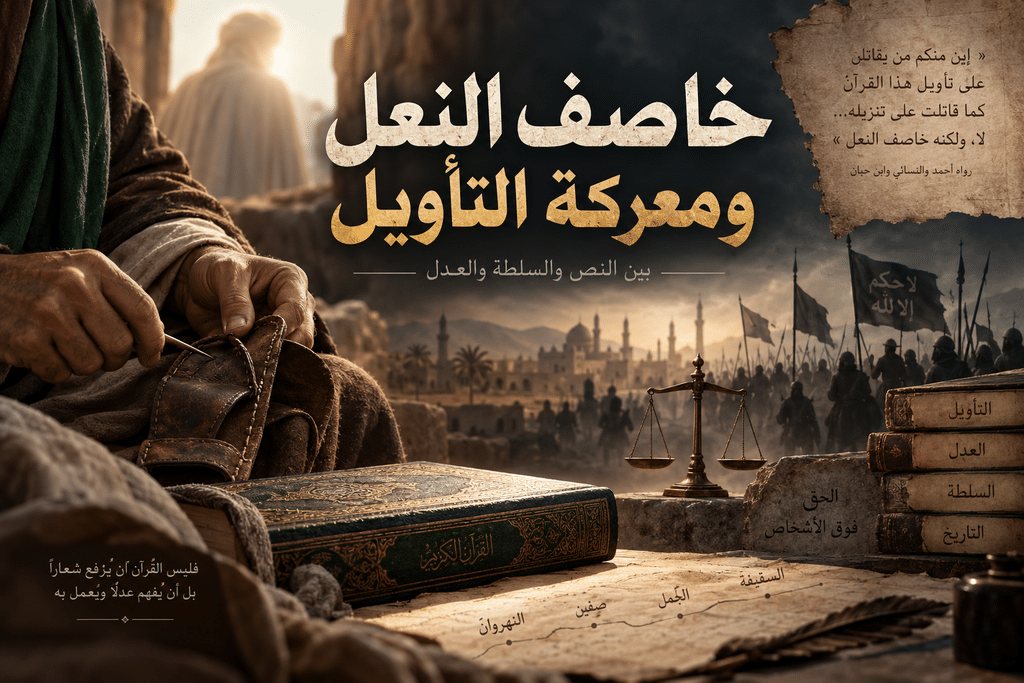
The narration of “khasif al-na‘l” is not merely one of Imam Ali ibn Abi Talib’s virtues, nor a passing anecdote about a Companion. It carries a deep implication about interpretation and Ali’s place in the struggle over understanding and applying the Qur’anic text. The Prophet (peace be upon him) is reported to have said, “There is among you someone who will fight over the interpretation of this Qur’an as I fought over its revelation.” When the Companions asked who that person would be, he replied, “No, rather he is the one who mends my sandal.” Ali (may God be pleased with him) used to mend the Prophet’s sandal. Shuaib al-Arna’ut authenticated the version in Musnad Ahmad, and a similar wording appears in al-Nasa’i’s Sunan al-Kubra and in Ibn Hibban’s Sahih.
The importance of this report is that it places Imam Ali beyond mere precedence, kinship, or status and situates him as the interpreter at a time when the battle over understanding the text would become part of the political and military struggle within the community. The Prophet fought over revelation when the conflict was between Islam and idolatry; the narration points to Ali fighting over interpretation when the dispute becomes internal to Muslim society itself, when the disagreement is about the meaning of the text and how it should be applied.
From this perspective Ali’s character appears different from the reduced image some historical readings have imposed. He was not simply the fourth caliph or one of the major Companions. He was among those closest to the Prophet in lineage and family ties, one of the earliest believers, and a man of knowledge, judgment, courage, and a clear stance on the relationship between religion, authority, justice, and politics.
Therefore, any reading of the post-Prophetic period should not begin with later political assumptions and then seek the evidence to support them. It should return to the facts themselves and examine Ali’s and the Ahl al-Bayt’s positions without trying to erase or marginalize the points of disagreement.
Saqifah was a foundational moment in Islamic political history. While Ali and the Hashim family were occupied with preparing and burying the Prophet, the consultations at Saqifah were underway about the future of authority. This observation does not by itself deliver a final verdict on everything that happened there, but it is enough to show that the transfer of power was not an automatic, uncontested event; it involved competition, effort, and disagreement.
A reading that treats Saqifah as the natural and settled end of the caliphate question and then asks history only to justify it shuts the door on inquiry before it begins. Ali’s perspective invites attention to the relationship between consultation (shura) and legitimacy, between de facto power and the consent of those entitled to it, and between the unity of the community and an individual’s right to object to a political course he deems wrong.
The issue becomes especially sensitive in the case of Fadak. The report in Sahih al-Bukhari recounts that Fatimah (may God be pleased with her) claimed an inheritance from Abu Bakr, who replied with the hadith, “We do not inherit, what we leave is charity,” and that Fatimah was angry with him and distanced herself until her death.
This narration should not be reduced to a dispute over land or money. It reveals a genuine disagreement between figures at the heart of the Prophet’s household and the new authority. Turning every objection by the Ahl al-Bayt into mere misunderstanding or a personal emotion does not serve historical truth. Respect for the Companions does not cancel the right to criticize, and respect for history does not transform its actors into figures beyond scrutiny.
Here a fundamental problem appears in some radical Salafi discourses that treat early history as a forbidden zone for criticism. They are willing to critique reports that concern their opponents, yet hesitate to apply the same standard when narratives touch those associated with the first political authority. This selectivity makes history subordinate to political creed instead of making political creed answerable to historical evidence and scriptural texts.
Ali’s project was not based on revenge or the dismantling of the community. He believed that unity does not justify abandoning justice, that a gathering of people does not justify silence in the face of wrong, and that authority does not become an absolute right merely because it has become a fact on the ground. For this reason his positions were more complex than simplified narratives suggest: he engaged in public affairs, dealt with the caliphs, counseled and advised, but he did not feel compelled to relinquish his principles merely to preserve an idealized historical image.
When Ali assumed the caliphate he faced an enormous political accumulation. His conflicts with the people of the qibla were not only battles for power; they were also struggles over legitimacy, interpretation, the limits of obedience, and the use of religion in politics. In Jamal, Siffin, and Nahrawan the Qur’an stood at the heart of the conflict, and the problem was not the existence of the text but how it was understood and employed.
This is where the hadith of the sandal-mender gains added value. The struggle Ali engaged in was not against the Qur’an but over its interpretation. That is crucial: possessing the text does not necessarily mean possessing the truth. One may raise the Qur’an yet read it through the lens of authority, factionalism, or interest; the sacred text can become a political tool when detached from justice and from the purposes for which it was revealed.
The Kharijites are a clear example of the danger of a literalist reading divorced from the text’s objectives. Their slogan “There is no rule but God’s” is true in itself, but the problem arose when this abstract right was turned into a weapon to overturn realities and escalate conflict, until the Qur’anic slogan itself became a justification to judge Muslims and permit their bloodshed. Ali’s stance was deeper: he did not reject the text but refused its use outside of context and purpose.
Seen from this angle, Ali represents a different model for relating religion to politics. He did not sanctify authority simply because it was authority, nor did he reject the community merely because it disagreed with him, nor did he turn the text into a slogan divorced from justice. He placed the human being, authority, and political reasoning alike under the standard of right.
Supporting a reading that favors Ali does not mean denigrating Abu Bakr, Umar, or Uthman (may God be pleased with them), nor does it mean adopting a closed sectarian narrative. It means granting Ali the standing that the texts and facts permit and refusing to subject his persona to later political measures that were formed after him and retroactively applied to his era.
The problem with some radical Salafi interpretations is not respect for the Companions—that is an Islamic value—but turning that respect into historical immunity that blocks criticism and closes the door to reassessment. History does not become sacred because its personalities were close to the prophetic era, nor do texts lose their critical value because their implications are uncomfortable for received narratives.
Imam Ali himself offers a more mature criterion: he did not make people the absolute measure of truth, but made truth the measure by which men are judged. That idea makes his intellectual and ethical project more consistent with the spirit of Islam than an approach that begins by sanctifying individuals and then seeks to justify every one of their actions.
Ali’s strength was not in his sword alone, nor in his lineage, nor only in his closeness to the Prophet, but in the combination of knowledge, justice, courage, and the ability to read the text in its context. For that reason the hadith of the sandal-mender acquires exceptional significance: it places Ali at the center of one of the most complex issues facing Muslims after the Prophet’s death—the transition from the stage of revelation to the stage of interpretation and application within a changing political reality.
Reading Ali’s history from this vantage point, we do not see a man defeated by politics but a man who sought to prevent politics from defeating the truth. His positions remained present and his words continue to be read centuries later because the issue he confronted was not limited to his time. It recurs whenever authority attempts to make its interpretation of religion the final one, and whenever tradition seeks to close the door to ijtihad and critique in the name of protecting the community.
Ali does not need manufactured virtues nor invented adversaries. It is enough to read the texts, place them in their context, and let the facts speak without fear of the outcome. Then the “sandal-mender” appears not only as the man who repaired the Prophet’s sandal, but as the symbol of someone who would later stand against the monopolization of interpretation when the text turns from guidance into a tool of conflict.
Defending a reading that favors Ali is not defending a person against other people; it is defending a method that holds that the Qur’an is not grasped by slogans alone, that legitimacy is not produced by force alone, that unity does not mean burying injustices, that respect for predecessors does not suspend reason, and that Islamic history is not a sealed museum but a human experience to be read with text, justice, and reason together.
Perhaps Ali’s greatest legacy is this spirit that places truth above persons, justice above authority, and reality above heritage. The battle of interpretation indicated by the narration of the sandal-mender did not end with Ali’s death; it remains open in every age. Whenever the sanctity of the text clashes with the authority of interpretation, the same question returns, and Ali remains present as one of the most prominent models linking text and justice, religion and responsibility, authority and right.