












Reading in English | Read in العربية (Arabic)
Every time a rational person opens a window for questioning, some radical Islamists emerge as if they are the gatekeepers of heaven, carrying the keys of the unseen in their pockets. They decide who is allowed to think and who must remain silent. These individuals are not disturbed by ignorance; rather, they are disturbed by intellect. They are not as concerned about moral deviation as they are about a simple question that starts with “how” or “why.” It seems that the gravest threat to faith is not atheism or injustice, but rather the act of thinking itself.
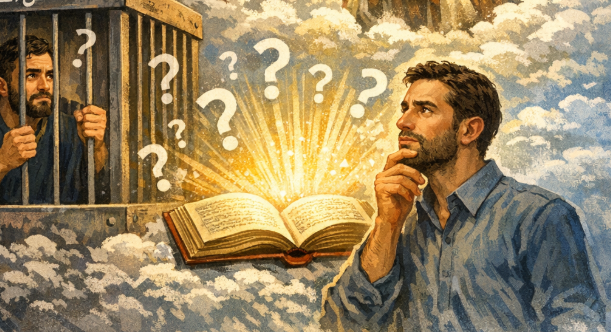
If questioning were a crime, the first person to be put on trial would be Moses, peace be upon him, when he said, “O my Lord, show Yourself to me.” Was Moses a doubter, or was he a seeker of knowledge aspiring to reach a higher level of certainty? Or do some contemporary zealots consider themselves more protective of faith than a prophet who spoke directly with God? Their reasoning seems to suggest that yes, they are more concerned than the prophets about safeguarding God from the questions of His servants.
If seeking understanding were a sign of weakness in faith, then Abraham, peace be upon him, would be under suspicion when he asked, “My Lord, how do You bring the dead to life?” He did not question whether God could bring the dead to life but rather how He did so. The distinction between “whether” and “how” is the difference between denying the principle and seeking understanding. Nevertheless, he was not met with reprimands or accusations of weak faith; instead, he received answers that were educational and reassuring, for faith, in its essence, is a journey of ascent, not a stagnant station.
When it is recounted that Muhammad, peace be upon him, said, “We are more entitled to doubt than Abraham,” this statement is understood among scholars of jurisprudence and language as a rhetorical teaching that confirms that seeking reassurance is not a challenge to faith. Yet, for some radicals, every word becomes an excuse to shut the door on any mind that tries to breathe, as if they do not realize that the Prophet, who taught his companions to ask questions, and said that “the cure for ignorance is questioning,” was not building a herd but rather shaping a conscious nation.
The ironic contradiction is that those who raise the banner of following forget that in the Quran, true following is accompanied by insight. Blind imitation has always been the hallmark of nations criticized by revelation when they claimed, “We found our forefathers on a path, and we are following in their footsteps.” Yet, they seek to reproduce the same version, only with a larger turban and a louder voice.
They talk about the caliphate, empowerment, and identity as if these are magical words, while neglecting the fact that the first honor bestowed upon humanity in the Quran was the teaching of names, granting the ability to understand, classify, and analyze. The text does not state that He taught them blind obedience, but rather that He taught them names, highlighting the vast difference between a person who knows, asks, and contemplates, and a person who repeats without understanding.
The radical Islamist fears questioning because he knows deep down that his authority is built on monopolizing understanding. If people begin to think, the monopoly collapses, and when the monopoly falls, the façade shatters. When the façade falls, the ordinary human being, who had been hiding behind grandiose phrases, emerges. Thus, the easiest way to protect their influence is to turn every question into a suspicion, every discussion into discord, and every disagreement into a departure from the community.
They repeat that reason is limited; yes, it is limited, but they forget that it is the basis of obligation and that the irrational is not accountable under the law. So how can that which we are tasked with be a danger to what we are charged with? This contradiction does not bother them because they do not engage with the idea; instead, they manipulate the emotions of the masses, knowing that stirring fear is easier than building a solid argument.
In Islamic heritage itself, great scholars established entire schools based on debate, reflection, and reasoning, seeing this not as a betrayal of religion but as a service to it. Among the most prominent of these scholars is Ibn Rushd, who affirmed that truth does not contradict truth and that sound reasoning does not oppose authentic transmission, and that contradictions arise only from misunderstanding. However, if he were resurrected today in some environments, he might be accused of heresy before completing his first sentence because his logic threatens the ready-made narrative.
The greatest irony is that the very ones who accuse others of doubt are themselves doubtful about religion’s ability to withstand questioning. If they were confident in the strength of their arguments, they would welcome discussion; if they were assured of the solidity of their beliefs, they would view dialogue as an opportunity, not a threat. Yet, their deep-seated anxiety manifests itself as loud outcries and repeated warnings against thinking, as if minds were ticking time bombs.
A religion that established a civilization did not do so by training its followers to repeat slogans, but rather by unleashing in them the energy for inquiry and discovery. When questioning was a virtue, and disagreement was a mercy, and discussion was a path to understanding, the sciences flourished. However, when religion becomes a rigid identity fearful of reflection, minds shrink and horizons narrow.
The radical Islamist desires a compliant individual, not a thinker; a follower, not a critic—someone who listens without questioning. He knows that a person who thinks might one day ask him about his authority, his sources of knowledge, and the limits of his understanding. At that point, empty phrases will not suffice, nor will a loud tone save him.
When God sent prophets, He did not send them to confiscate people’s minds but to awaken them. He did not send them to create a herd but to liberate humanity from the bondage of man, from the shackles of superstition, and from the bondage of fear. Faith, in its essence, is a free act that arises from conviction, not from social intimidation or collective pressure.
Those who desire a religion without questions should choose a new idol for themselves, for only an idol cannot withstand dialogue. The true God is not shaken by the questions of His servants; rather, He guides them through such inquiries to a deeper certainty. Even the prophets taught us that the path to reassurance sometimes passes through a courageous question rather than cowardly silence.
Thus, the real battle is not between belief and disbelief, as radicals like to depict, but between conscious faith and inherited faith, between an active mind and a dormant one, between a religion that trusts itself and one that fears the light. Those who choose the former path walk in the footsteps of the prophets, while those who choose the latter must bear the responsibility of transforming a message that honors humanity into a tool for its subjugation. The difference between the two paths lies not in the abundance of slogans but in the courage to face questions without fear, without guardianship, and without claiming a monopoly on truth.