












Reading in English | Read in العربية (Arabic)
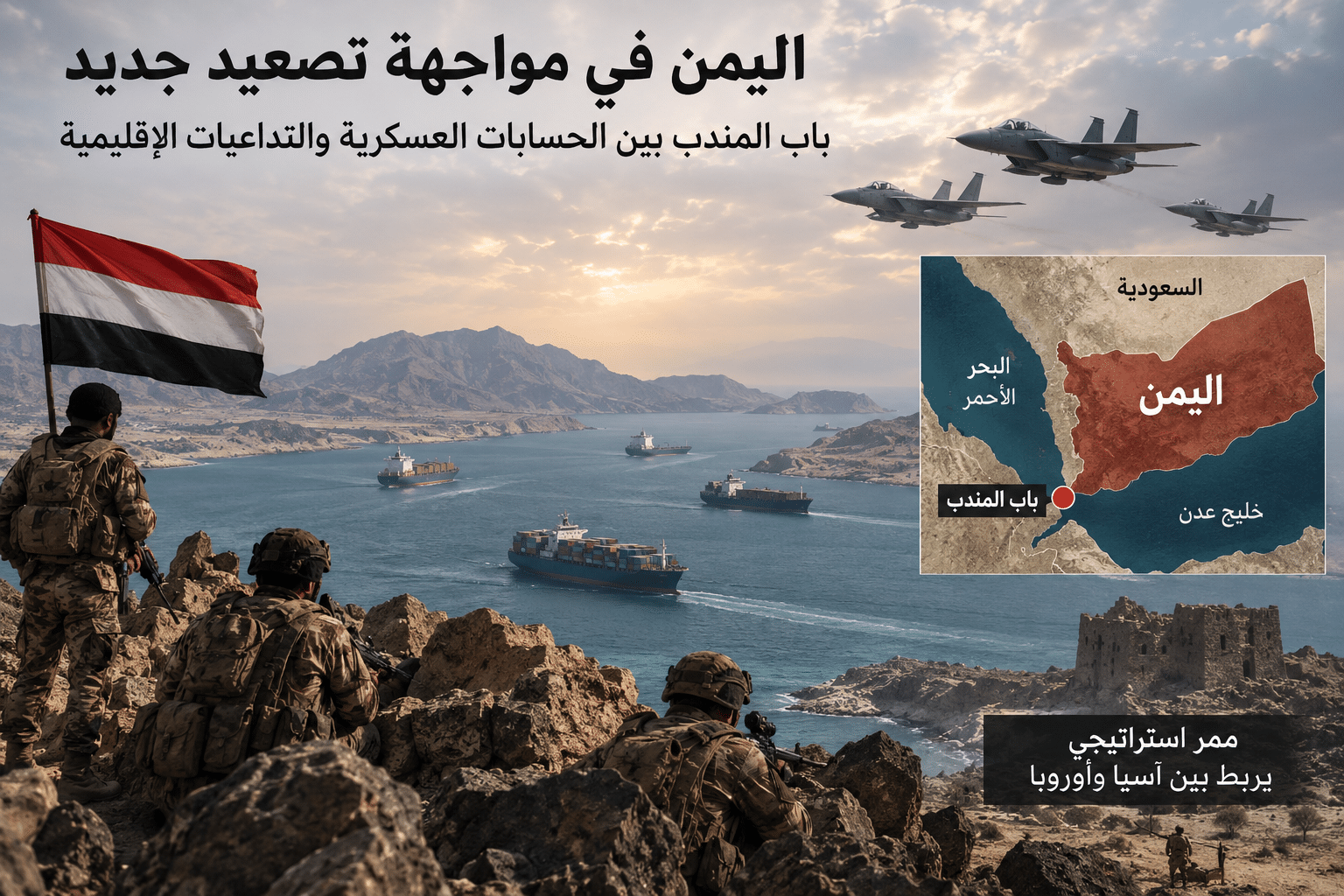
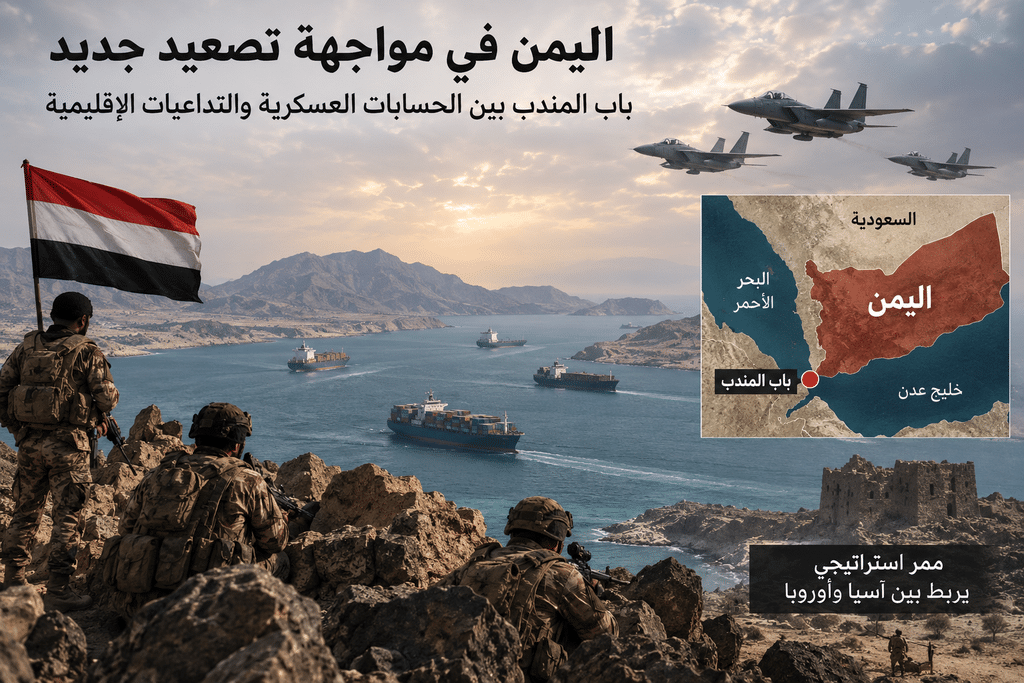
Bab al‑Mandeb: Between Military Calculations and Regional Repercussions
Introduction
October 5 was not an ordinary day in the course of the Yemeni war. In a matter of hours the frontlines shifted from limited escalation to a broad confrontation that carried signs of the regional war returning to Yemen after a long period of relative calm following the 2022 truce.
This episode is more complex than a mere new attack on Ansar Allah positions. Saudi Arabia entered the fight with significant air capabilities, Yemeni government forces advanced on multiple axes, and Ansar Allah tried to respond on the ground and in the air while expanding its messaging toward Saudi Arabia and its vital interests.
The most worrying development is that the military center of gravity has moved close to Bab al‑Mandeb. The battle over Mokha, Dhubab and the areas around the strait is not only about control of Yemeni territory, but about the ability to influence one of the most important maritime gateways between Asia and Europe.
Therefore, reading the events of that day requires going beyond the exchanged military statements. Much of what the belligerents announced could not be independently verified, and some of the claimed figures and gains will need time to be confirmed on the ground. It is necessary to separate what actually happened from what was claimed, and from what these developments might mean for the next phase.
A military day open on multiple fronts
The Yemeni government forces announced the start of a large military operation they called “Dawn of Yemen,” coinciding with a direct and intensive entry of Saudi air power into the operations.
The Saudi side spoke of roughly a hundred aircraft participating in strikes against numerous Ansar Allah targets. Regardless of the exactness of the numbers released by coalition command, the deployment of that scale of air power signifies that Riyadh views the developments as a direct security threat, not merely another round of Yemen’s internal conflict.
Ansar Allah, for its part, announced military operations on several fronts and emphasized in its media messages its ability to strike inside Saudi Arabia and to target government forces and vehicles with armed drones.
On the ground, the western coast axis clearly appeared to be a principal target of the new operation. Government forces reported advances in Dhubab and areas near Bab al‑Mandeb, then later spoke of retaking Mokha, although some details of that control remained unclear militarily, especially since battles in these areas can shift within hours.
At the same time, the Taiz front moved in almost the opposite direction, with Ansar Allah reporting gains in several areas and claims of approaching zones tied to the Yemeni leadership. These latter claims lack sufficient independent evidence but nevertheless indicate that the group does not treat the government offensive on the coast as detached from the other fronts.
Bab al‑Mandeb is the primary objective
At first glance, the fighting in Dhubab or Mokha may seem like contests over coastal towns and positions, but their real value is far greater.
Bab al‑Mandeb is the choke point through which ships transit between the Red Sea, the Gulf of Aden and the Indian Ocean. Controlling the surrounding area gives the holder an important strategic position, though it does not automatically confer the ability to close the strait or to fully control navigation.
The strait cannot be controlled by ground forces alone. Effective control requires air superiority, reconnaissance capabilities, coastal protection, defensive systems, and the ability to counter rockets and drones.
This is where Saudi air power matters in the current battle. Government forces can advance on the ground, but holding that advance requires continuous air cover—especially in a relatively open area like the triangle between Mokha, Dhubab and Bab al‑Mandeb.
Thus a simple military rule applies on this front: whoever controls the air has a better chance of maintaining control on the ground.
Drones are changing the shape of the battle
One of the main takeaways from the day’s events is that drones have become an integral part of the fight, not just an auxiliary weapon.
Footage released by Ansar Allah shows, based on what could be verified, strikes on government vehicles and positions by small armed drones. Some clips correspond to the areas where fighting is taking place, but not every posted video can be treated as definitive proof of losses or of when it was filmed.
The point is not the video itself but the evolution in how weapons are used.
Forces that possess relatively inexpensive drones capable of hitting military vehicles accurately can disrupt an advancing ground force—even if that force has conventional air support.
This partly explains why rapid ground advances do not necessarily equate to a stable military victory. The farther government forces advance from their bases and supply lines, the more vulnerable they become to drone strikes and indirect fire.
Conflicting claims are part of the battle
A notable feature in recent hours has been the rapid succession of announcements.
Early claims proclaimed control of Bab al‑Mandeb, then later statements said operations were still ongoing to reach the same area; there were announcements of retaking Mokha, while counter-narratives spoke of Ansar Allah forces still present in parts of the area.
This contradiction does not necessarily mean all statements are false, but it reflects the nature of the information war that accompanies military operations.
Each side seeks to cement its narrative before the battlefield picture stabilizes. In such conditions, declaring “control” differs from actual military control: fighters may enter a position for hours only to face a counterattack, or an opposing force may withdraw without losing the ability to strike that position.
Accordingly, a true assessment of the coastal battle’s results will depend on monitoring supply lines and force dispositions in the coming days, not just on statements released during the first hours.
Saudi Arabia faces a different equation
Saudi Arabia is not fighting the same battle it fought years ago.
The political and regional circumstances have changed, as have the nature of the military threats. But the deployment of Saudi airpower at this scale indicates Riyadh believes the situation in Yemen has gone beyond an internal conflict and now directly affects its security.
This is the problem.
The more Saudi air operations expand inside Yemen, the more Ansar Allah will have political and military justification to widen their response toward Saudi territory. The group has already begun issuing warnings concerning Saudi aviation, airports and critical infrastructure.
Announcing a “no‑fly” posture against Saudi Arabia does not mean the group has imposed an actual no‑fly zone—that is a different matter militarily. Rather, it reflects a desire to move the battle into domains where they can pressure Saudi Arabia: the airspace, economic and energy infrastructure, and airports.
Thus Riyadh faces a difficult balance: achieving quick gains inside Yemen without allowing the war to revert into an attrition conflict inside Saudi Arabia.
The Makkah Alliance faces its first real test
Another development worth noting is that the Makkah Alliance has moved into practical implementation.
Saudi Arabia, Turkey and Pakistan have shifted from the political framework of the alliance to operational defensive arrangements, with talk of providing and deploying military capabilities inside Saudi Arabia under existing agreements.
This step is important because it would give Saudi Arabia more room to redistribute its military capabilities. If Turkish and Pakistani forces assume part of the air defense and protection of vital facilities and sites, Saudi forces could concentrate more on operations related to the Yemeni front.
But this involves complex calculations for Ankara and Islamabad.
Defending Saudi territory differs greatly from participating in a war inside Yemen. The former can be framed as a defensive commitment between allied states; the latter could make Turkey and Pakistan direct parties to the war.
That likely explains the caution in defining the exact roles those countries will play in the coming phase.
What this means for Yemen
Yemen will pay the heaviest price if the current round turns into a prolonged war.
The areas where fighting is occurring are more than military contact lines: they are roads, ports, residential areas and trade corridors. Any expansion of the fighting means more displacement, disruption to commerce, and economic decline.
Worse, the conflict could reproduce divisions within the anti‑Ansar Allah camp.
Government forces, southern forces, local formations, and units backed by various regional actors do not necessarily share a unified political or military vision. Those differences may become more pronounced if government forces recapture strategic coastal areas.
Therefore a military victory could change lines of control without necessarily producing a new political settlement.
What this means for Saudi Arabia
For Saudi Arabia, controlling parts of the Yemeni coast could provide better security depth and reduce Ansar Allah’s ability to approach some strategic areas.
But that gain will depend on the government forces’ ability to hold what they retake.
Seizing a position is not the hardest part; the challenge is securing it, protecting it from drones, safeguarding its supply lines, and preventing it from becoming an attritional target for forces stationed there.
If government forces fail to consolidate their positions, a swift offensive could turn into another war of attrition.
The Red Sea is the greatest risk
This may be the most important point for the international community.
The Yemeni war ceased to be a purely Yemeni matter the moment Bab al‑Mandeb became central to military operations.
Any sustained threat to navigation in this area will have direct effects on the cost of moving goods and energy, marine insurance, and shipping between Asia and Europe.
Shipping companies do not necessarily need the strait to be closed before changing routes. An increased level of risk and rising insurance and protection costs are enough for some carriers to choose alternatives.
That means a prolonged war could make the Red Sea part of an economic battlefield, even if navigation continues partially.
General assessment
The current battle appears to be in its early stages, and it is premature to treat the military movements of a single day as a decisive shift in the war’s balance.
Government forces received broad Saudi air support and achieved advances in key areas on the western coast, but Ansar Allah retained the ability to open other fronts and to use missiles and drones—making the fight far from decided by control of Dhubab or Mokha alone.
Conversely, Saudi Arabia seems to be attempting to redraw the security environment along its southern border, but it risks reverting to an extended pattern of war if military gains are not converted into political arrangements.
The Makkah Alliance has entered a real test phase, and the nature of Turkish and Pakistani deployments in the coming days and weeks will determine whether the alliance remains a defensive framework for protecting Saudi Arabia or evolves into a broader role in the war.
Bab al‑Mandeb remains the most sensitive factor in the whole equation. The battle there will not only determine who controls part of Yemen’s coast, but will set the level of risk facing international trade through the Red Sea.
The broader conclusion is that Yemen faces two contradictory possibilities. One is that the current operation is a pressure campaign that ultimately leads back to negotiations from a different position. The other is that it becomes the start of a new cycle of open regional war.
So far there is insufficient evidence to choose between these outcomes. What is clear is that continued operations around Bab al‑Mandeb, the widening Saudi role, and the Makkah Alliance moving into implementation will make the Yemeni crisis in the coming period far more tied to Saudi security, the Red Sea, and international trade than at any time since the large‑scale fighting ceased in 2022. Stopping the escalation is therefore not only a Yemeni or Saudi interest; it is also essential to prevent Bab al‑Mandeb from becoming a permanent regional front, because continued fighting in that area would push the war’s consequences beyond Yemen’s borders to the region’s economy and maritime security.