











Reading in English | Read in العربية (Arabic)
When we read the life of Ali ibn Abi Talib, may God be pleased with him, we are not reading the story of an ordinary man who passed through history and vanished. We are reading about someone who stood at the center of one of humanity’s greatest transformations. He was close to the Prophet, peace be upon him, from the earliest years and witnessed the beginnings of the Islamic mission when embracing it demanded great sacrifice. Standing by the Messenger then meant confronting an entire society with all its power, influence, and tribal loyalties.
For that reason I do not like to remember Ali only through his caliphate or the political conflicts that followed the Prophet’s death, nor reduce his personality to the battles he fought or the disputes that later surrounded him. Ali was greater than those labels; his presence in the Prophet’s life and in the formative years of Islam was too deep to be summarized by a title, a single battle, or a political controversy.
I prefer to return to Ali the youth — before he became the Commander of the Faithful, before he was known as the father of Hasan and Husayn, before he became one of the most vivid figures in Islamic memory. I want to remember the young man who grew up close to the Prophet, who lived through the early years of the call and saw with his own eyes a single man standing against an entire society while carrying a message he believed was from God.
Ali could have chosen a safer path, lived like other young men of Quraysh, and left Muhammad ibn Abdullah to bear the burden of the call alone. He did not. He stayed near his cousin, sharing those difficult years when no one knew where the mission would end, how many would embrace it, or whether it would triumph or be crushed under Quraysh’s pressure.
This is the essence of Ali’s greatness: he did not join Islam after it had become powerful; he stood by the Prophet when Islam was weak and its followers few, when Quraysh viewed the call as a threat to their existence, status, and social order.
Ali bore with the Prophet some of the heavy load that the new message placed on its supporters. He saw with his own eyes the ridicule, the siege, and the hostility leveled at the Messenger, and he knew that standing by him was not merely an emotional choice but a path that might lead to danger, confrontation, and death.
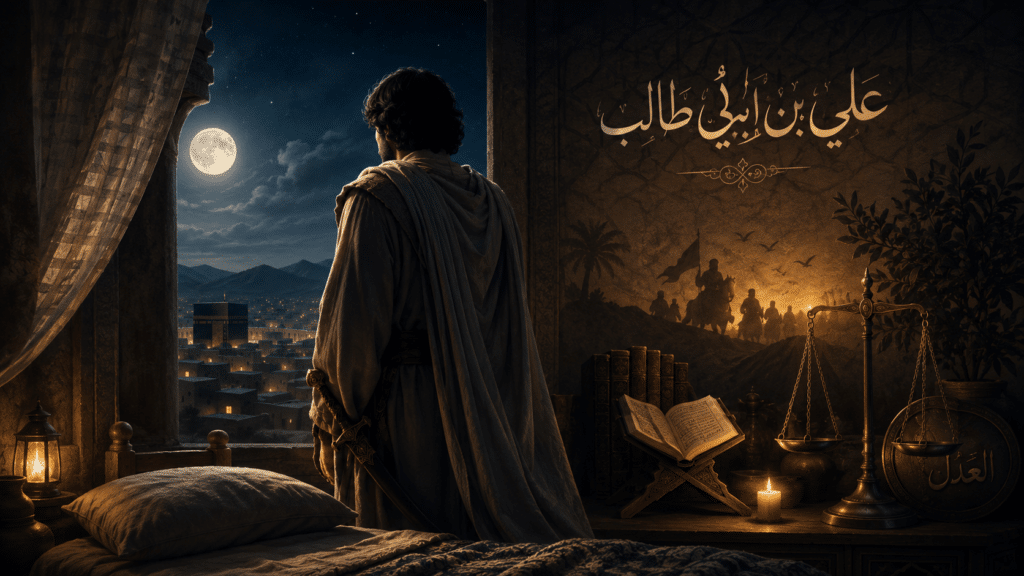
Then came the Night of the Hijra — the Migration — which revealed the measure of that youth in a way the Islamic memory cannot forget.
Quraysh had gathered to kill the Prophet, danger surrounded him from every side, and he had to leave Mecca in utmost secrecy. Ali knew the men searching for the Messenger sought not conversation but his life. He knew that being discovered in the Prophet’s bed could mean his death. Yet, he slept in that bed.
We should pause over that image. Courage is not always the clash of swords. Sometimes it is greater when you place your body where the swords might strike, not knowing when or from which direction they will come. Ali knew the risk; he had no army to protect him, no circle of men, no state to back him—only his faith, his trust in the Prophet, and his readiness to risk his life so the Prophet might escape Mecca.
His task did not end with the Prophet’s departure. He stayed behind in Mecca to return the trusts people had left with the Prophet — a gesture no less significant than an act of sacrifice. Even those who opposed the Messenger had left their valuables in his care; Ali returned them despite the fact that Mecca knew the very man they tried to kill was the one who stood beside him. This reveals a great moral lesson: Islam was not merely a call to worship but a school of trustworthiness and fidelity, even toward opponents.
When Ali moved to Medina, a new phase of his life began. He was no longer just the young companion near the Prophet; he became part of the nascent Islamic state and one of its foremost defenders. At Badr, Uhud, the Trench, and Khaybar, Ali appeared as a fearless warrior at moments when others faltered. Yet to reduce him to the sword would be an injustice. The man who bore the sword also carried a wide intellect and deep understanding of religion, life, judiciary matters, and politics.
Ali was as much a man of knowledge as he was a man of combat, as much a judge as he was a man of the field. He could lead the charge when the community needed a warrior, sit in the council when it needed wisdom, and be the intimate companion the Prophet trusted when closeness and faithfulness were required.
At Khaybar one of Ali’s most famous merits emerged: the Prophet told his companions that he would give the banner to a man whom God and His Messenger loved and who loved them in return — and he gave it to Ali. That prophetic endorsement is higher than many later titles; a man whom God and the Messenger love does not need honorifics or political contests to establish his status. His place was already set long before later struggles began.
Ali’s relation to the Prophet was more than that of a cousin; he belonged to the Prophet’s household, was his son-in-law through fatigue’s marriage to Fatimah, fathered Hasan and Husayn, and was among the closest to him in daily life, call, and military action. This closeness was not merely blood: it was companionship, shared trials, and common experience. Ali lived long years with the Messenger, witnessing fear before victory, weakness before strength, Mecca before statehood, and secrecy before public proclamation.
Those who wish to understand Ali apart from sectarian conflict should start from this simple fact: he did not become great because later generations decided to grant him greatness. He was already great in the life of the Prophet and present at the moments that shaped Islamic history.
Some of the deepest phrases tied to Ali’s status in the Islamic imagination — that he divides Paradise and Hell, that his stance reveals whether a person is believer or hypocrite — differ in interpretation among Muslims. Yet, regardless of doctrinal readings, these sayings reflect something clear in Islamic memory: Ali was not merely a political figure; he became a symbol of truth, fidelity, courage, and justice.
Hence the expression that God made the Prophet a separator between Islam and disbelief, and made Ali a separator between faith and hypocrisy. In Muslim sentiment this carries deep meaning: the Prophet carried the message that marked the division between the age of ignorance and the age of monotheism, while Ali came to exemplify the man who would not abandon the truth when the price was high.
A well-known hadith reports that the Prophet entrusted Ali with the statement that “only a believer loves him, and only a hypocrite hates him.” This elevated status made love for Ali in popular consciousness more than affection for a historical figure; it linked his place among Muslims with faith, loyalty, and sincerity.
The description of Ali as the divider of Paradise and Hell should be understood in its cultural and symbolic frame, not as implying that judgment over people’s fates has passed from God to a human — judgment belongs to God alone. Rather, it means that loving Ali and standing with the truth he represented became, for his admirers, a sign of sincere faith; hating him, in some narratives, became associated with hypocrisy.
This image places Ali in the Islamic heart as more than a warrior; his name came to signify the distinction between truth and falsehood, between sincerity and hypocrisy, between loyalty and betrayal, and between principled adherence and self-interest.
Thus Ali was not merely a name in the record of Islam: he was part of the making of that record, and his life itself testifies to the meaning of sacrifice for a cause and a principle.
He gave Islam his youth, his strength, his knowledge, his sword, his time, and his life. A person can give money and later reclaim it, give time and find it spent, give effort and then rest — but the hardest thing to give is one’s life. Ali did that in his youth when he slept in the Prophet’s bed on the night of the Hijra.
For this reason I believe talk about Ali should be freed from the language of antagonism that followed him. Every party has tried to present Ali in ways that serve its narrative; every school has read his life from a certain angle, until at times the historical person has been obscured by sectarian or political images. The real Ali is larger than all that.
He is the Ali who loved the Prophet, believed in him, aided him, lived through the years of trial, stood with him in battles, bore with him the burdens of building a new society, and later carried the burdens of the community when he became caliph.
Even when he reached power, his life was not that of a man seeking comfort or privilege. He found himself in one of the most difficult phases of Islamic history: the community was deeply divided and strife threatened Muslim unity. Yet Ali remained the same man we knew at the start — one who saw truth as more precious than authority and believed justice was not a slogan to be abandoned once one attained power.
Ali could have remained merely a great warrior, his story ending on the battlefield, but history kept him larger. He left a legacy in knowledge, jurisprudence, politics, oratory, wisdom, and ethics, and his name is present across the layers of Islamic memory.
His greatest feat, perhaps, is that he was not a man of a single moment. He was present in Mecca when Islam was a call, in Medina when it became a society, in battle when the state was threatened, and in governance when the community was torn. To me, this is the essence of true companionship: to be with the Prophet when the road is uncertain and to remain with him when it becomes clear; to share the pain when believers are few and to share the burden of state when Islam becomes a political force.
Ali was not the man of one moment; he was the man of the whole journey.
So when I recall him I do not begin with the caliphate and end with the strife. I begin with the boy who chose to stay with the Prophet when staying was a danger, and I remember the man who carried that fidelity to the end of his path.
This is Ali I want to remain in memory.
Ali the human before Ali the title, Ali the warrior before Ali the caliph, Ali the friend before Ali the politician, Ali who stood with the Prophet before his name became part of Muslim conflicts.
The epithet “al-Faruq of the community” for me expresses what Ali left in the Islamic conscience — not an attempt to seize a title belonging to someone else, but the image of the man who tried to make truth the criterion above tribalism, justice above self-interest, and religion above power.
Ali was part of the generation that carried Islam from its first moments to horizons none then imagined. Looking back more than fourteen centuries later, we see that this generation were not entries in a book but human beings who paid for their faith with their lives, years, and comforts. Ali was one of the most present of those men at the heart of the experience.
Therefore I do not want to view Ali through the eyes of enmity, through the later debates, or through books that sometimes turned him into a symbol for one party or another. I want to see him as he was: the youth who slept in the Prophet’s bed knowing swords might be searching for him; the young man who stayed in Mecca to return trusts; the warrior who carried the banner when Islam needed an unyielding man; the scholar who saw knowledge as a responsibility, not ornament; the judge whose name is linked to wisdom and justice; the husband and father who raised a generation among the greatest of Islam; the caliph who found himself facing a nation exhausted by strife yet tried to remain faithful to what he believed from the start.
Perhaps this is why Ali remains present in the Islamic memory today: some men’s lives end with their death, while others’ lives turn into a continuous question for the generations that follow.
How can a person remain faithful to principles when the price is high? How can one love without turning that love into partisanship? How can one be strong without becoming unjust? How can one attain power without making power an end in itself? How can one devote oneself to a cause larger than oneself without expecting recompense?
These questions keep Ali’s life alive.
For this reason I say Ali does not belong to a single sect, school, or doctrine. Ali is part of the entire Islamic memory.
If history has turned his name into a field of dispute, we must restore him to his natural place in human memory: a man who lived for a cause he believed in and bore, for its sake, enough pain, danger, and responsibility to make his name enduring.
This is the Ali I want: the Ali who knew the Prophet before history books did; the Ali who lived with him before he became a subject of controversy; the Ali who sacrificed for him before he became a symbol; the Ali who carried the burdens of the call before books bore his name.
Ali was not merely a name in the history of Islam; he was part of its making.
When I remember him I do not start with the caliphate nor end with the discord. I start with the boy who chose to stay with the Prophet when staying was perilous, and I remember the man who carried that loyalty to the end.
That is Ali: the Faruq of the community in the sense of truth and justice; its friend in the sense of fidelity; its knight when a knight was needed; its scholar when knowledge was required; its man when the community needed a man.
No matter how much historiography varies in its accounts, Ali’s humanity cannot be obscured, nor can prolonged disputes erase his impact. History may contest people, but great stands do not lie. Ali was present at the great moments from the beginning of the story until its end.