












Reading in English | Read in العربية (Arabic)
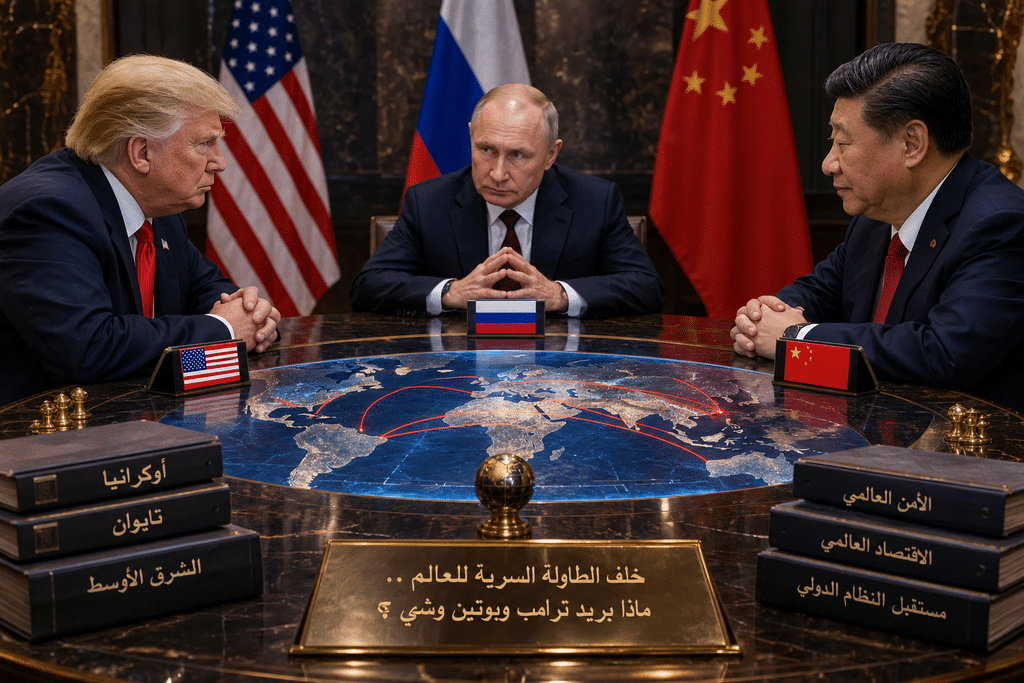
In the corridors of politics, meeting around a single secret table implies there is a map hidden from the rest of the world. Those who sit around it are not just presidents but maps of influence, memories of wars, national fears, and imperial ambitions searching for a place in the new century. That is why the idea of a meeting between Donald Trump, Vladimir Putin and Xi Jinping — reportedly possible during the APEC summit in China in November — is more than a photo of three men in one room. The Kremlin hinted at the possibility, though no final agreement has been reached.
The important question is not whether they will meet, but why such a meeting has become possible now. The answer lies in the widening and re-centering of international politics: the world we knew no longer revolves around a single center. Washington still holds enormous military and economic power; Moscow retains nuclear and geopolitical weight; while Beijing is transforming into an economic, technological and political hub capable of redrawing large swathes of international relations. Three powers, three visions, three leaders — each aware that the twenty-first century will not be written with a single pen.
If the meeting takes place in China, the venue itself will send a message. Beijing would not just be a host but the owner of the ground receiving two strategic rivals. China does not need to choose between Washington and Moscow; it wants to become the point neither can bypass. In recent talks between Trump and Xi, topics such as trade, artificial intelligence, Taiwan, Ukraine, the Middle East and crisis-management channels came up. The Chinese calculus is more complex than it appears: stay close enough to Russia to influence it, close enough to the United States to negotiate with it, and far enough from both to preserve independent decision-making — an attempt to shift from being a player in the international system to one of its architects.
For Putin, the meeting may be seen less as a photo opportunity and more as a chance to redefine Russia’s position. Russia does not want to be reduced to the Ukraine war or to have its future held hostage by sanctions or Western arrangements. Moscow views Washington and Beijing as separate spaces for maneuver: with Washington there is conflict and negotiation, with Beijing a strategic partnership and intertwined interests. With its nuclear capabilities, energy resources and geography, Russia remains a party that cannot be easily sidelined.
Trump brings a different logic: he treats international relations as arenas of interest and bargaining power. A meeting between Putin and Xi could give him an opportunity to measure how close Moscow and Beijing are, to see where to press and where to negotiate. Yet the table may reveal another reality to Washington: despite differing interests, Moscow and Beijing do not want a world in which the United States has the final word on every issue.
Ukraine and Taiwan will be present in the room even if not explicitly listed on the agenda. Ukraine is, for Moscow, a matter of security and influence; Taiwan is, for Beijing, a matter of sovereignty, identity and borders not easily open to compromise. Any trilateral dialogue among the United States, China and Russia will not only debate current crises but will also seek to discover each power’s red lines.
Europe and the Middle East will watch closely. Europe will follow the talks carefully because any U.S.-Russian understanding on Ukraine or European security will have direct consequences. The Middle East will not be far from these considerations: energy moves through its corridors, trade crosses its seas, and international security intersects with its crises. The presence of Washington, Moscow and Beijing in the region means any agreement among them will have effects far beyond the meeting room. Often the region does not need to be an explicit agenda item to be part of the calculations — geography itself can be the unspoken issue.
This gathering might resemble the conferences of great powers that once redrew the world after wars, but the current century is far more complex. The map is no longer the preserve of three capitals: there are regional powers, markets, tech companies, sea lanes, energy flows, artificial intelligence and cross-border crises. If Trump, Putin and Xi do meet, they will not necessarily be dividing the world; they may face an even harder question: who has the right to write the rules when the world no longer accepts a single author?
Their meeting may not produce a new empire or a historic agreement, but its very occurrence would send one clear message: the era of unilateral power faces a new test. The next century will not be written by Washington, Moscow or Beijing alone, but in the tense space between them. In politics, sometimes the most consequential thing is not what the men at the table say, but what the world reads into their sitting together.